



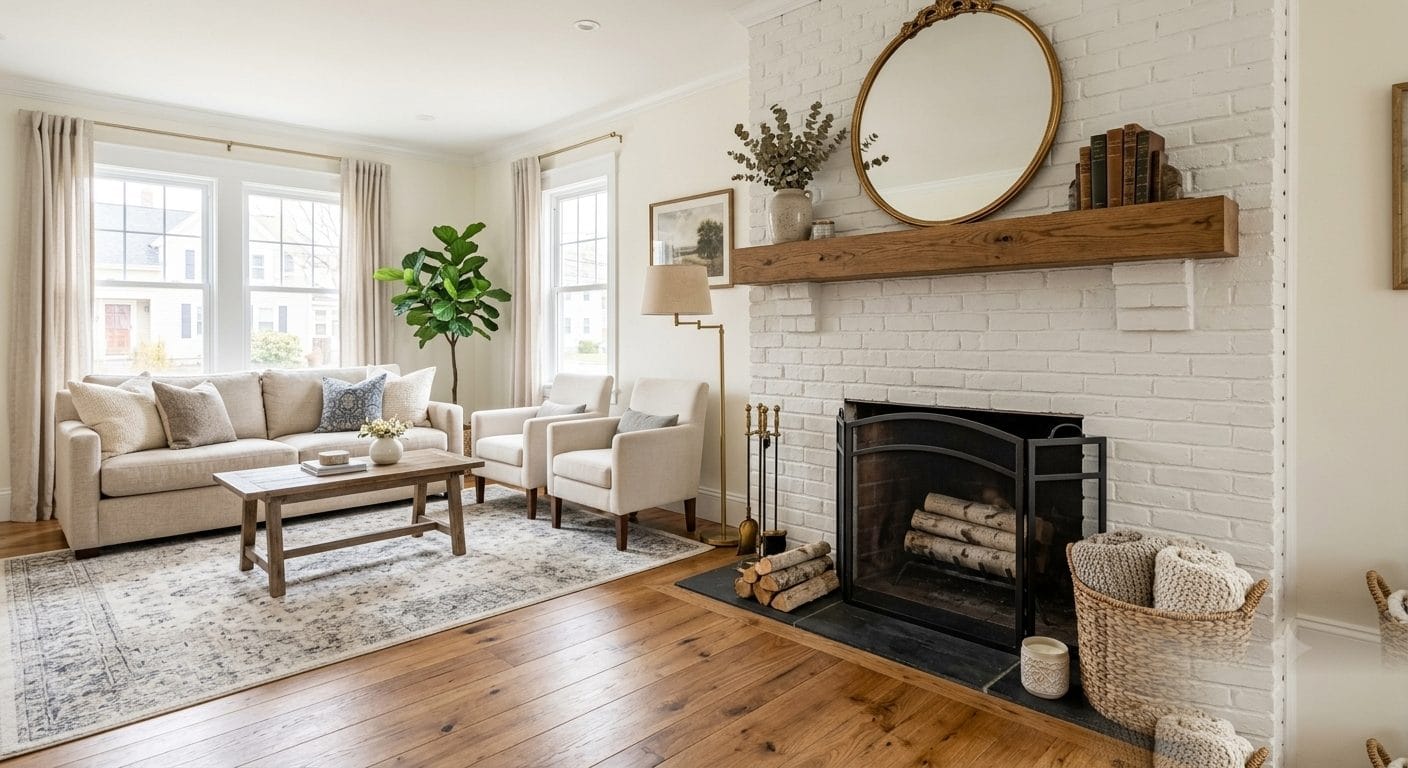
TL;DR: Painting a dated brick or stone fireplace is one of the highest-impact updates you can make to a room — a tired red-brick surround becomes soft white, moody charcoal, or a textured limewash, and the whole space feels new. The brick face and surround don't get hot enough to need special paint, so a cleaned, masonry-primed, two-coat latex finish does the job; only the interior firebox needs high-heat paint (or nothing at all). The one big caveat: painting brick is nearly permanent — if you want a breathable, easier-to-reverse update, choose limewash instead. A standard fireplace surround runs about $400–$1,200 in MetroWest Boston.
Staring at a fireplace that's dragging your living room down? Call or text Dave for a free, no-pressure estimate — (774) 217-9567. We'll tell you honestly whether paint, limewash, or leaving it alone is the right call for your brick.
In a lot of MetroWest homes — especially those built from the 1950s through the '80s — the fireplace is a big expanse of orange-red brick that anchors the living room and quietly dates the entire space. Painting it is one of the most requested updates we do, and for good reason: nothing else changes a room's whole mood for so little. But it's also a decision worth making with your eyes open, because brick doesn't forgive a change of heart. Here's everything you should know first.
Can you paint a brick or stone fireplace?
Yes — the brick or stone you see out in the room (the surround and the face) takes paint beautifully once it's properly cleaned, primed, and coated. It's a standard, well-proven update. The only part that's different is the inside of the firebox, where the fire actually burns; that's a separate conversation we'll get to. For the part everyone's actually looking at, painting is absolutely on the table.
Should you paint your brick fireplace?
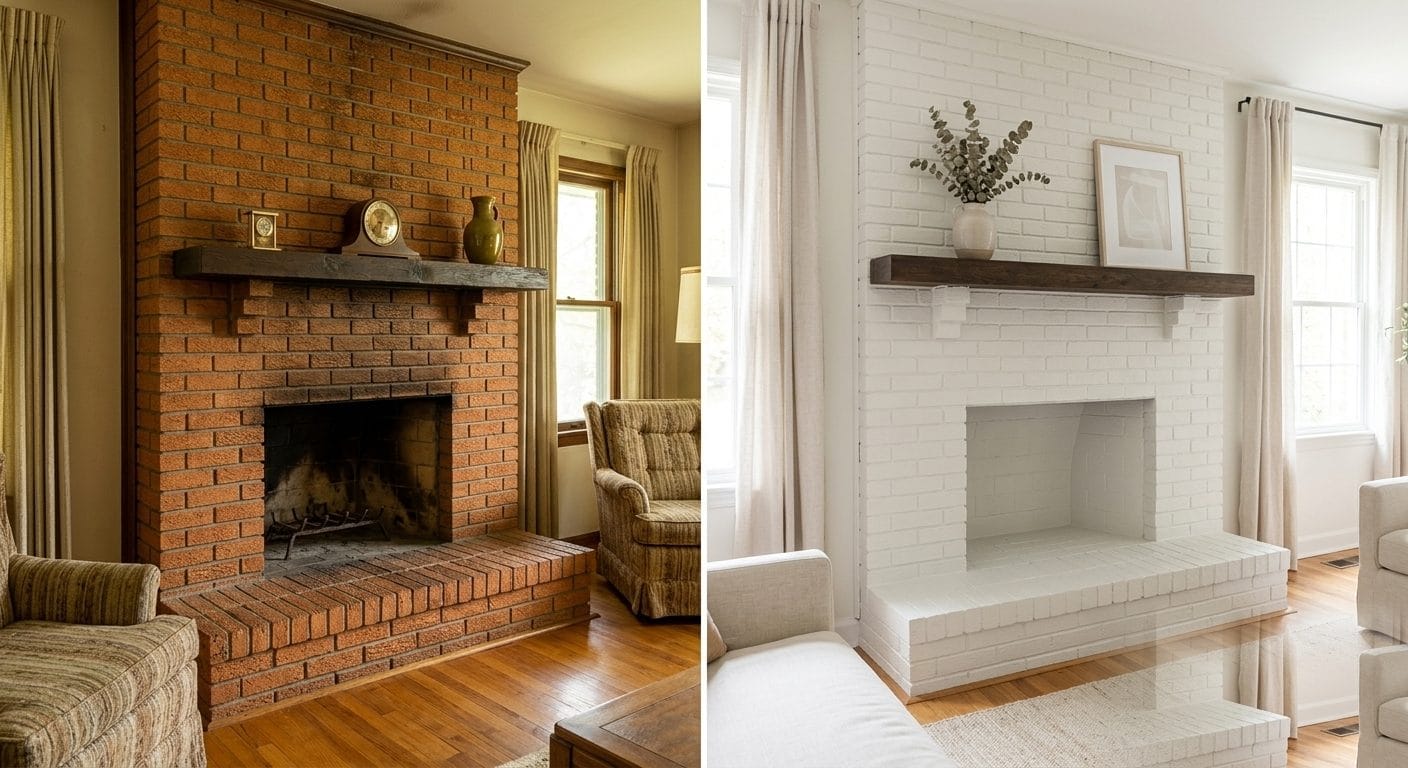
For most dated brick, painting is a clear win — but weigh the one real trade-off first.
In favor: it instantly modernizes the room, brightens a dark corner, and lets the fireplace work with your decor instead of fighting it. It's dramatically cheaper than re-facing with new stone or tile.
The caveat: painting brick is, for practical purposes, permanent. Paint soaks deep into porous brick, and stripping it back to clean natural brick later is a difficult, messy, expensive job — rarely worth it. So if your brick is genuinely beautiful natural stone or you suspect you might want it bare again someday, pause. In that case, limewash is the smarter route: it's breathable, gives a softer mottled finish, and is far easier to live with or reverse. We cover it fully in our guide to limewash and lime paint interiors.
Do you need heat-resistant paint?
This is the question we get most, and the answer is reassuring: for the surround and face, no. The brick out in the room never approaches the temperatures that would trouble normal paint, so a quality masonry-primed latex finish is completely safe and durable there.
The exception is the interior firebox — the chamber where the fire burns, often lined with fire brick. That surface sees real heat, and only high-temperature stove or grill paint (rated to roughly 1,000–1,200°F) belongs there. Honestly, most homeowners simply leave the firebox unpainted, and that's perfectly fine. We'll never coat a firebox with standard paint, and you shouldn't either.
How do you prep a fireplace for paint?
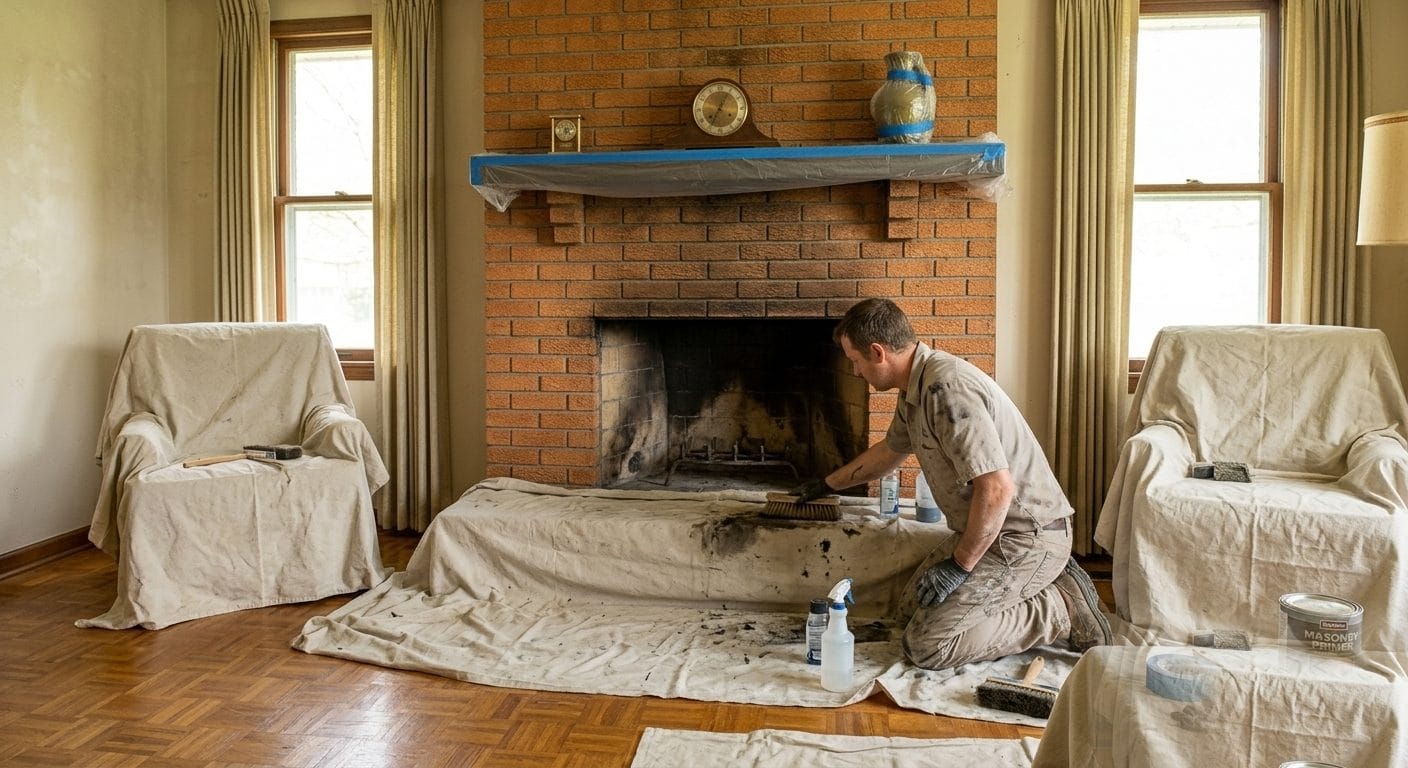
With brick, the prep is the whole game — it's the difference between a finish that looks crisp for years and one that flakes out of the mortar joints in a season. The process:
- Clean thoroughly. Years of soot, dust, and grease have to come off with a masonry cleaner or TSP substitute. Paint will not bond to a dirty fireplace.
- Repair the mortar. Repoint any loose or crumbling joints and fill cracks so the surface is sound.
- Mask everything. Brick painting is messy — the joints drink paint and it spatters — so the mantel, hearth, floor, and surrounding walls get fully protected.
- Prime with masonry primer. A quality masonry or stain-blocking primer seals the porous brick and stops soot stains from bleeding through.
- Two finish coats, worked into every mortar joint by brush and rolled across the faces, using a paint suited to masonry.
That porosity is also why brick uses far more paint than a flat wall of the same size — the joints and texture swallow it. It's the same principle behind why prep is 80% of a great paint job: the lasting result lives in the steps you can't see.
What color should you paint a brick fireplace?
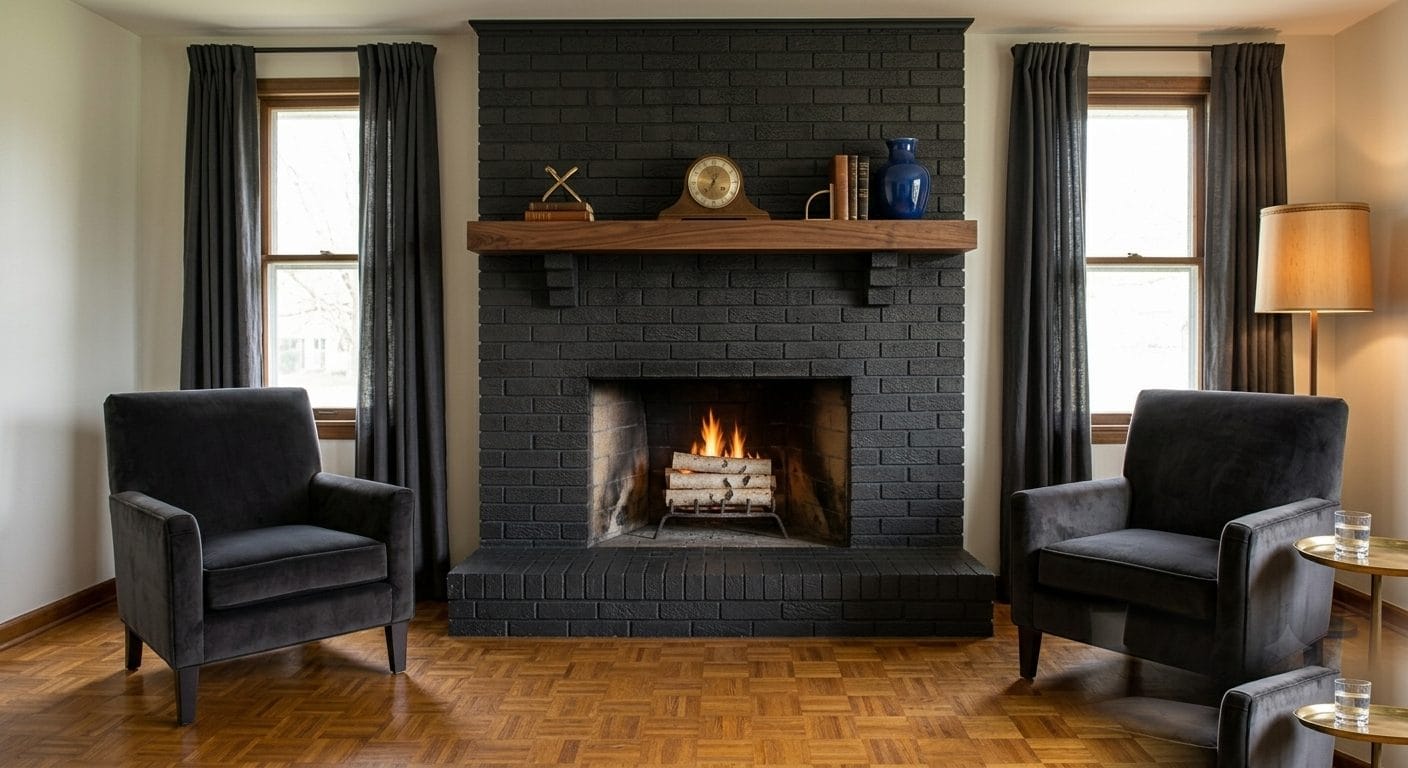
The most popular directions right now:
- Soft white or warm white — the classic. Brightens the room, makes the fireplace feel fresh and architectural, and pairs with almost any decor.
- Charcoal or near-black — bold and modern. A dark fireplace becomes a dramatic focal point, especially against light walls and a natural-wood mantel.
- Greige and warm neutrals — a quieter update that softens the orange brick without going stark white.
- Limewash whites and soft tones — for a mottled, old-world, breathable finish with more depth than flat paint.
Whatever the color, look at large samples on the actual brick and in your room's real light before committing — and consider how it plays with the rest of your palette. Our roundup of interior paint colors for New England Colonials and our guide to choosing the right finish can help you land it.
Paint, limewash, whitewash, or German smear — what's the difference?
A quick map of the options, because the words get used loosely:
- Solid paint — full, opaque, uniform coverage. The most dramatic change; the least reversible.
- Limewash — a thinned, mineral lime coating that soaks in for a soft, matte, mottled look; breathable and easier to reverse. (Full details in our limewash guide.)
- Whitewash — diluted regular paint wiped on so some brick color shows through; a lighter touch than solid paint.
- German smear (mortar wash) — a smeared mortar finish that partly covers the brick for a rustic, Old-World cottage texture.
Which one's right comes down to how much of the brick you want to keep, how reversible you need it, and the look you're after — something we're happy to walk through in person.
How much does it cost to paint a fireplace in MetroWest?
Fireplace pricing depends on size, the condition of the brick, and the technique. Realistic MetroWest ranges:
- A standard brick fireplace surround typically runs $400–$1,200 to paint, including cleaning, priming, and two coats.
- Large floor-to-ceiling brick or stone walls run higher, simply because of the square footage and texture.
- Heavy cleaning or mortar repair on a sooty or aged fireplace adds to the prep.
- Limewash treatments are often in a similar range to a standard paint job, sometimes a touch more for the hand-worked finish.
For where a fireplace fits into a larger living-room or whole-home refresh, see our complete guide to house painting in MetroWest Boston.
The bottom line
A painted or limewashed fireplace is one of the best-value updates in a home — it transforms the focal point of a room for a fraction of what re-facing costs. The keys are honest prep (clean, repair, prime), the right product for each part (normal paint outside, high-heat paint or nothing in the firebox), and an upfront decision about permanence: solid paint for a clean modern change, limewash if you want to stay breathable and reversible. Get those right and your fireplace stops dating the room and starts making it.
Paint Pro New England has painted and limewashed fireplaces — along with trim, cabinets, staircases, and full interiors — across Holliston, Medway, Hopkinton, Sherborn, Dover, Wellesley, and the rest of MetroWest Boston for 15 years. EPA Lead-Safe certified, fully insured, 2-year warranty, 5.0 stars across 60+ reviews. For a free, itemized estimate, call (774) 217-9567.
Dave Griffiths
Dave Griffiths is the owner of Paint Pro New England, a professional painting company serving MetroWest Boston since 2011. With 15+ years of interior and exterior painting experience across the region, he leads every project with thorough prep, premium Benjamin Moore and Sherwin-Williams paints, and a 2-year warranty.

