



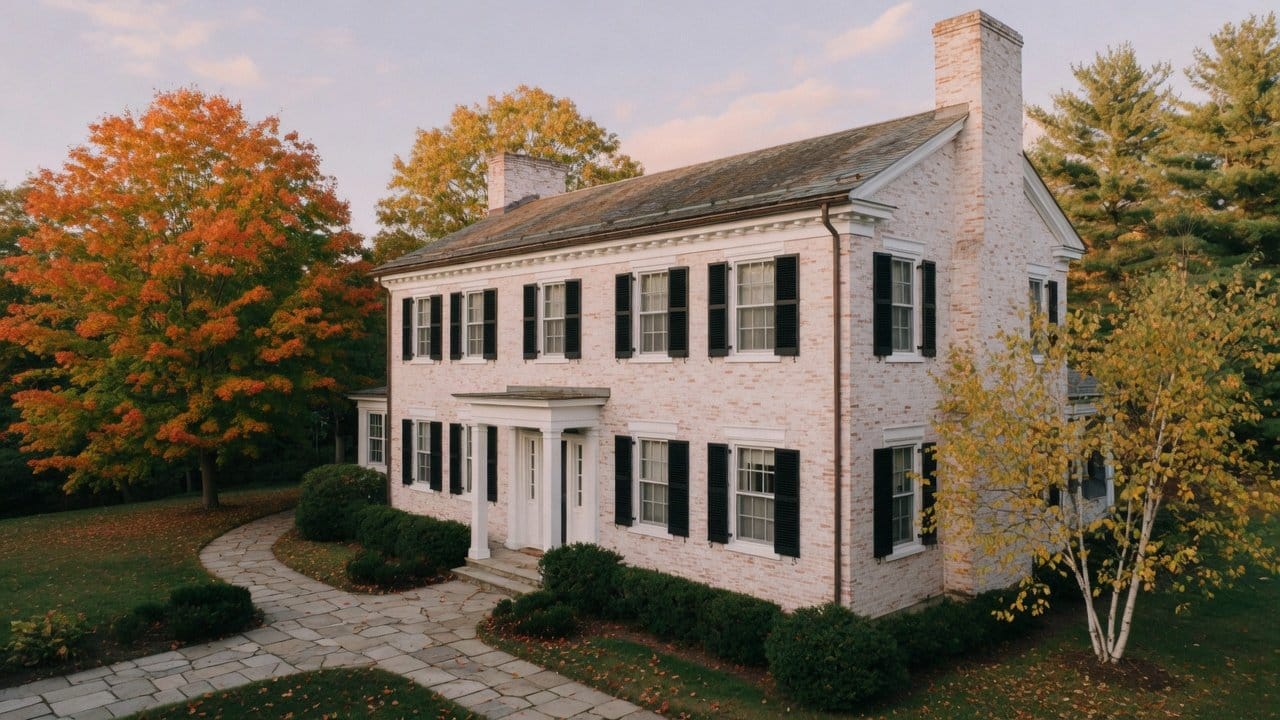
TL;DR: On a New England brick exterior, limewash and German smear are both far safer than paint, because brick must breathe. Standard film-forming exterior paint traps moisture behind it and the freeze-thaw cycle then spalls the face off the brick. Limewash runs roughly $2 to $6 per square foot installed, is fully reversible, and needs refreshing every 5 to 10 years. German smear runs roughly $1 to $4 per square foot, is effectively permanent, and cannot be undone if you change your mind. Both require unpainted, unsealed brick. If your brick was painted at some point, stripping at $0.50 to $2 per square foot comes first, and it can cost more than the finish itself.
Thinking about your brick? Call or text Dave at (774) 217-9567 and we will tell you honestly whether your masonry is a candidate, or whether it needs repointing before anything goes on it.
We have painted a lot of brick in MetroWest over 15 years, and I will say plainly that most of it should not have been painted. Homeowners see a dated orange-red brick facade and reach for the obvious fix. The obvious fix is the one that causes the most expensive damage in this climate. Limewash and German smear are the two finishes that get you the same softened, aged, European look without sealing your walls shut.
Why does breathability matter so much on New England brick?
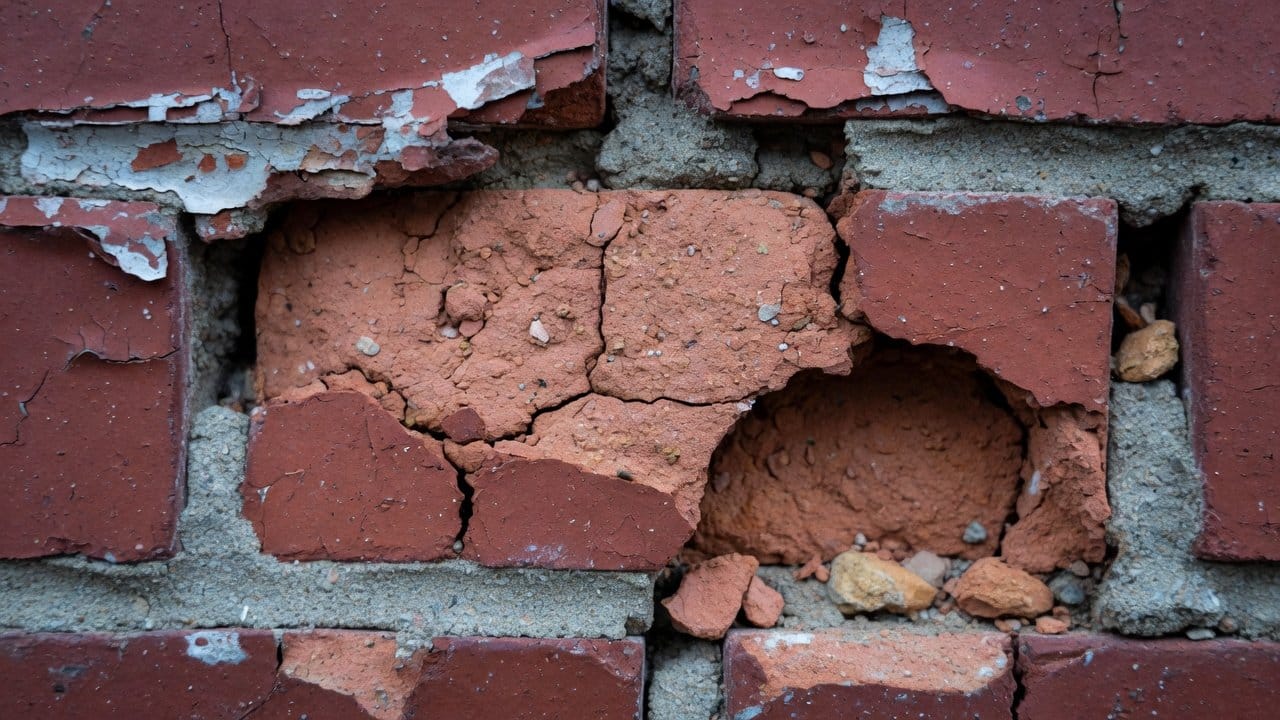
Brick and mortar are absorbent by design. They take on moisture and release it as vapor. That works fine until you put a film over the face that will not let the vapor out.
Then the water stays in the masonry, and every night the temperature drops below freezing that trapped water expands. Repeat that through a MetroWest winter and the face of the brick fractures and pops off. That is spalling, and it is not cosmetic. Once brick faces start coming away you are into replacement of individual courses, which is masonry work at masonry prices.
The numbers make the point. Limewash and mineral coatings test in the range of 75 to 85 perms for vapor permeability, while a 4 inch brick masonry wall is around 10 perms. The coating is many times more permeable than the wall itself, which means it is never the bottleneck. A conventional exterior paint film is the opposite: it becomes the bottleneck, and the wall pays for it.
What is limewash, and what does it look like?
Limewash is slaked lime thinned with water and tinted with mineral pigment. It does not sit on top of the brick, it soaks into the surface and crystallizes as part of it. There is no film to crack, blister or peel, because there is no film.
The look is soft, matte and mottled, with the brick texture still legible underneath. Applied thin it veils the color and lets the original tone glow through. Applied heavier it approaches a solid limewashed white. And it can be manipulated while wet: wipe portions back with a wet brush or sponge and you get an aged, uneven, centuries-old effect that suits older New England housing stock.
Practical points:
- Fully reversible. Because it is a mineral coating on porous brick, it can be pressure washed off if you hate it. That is a real advantage over any permanent choice.
- Refresh cycle of 5 to 10 years on exteriors, done as an additional coat rather than a strip-and-redo.
- It weathers rather than fails. It thins gradually and unevenly, which reads as patina, not damage.
- Material cost is real. A 15 litre pail of a quality classic limewash retails around $340 to $380, and a typical 2,000 square foot exterior needs about three pails.
If you like the finish but the project is inside, the same material behaves differently indoors and lasts far longer, which we cover in limewash and lime paint for New England interiors.
What is German smear, and how is it different?
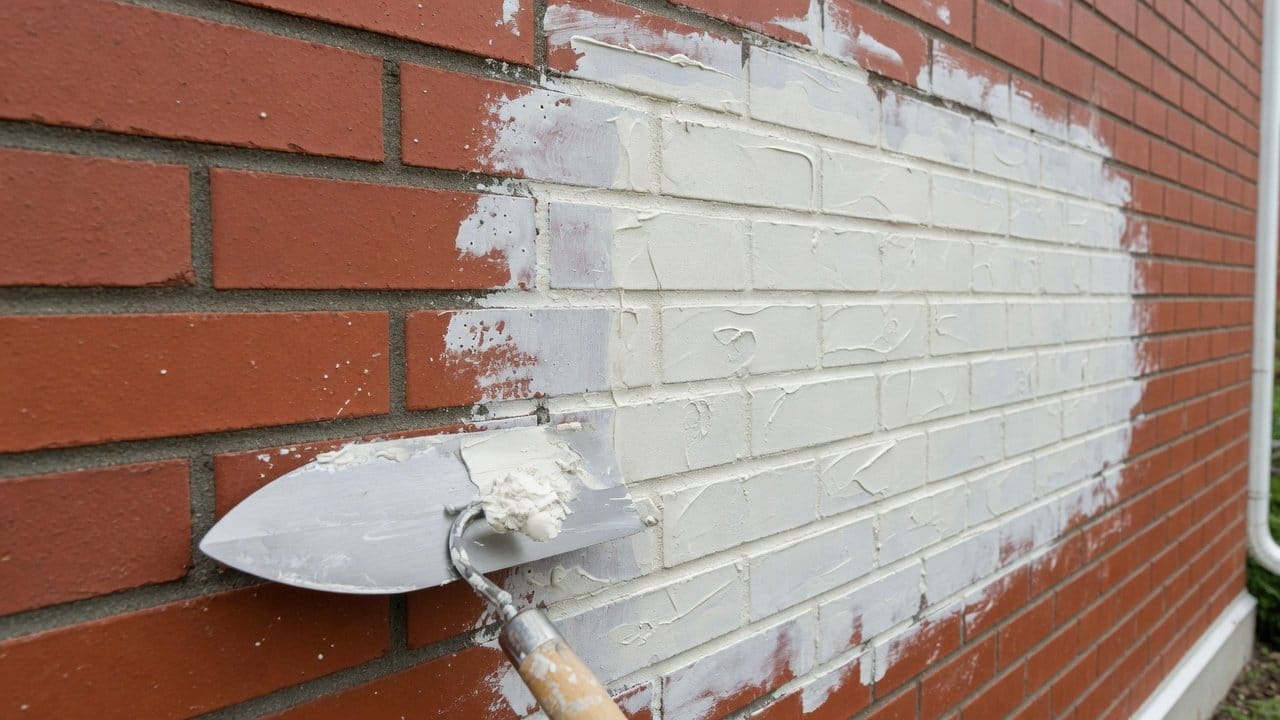
German smear (also called schmear or mortar wash) is a different animal entirely. Instead of a thin mineral stain, wet mortar is troweled across the brick face and then wiped back while it is still workable, leaving mortar in the joints and in the low spots and exposing brick on the high points.
The result is heavier, more textured and more Old World cottage than limewash. Where limewash veils, German smear sculpts.
The tradeoffs against limewash:
- Permanence. The mortar cures and becomes part of the wall. It does not need refreshing and it will not wash off. That is either the best or the worst thing about it, depending on whether you are certain.
- Longevity. One to two decades with minimal maintenance, against roughly 5 to 10 years before a limewash exterior wants another coat.
- Slightly less permeable. Still breathable and vastly better than paint, but the thicker application in places makes it marginally less vapor-open than limewash.
- Cheap materials, skilled labor. The mortar itself is inexpensive, roughly $30 of material for 1,000 square feet of brick. What you are paying for is the hand that knows how much to wipe back, and that judgment is not recoverable once it cures.
What do they cost on a New England house?
Professionally applied ranges:
- Limewash: about $2 to $6 per square foot, with some specialty applicators quoting higher
- German smear: about $1 to $4 per square foot, or roughly $2,000 to $8,000 on an average 2,000 square foot brick home, with labor accounting for $1 to $3.50 of that per square foot
Two multipliers to budget for honestly. Height: multistory work can add up to 50% per story for staging, and scaffolding rental alone can add a fixed $1,500 to $2,500. And prior coatings: both finishes need porous, unsealed brick to bond. If your brick has been painted or sealed, stripping runs $0.50 to $2 per square foot, roughly $1,000 to $4,000 professionally, and on a previously painted house that line item can exceed the finish itself.
For comparison against conventional approaches on other substrates, our Massachusetts house painting cost guide sets the baseline.
Is your brick actually a candidate?
This is the part a good contractor checks before quoting a color. Walk the walls and look for:
- Existing spalling. Fractured or crumbling brick faces mean the masonry has already absorbed water and been through enough freeze-thaw cycles to crack from the inside. Coating over spalled brick traps moisture in existing fractures and accelerates the damage. Those courses need replacing first.
- Failing mortar joints. Repointing comes before any finish, not after.
- Prior paint or sealer. Determines whether you are looking at a finish job or a strip-then-finish job.
- The moisture source. Grade, gutters, downspouts and flashing. A wall that stays wet will fail whatever you put on it, which is the same principle behind why house paint peels.
Timing matters too. These coatings want temperatures above roughly 50°F and dry conditions to cure properly, so late spring through early fall is the workable season around Boston. Interior masonry is unconstrained by weather, and a brick or stone fireplace is a good way to try the finish at small scale before committing the whole facade.
The bottom line
If your brick is unpainted and sound, both finishes are appropriate for this climate in a way that conventional paint is not. Choose limewash when you want a softer veiled look, want the option to change your mind, and accept a coat every 5 to 10 years. Choose German smear when you want the heavier textured cottage look, want to do it once, and are genuinely sure. The one decision that is hard to walk back is sealing New England brick under a film, and neither of these does that.
Paint Pro New England has worked on MetroWest masonry for 15 years, serving Holliston, Medway, Hopkinton, Sherborn, Dover, Wellesley, Natick and the surrounding towns, with a 2 year warranty and 5.0 stars across 60+ reviews. For an honest assessment of your brick before you commit, call (774) 217-9567.
Dave Griffiths
Dave Griffiths is the owner of Paint Pro New England, a professional painting company serving MetroWest Boston since 2011. With 15+ years of interior and exterior painting experience across the region, he leads every project with thorough prep, premium Benjamin Moore and Sherwin-Williams paints, and a 2-year warranty.

