



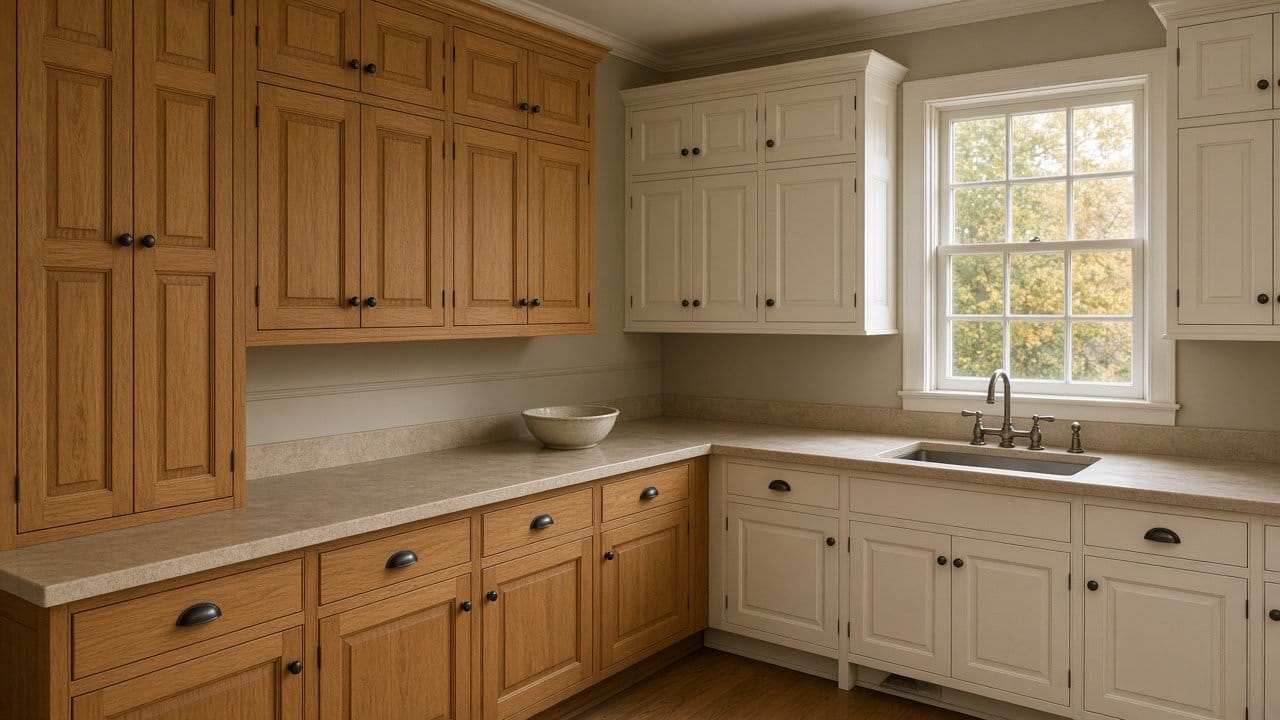
TL;DR: Refinishing keeps your doors and boxes and changes the color, roughly $25 to $65 per linear foot, with most kitchens landing $1,500 to $5,000. Refacing keeps the boxes and gives you new doors and veneered faces, commonly $150 to $450 per linear foot, with Angi putting the 2026 average job at $7,233. Replacing starts near $100 per linear foot installed for stock and runs past $650 for semi-custom. The condition of the boxes and whether the layout works decide which of the three you are actually allowed to choose.
Not sure which category your kitchen falls into? Call or text Dave at (774) 217-9567. We will open a door, look at the box, and tell you straight, including when refinishing is the wrong answer.
Most articles on this subject give you two choices. Paint them or replace them. There is a third option sitting between those two, and leaving it out is how people end up spending replacement money on a kitchen that did not need it, or paying to refinish boxes that should have come out.
What each option actually touches
- Refinishing. Your existing doors, drawer fronts, and boxes stay. They are cleaned, degreased, sanded, primed, and sprayed. Nothing changes shape. The color and the finish change completely.
- Refacing. Your boxes stay in place. New doors and drawer fronts go on, and a matching veneer or laminate skin goes over the visible box faces and end panels. The footprint does not move.
- Replacing. Everything comes out. New boxes, new doors, new hardware, and the option to change the layout entirely.
Notice what all three share: none of them fixes a bad layout except the third one. That is the first question to settle, before anyone talks about money.
What do the boxes have to be for this to work?
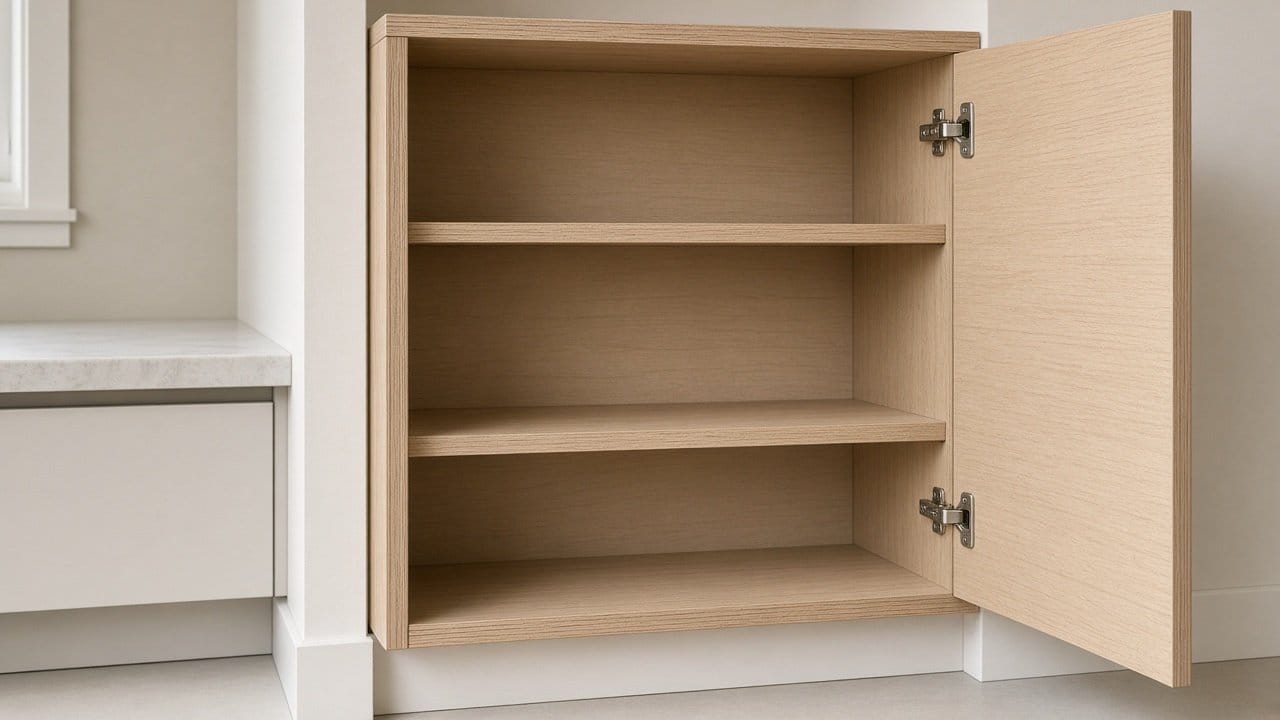
The box is the whole decision, and you can check it yourself in about two minutes. Open a door and look at the inside of the cabinet and the exposed edge of the side panel.
- Solid wood or plywood, clean joints, no sag: refinishing and refacing are both on the table.
- Particle board in good condition, no water exposure: refinishing is usually fine. Refacing is possible but the veneer has to be applied to a sound surface, and fasteners for new hinges need something to bite into.
- Swollen, crumbling, or delaminating, typically under the sink: neither. That box is done.
- Shelves bowed under normal load, face frames racked, doors that will not stay aligned: replacement territory.
There is an objective yardstick for what a sound cabinet is supposed to survive. The Kitchen Cabinet Manufacturers Association administers ANSI/KCMA A161.1, the performance and construction standard for kitchen and vanity cabinets, and it has been in use since 1965. Certified cabinets pass five structural tests, two door tests, two drawer tests, and five finish tests, including a 600-pound load test on wall cabinets and doors cycled open and closed 25,000 times under load. Between 40 and 50 percent of manufacturers fail on their first attempt. The details are at KCMA's quality cabinet certification page.
That standard is not something you apply to a 30-year-old kitchen with a meter. It is a useful frame: if the boxes would plainly not survive that load test today, no finish is going to fix it.
What the three cost in 2026
Published figures vary more than most cost guides admit, so here they are with their sources attached rather than averaged into one tidy number.
Refinishing. Cabinet painting and refinishing runs roughly $25 to $65 per linear foot, and most whole kitchens land between $1,500 and $5,000. Because nothing changes shape, the job is often priced per door and drawer face rather than by the foot.
Refacing. Angi puts the 2026 average at $7,233 with a range of $4,484 to $10,586, or $150 to $450 per linear foot. HomeGuide lands on the same per-foot band with totals of $5,000 to $13,000. Modernize publishes a lower band at $100 to $250 per linear foot. See Angi's 2026 cabinet resurfacing cost data and HomeGuide's 2026 refacing cost guide.
Replacing. Installed cabinetry runs about $100 to $280 per linear foot for stock, $300 to $650 for semi-custom, and $500 to $1,500 for full custom.
On the savings claim, the sources genuinely disagree. HomeAdvisor puts refacing at 30 to 50 percent below replacement. Others claim far more. Bob Vila notes the case where refacing costs nearly as much as new cabinets, which is the part the marketing tends to skip. We would rather you see the spread than a single flattering figure.
Our own cabinet pricing detail sits in kitchen cabinet painting cost in Massachusetts.
How to measure your own linear feet in five minutes
Run a tape along the wall at the cabinet run and write down the feet. Then the part that trips everyone up: on any wall that has both uppers and lowers, count that footage twice. Ten feet of wall with cabinets top and bottom is twenty linear feet, not ten.
Do that before you call anyone. It turns every per-foot number above into a real range for your kitchen, and it makes the conversation about scope rather than sticker shock.
When is refacing the right call?
Refacing earns its money in one specific situation: the boxes are sound, the layout works, and you want a different door, not just a different color. Going from a heavy raised panel to a flat slab or a shaker changes the character of a kitchen in a way paint cannot. If the doors themselves are what you dislike, no amount of refinishing fixes that.
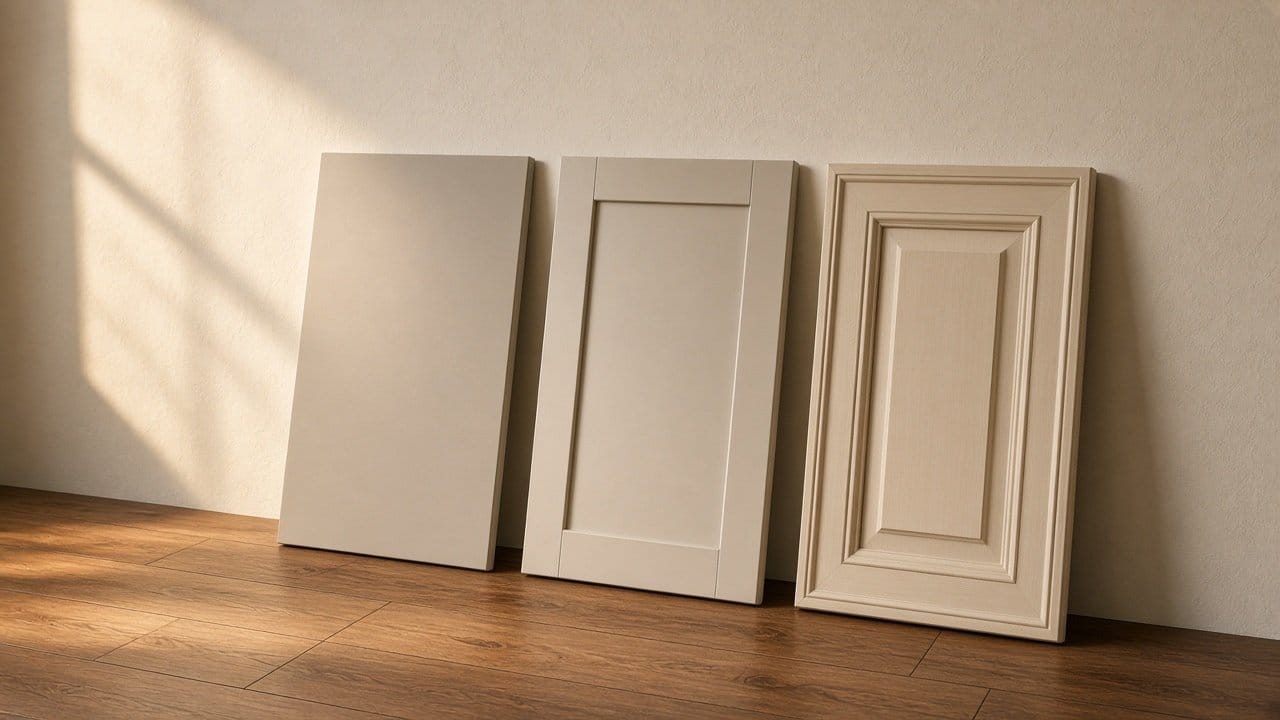
It is also the answer when doors are physically failing while the boxes are fine. Delaminating thermofoil, warped doors, cracked panel joints. You can refinish a sound door for a long time. You cannot refinish a door that has come apart.
Where refacing gets oversold is on solid wood. If your doors are solid wood in good shape, you are paying to throw away better material than the replacement, and refinishing preserves grain and profile that nobody is manufacturing at that price today.
When refinishing wins, which in MetroWest is often
The housing stock here decides this. A lot of MetroWest kitchens from the 1980s and 1990s have solid wood or plywood boxes with solid raised-panel doors, in a stain that has simply gone out of favor. The boxes are better than what stock replacement would put in. The doors are heavier than what refacing would hang. The layout was designed around the room and works.
That kitchen wants refinishing, and the finish quality is the whole game. Sprayed catalyzed coatings level out to a factory-smooth surface that brushwork cannot match on a door face, which we get into in sprayed versus brushed cabinet finish durability. Color choice matters more than people expect once the profile is staying, and that is covered in 2026 cabinet colors beyond sage.
When replacement is the honest answer
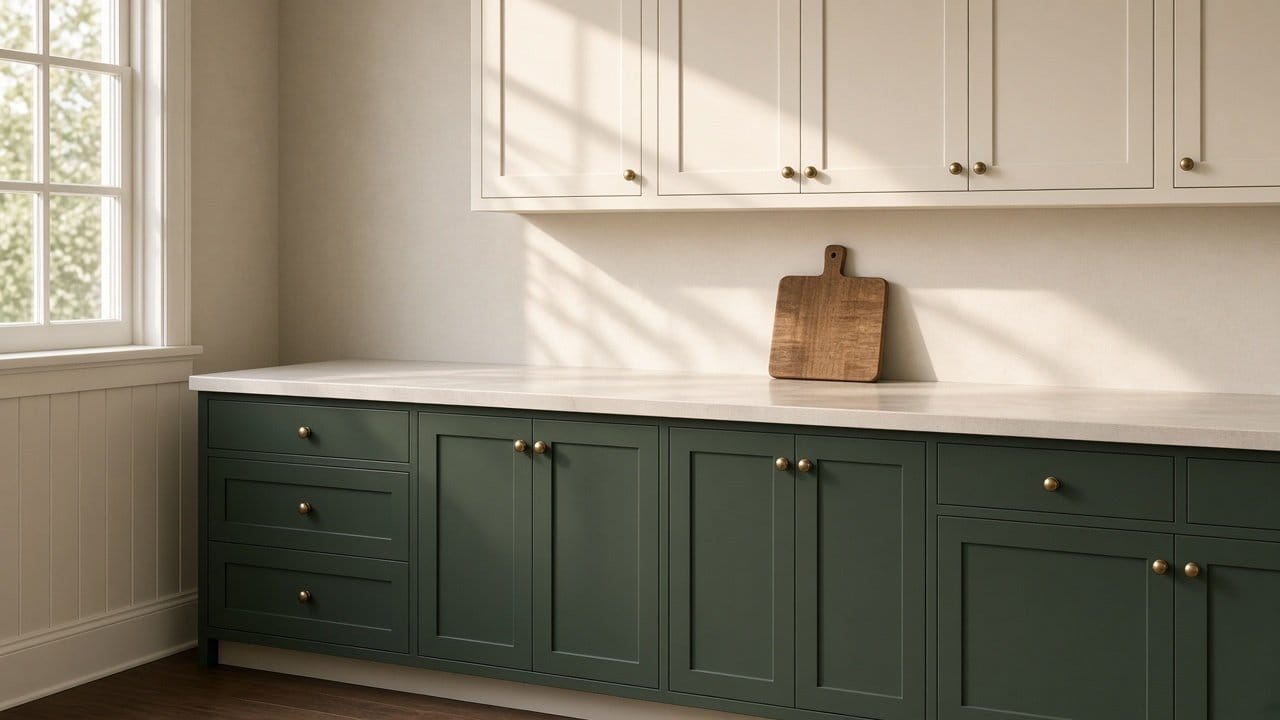
We will say this plainly even though we do not sell cabinets: replace when the layout is wrong, when the boxes are failing, or when the kitchen is coming apart for other reasons anyway.
A kitchen where the dishwasher is across the room from the sink, where there is no pantry and there is room for one, or where a wall is coming down, is not a finish problem. Refinishing a layout you dislike buys you a kitchen you still dislike, in a nicer color.
Worth budgeting for: replacement pulls other costs in behind it. Flooring where the old cabinets sat, countertop replacement, lighting that no longer lines up, sometimes plumbing and electrical. If new floors are part of it, the order of operations matters, and we cover that in whether to paint before or after new flooring.
A short way to decide
- Does the layout work? No means replace. Stop here.
- Are the boxes sound? No means replace.
- Are the doors sound? No means reface.
- Do you dislike the door style itself, not just the color? Yes means reface.
- Otherwise: refinish. You are keeping better material than you would buy, for the least money.
Four out of five kitchens we look at in MetroWest come out at step five. That is not a sales position, it is what the housing stock is made of. The cost comparison against full replacement is worked through in cabinet refinishing versus replacement.
Frequently asked questions
Is cabinet refacing cheaper than painting cabinets?
No. Refacing typically runs $150 to $450 per linear foot against roughly $25 to $65 for refinishing, because refacing includes new doors, drawer fronts, and veneer over the box faces.
Can you reface particle board cabinets?
Sometimes. The box has to be sound and dry, with enough material for new hinge screws to hold. Swollen or delaminating particle board, common under sinks, cannot be refaced.
How much does it cost to reface kitchen cabinets in Massachusetts?
National 2026 data puts the average around $7,233, with a common range of $4,484 to $10,586. Your linear footage and door selection move that more than anything else.
How long does cabinet refacing last compared to refinishing?
Both last for years when the boxes are sound. Refacing gives you factory-finished new doors, while a properly sprayed refinish on solid wood doors holds up comparably and keeps the original profile.
Is refacing worth it if I am changing the layout?
No. Refacing and refinishing both keep the existing footprint. If cabinets are moving, being added, or coming out for a wall change, that is a replacement project.
The bottom line
Layout first, boxes second, doors third. Most sound MetroWest kitchens with solid doors should be refinished, and the ones that should not, we will tell you about rather than talk you into. Paint Pro New England has been refinishing cabinets across Holliston, Wellesley, Needham, Dover and the rest of our 18 towns since 2011, Benjamin Moore and Sherwin-Williams, fully insured, with a 2-year warranty on our work. Call (774) 217-9567 and we will open a door before anyone writes a number down. We also serve Wellesley and the surrounding towns, and handle bathroom vanity refinishing on the same principles.
Dave Griffiths
Dave Griffiths is the owner of Paint Pro New England, a professional painting company serving MetroWest Boston since 2011. With 15+ years of interior and exterior painting experience across the region, he leads every project with thorough prep, premium Benjamin Moore and Sherwin-Williams paints, and a 2-year warranty.

