



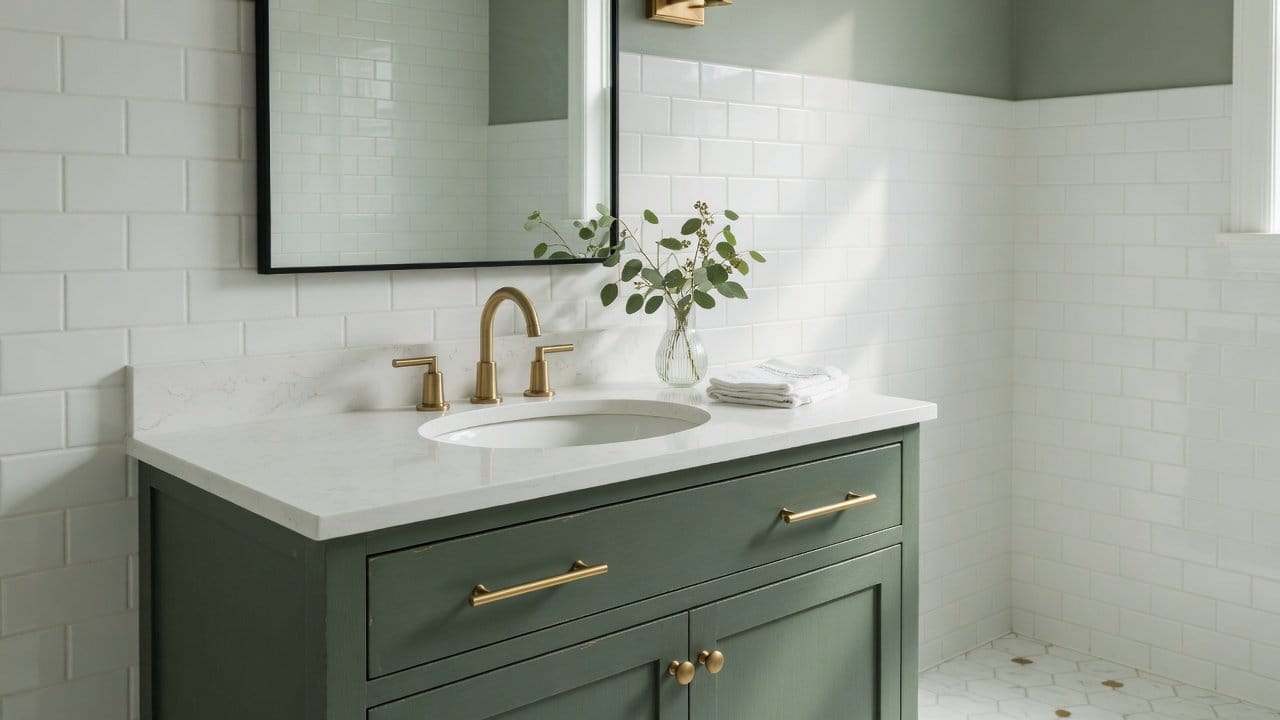
TL;DR: If your vanity box is structurally sound, refinishing beats replacing on cost by a wide margin. Replacement runs $665 to $3,300 typically and up to $5,000+ with plumbing changes, once you add the unit, $200 to $1,000 in installation labor, and $115 to $500 for removal and disposal. Refinishing the cabinet plus a sink refinish at $120 to $520 lands dramatically lower, and a professional refinish lasts 10 to 15 years. Replace instead when the box is water-damaged, when it is low-grade MDF that has already swelled, or when the layout has to change. A bathroom is the hardest room in the house on a finish, so product choice matters more here than anywhere else.
Wondering which way your vanity should go? Call or text Dave at (774) 217-9567. We will look at the box, not just the doors, and tell you honestly if refinishing is throwing money at a unit that is already failing.
The bathroom vanity is the piece homeowners most often replace when they did not need to and most often refinish when they should have replaced. The deciding factor is not how it looks. It is what the box is made of and whether water has already gotten into it.
What does refinishing save against replacing?
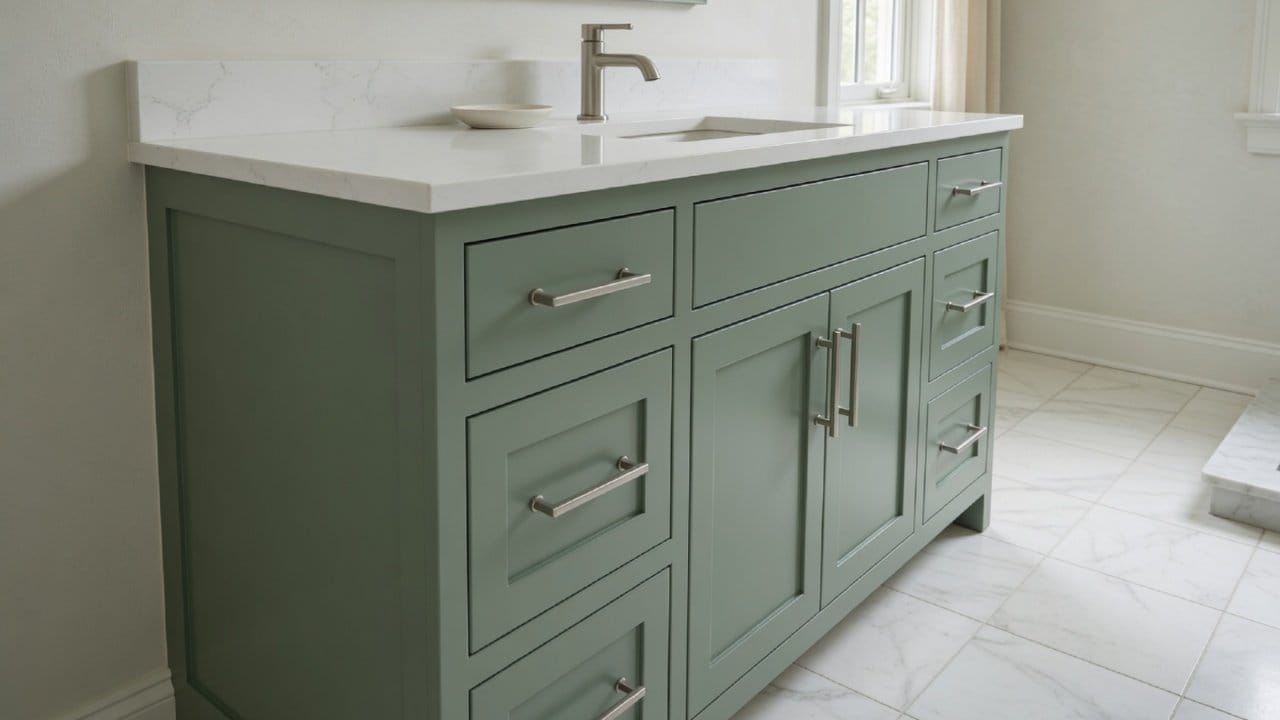
Replacement is rarely just the price of the vanity. The full picture:
- The unit: prefabricated vanities run $100 to $2,600; custom built runs $3,000 to $4,500
- Installation labor: $200 to $1,000
- Removal and disposal: $115 to $500, more for stone tops or heavy units
- Plumbing: $45 to $200 per hour for anything touching supply lines or drains
All in, a straightforward replacement averages $665 to $3,300, and a job involving layout or plumbing changes can pass $5,000.
Refinishing changes the arithmetic. You are paying for prep, primer, finish and labor on the cabinet, plus optionally a sink refinish at $120 to $520 if the basin is dated but sound. Add new hardware and, if you want, a new countertop, and you have effectively a new vanity without touching the plumbing or the walls. Replacing the countertop and refinishing the cabinet is frequently cheaper than a new unit plus installation.
The economics scale the way they do on kitchens, and the reasoning in our kitchen cabinet refinishing versus replacement guide applies here in miniature.
When should you replace instead?
Refinishing a failing box is money spent on something already on its way out. Replace when you find:
- Swelling at the base or around the sink cutout. That is water in the substrate, and paint does not reverse it.
- A soft or delaminating particleboard or MDF carcass. A cheap box that swells every few years costs more per year of use than a solid wood or plywood vanity you maintain and refinish for two decades.
- Cracks or a compromised substrate anywhere structural.
- A layout that needs to change, for a double sink, better clearance, or accessibility.
- Persistent odor, which usually means moisture has been sitting in the cabinet for a long time.
Solid wood and plywood boxes are almost always worth refinishing. Low-grade MDF that has already been through one swelling cycle is almost never worth it.
Why is a bathroom harder on a finish than a kitchen?
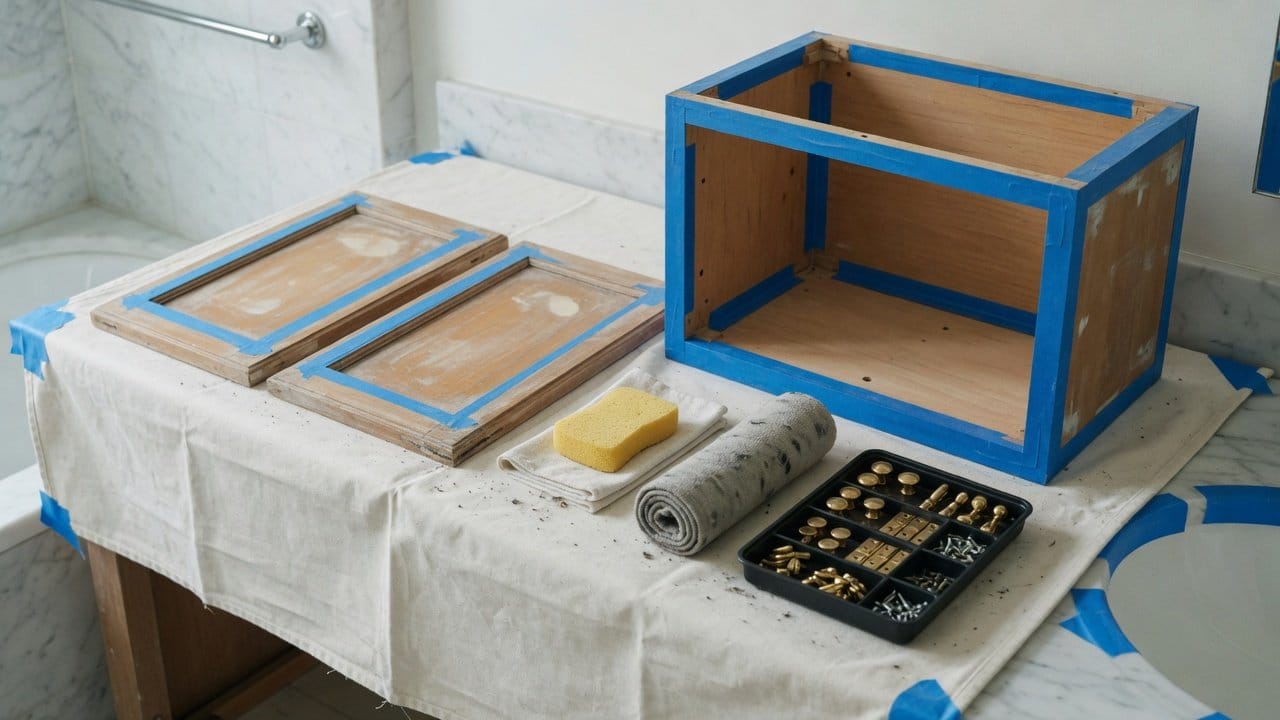
Because of what happens every single day. A shower drives the humidity to saturation, condensation collects on every cool surface including the vanity, and the finish gets that cycle once or twice a day, every day, in a room that is often poorly ventilated.
What that demands:
- A hard, moisture-tolerant topcoat. A waterborne alkyd or cabinet-grade enamel, not a wall paint. Wall paint on a vanity will print, mark and soften.
- Sealed edges, especially the bottom. The base and the toe kick are where water sits. Any unsealed raw edge is an entry point.
- Thorough degreasing. Vanities collect hairspray, lotion, cosmetics and soap film, which is a different contamination profile than a kitchen but just as hostile to adhesion.
- A real cure period. The same physics as kitchen cabinets applies: the surface hardens before the layer beneath it, so doors go back on and normal use resumes on a schedule, not the same evening. The full explanation is in our guide to sprayed versus brushed cabinet finishes.
- A primer that matches what is there. Older MetroWest vanities are frequently oil-based, so test before assuming, per painting over oil-based paint in older homes.
Ventilation is worth naming as a separate issue. If the bathroom has no working exhaust fan, the finish will have a shorter life no matter what goes on it, and that is worth fixing before or alongside the refinish. We touch on the broader moisture question in bathroom painting in older Holliston homes.
How long does a refinished vanity last?
A professional refinish on a sound box lasts 10 to 15 years with normal care, which is comparable to the realistic service life of a mid-range replacement vanity, at a fraction of the cost and with none of the plumbing disruption.
What shortens it: standing water left on the counter and running down the door faces, abrasive cleaners, no exhaust ventilation, and using the vanity before the finish has cured. What extends it: wiping spills, a functioning fan, and non-abrasive cleaning.
The bottom line
Check the box before you shop for a new one. A solid wood or plywood vanity that is merely dated is a refinishing candidate, and refinishing it with new hardware and possibly a new top will read as a new bathroom for well under what replacement costs. A swollen MDF box with water in the base is not, and painting it is money you will spend twice. Color-wise, a clay or khaki vanity is a low-risk way to try the 2026 cabinet colors beyond sage before you commit a kitchen. If the tile around it is the part you actually hate, that is a microcement bath conversation, not more paint. The finish product matters more in a bathroom than almost anywhere else in the house, because no other room puts a coating through that humidity cycle twice a day.
Paint Pro New England has refinished MetroWest cabinetry for 15 years, serving Holliston, Medway, Hopkinton, Sherborn, Dover, Wellesley, Natick and the surrounding towns, with a 2 year warranty and 5.0 stars across 60+ reviews. For a free assessment of your vanity, call (774) 217-9567.
Dave Griffiths
Dave Griffiths is the owner of Paint Pro New England, a professional painting company serving MetroWest Boston since 2011. With 15+ years of interior and exterior painting experience across the region, he leads every project with thorough prep, premium Benjamin Moore and Sherwin-Williams paints, and a 2-year warranty.

