



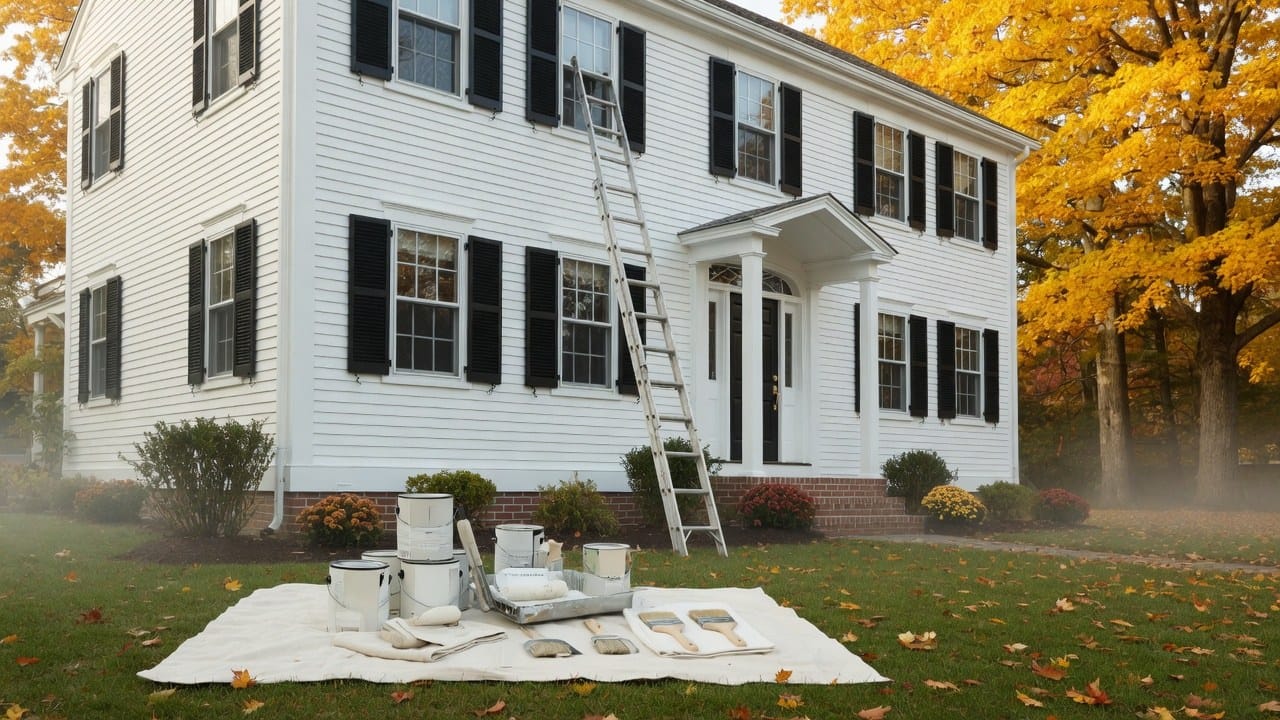
TL;DR: The fall exterior painting deadline in MetroWest is not a date on the calendar, it is a dew point number. Paint needs the surface to stay at least 5°F above the dew point during application and through the cure window, and standard exterior acrylics need 50°F or warmer (cold-rated formulas go down to 35°F if the temperature holds there for a full 24 hours). In practice that means our last reliable exterior week around Holliston runs somewhere in mid to late October, and by then the workable window has shrunk to roughly 10am to 3pm. Book early, because the season closes from both ends.
Want your exterior finished before the window shuts? Call or text Dave at (774) 217-9567. We schedule fall exteriors in booking order, and the last two weeks of the season fill first every year.
Every September I get the same call: "It is still 60 degrees out, why can't you paint next month?" It is a fair question, and the answer is the thing almost nobody outside the trade tracks. Air temperature is the number homeowners watch. Dew point is the number that actually decides whether your paint film survives the winter.
What is the dew point rule, and why does it end the season?
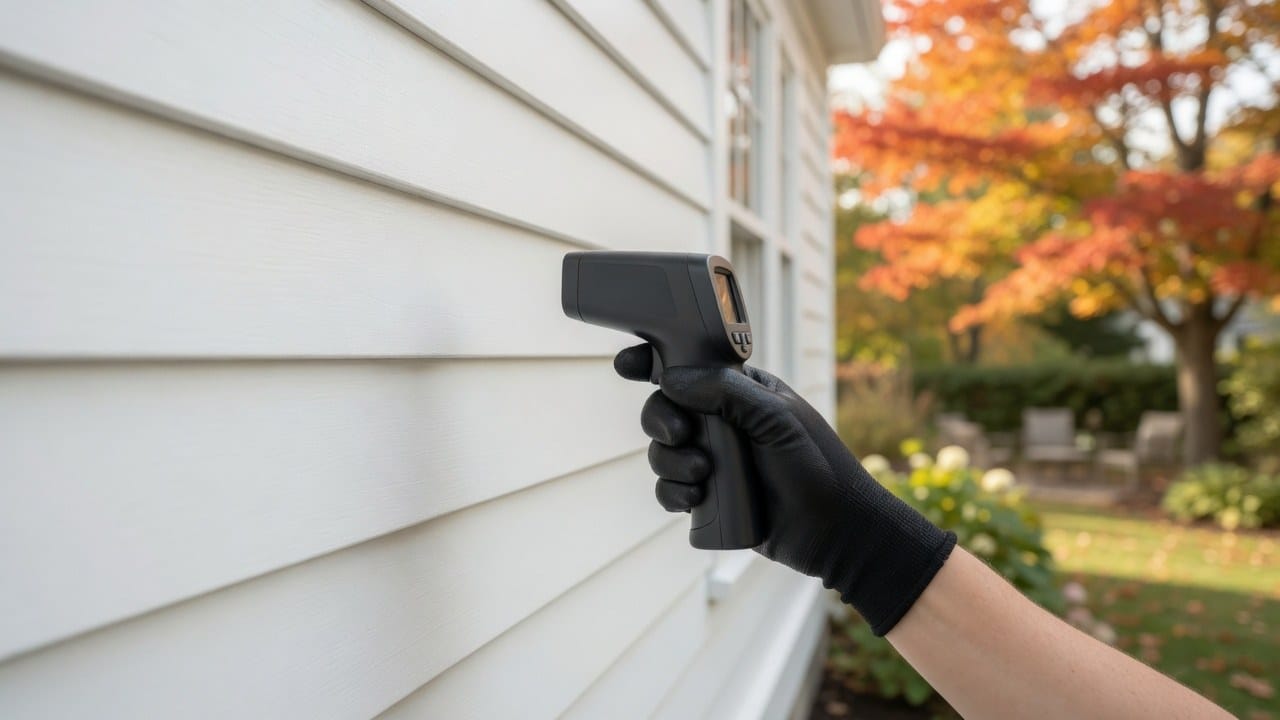
Dew point is the temperature at which moisture in the air condenses into water. The industry standard, written into ASTM D3924, is to apply coatings only when the surface is more than 5°F above the dew point, with a surface temperature in the 50 to 90°F band.
Here is why that matters in October. Your siding radiates away the heat it absorbed all day, so by late afternoon the surface is often colder than the air around it. When that surface reaches dew point, moisture condenses on it. If that happens while the paint is still coalescing, the water mixes into the film and you get the failures we spend every spring repairing: streaking, uneven sheen, blotchy color, a finish that stays tacky for days, and adhesion that lets go a year or two later.
Crucially, the rule applies through the cure window, not just the moment the brush touches the wall. A wall painted at 2pm on a beautiful 58°F afternoon can still fail if the overnight low crosses the dew point before the film sets.
What temperature is actually too cold to paint?
Two thresholds, and the difference between them is the product in the can:
- 50°F is the floor for standard exterior acrylics. Below it the paint cannot form a proper film, no matter how good it looks going on.
- 35°F is the floor for cold-weather rated formulas, and the catch is that the surface must stay at or above 35°F for the next 24 hours, not just at the moment of application.
That 24 hour requirement is what quietly closes the season in MetroWest. We regularly get a 55°F afternoon in early November followed by a 31°F night. That day is unpaintable even though the daytime number looks fine. We go deeper into the product side of this in our guide to exterior painting temperature requirements in Massachusetts.
How much does the workable day shrink in October?
A lot, and this is the part that surprises people who assume a warm forecast means a full day of work.
In July we can be on a wall from 7am to 6pm. By mid October the morning dew does not burn off until roughly 9:30 or 10am, and we need to stop at least 2 hours before sunset so the film sets before the evening temperature drops toward the dew point. With sunset around 5:45pm in mid October, that leaves a working window of about 5 hours, less than half of a July day.
So a three day house in summer becomes a six or seven day house in late fall. That is not padding, it is physics, and it is why the calendar fills faster than the number of remaining warm days suggests. Our breakdown of how long exterior painting takes in MetroWest assumes summer conditions, so add roughly half again for a fall job.
How do you sequence a fall exterior job?
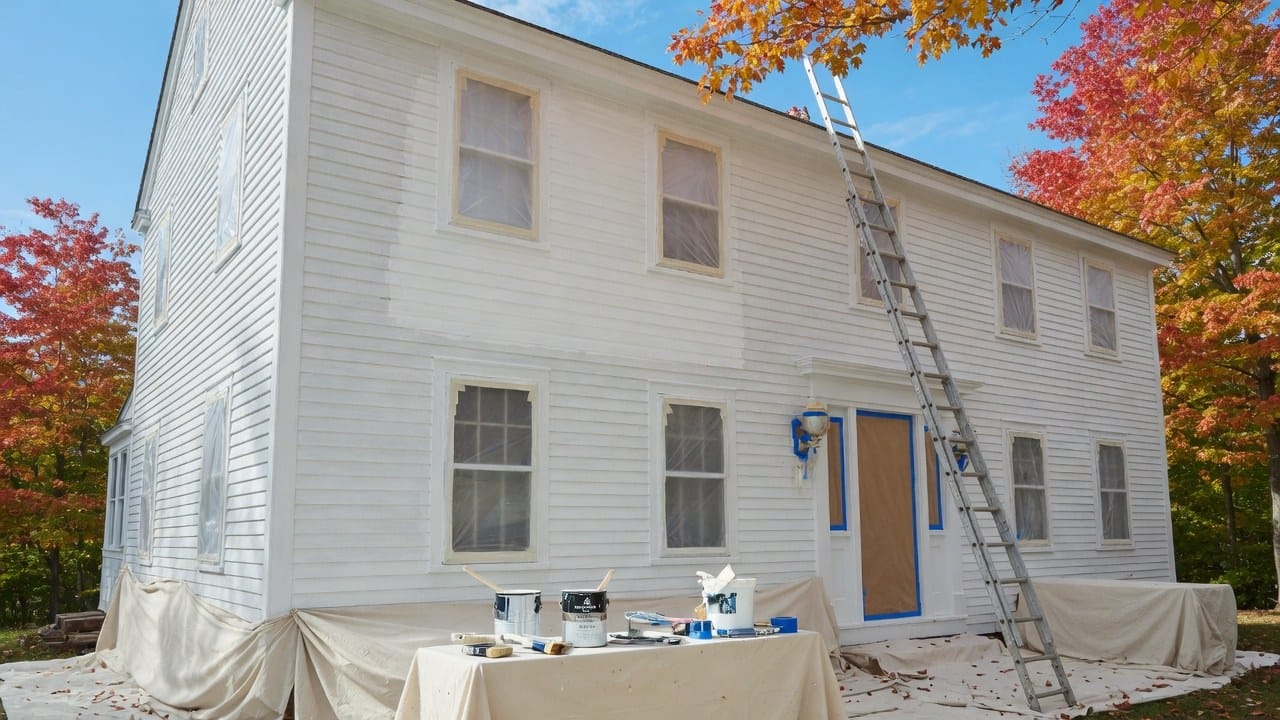
We chase the sun rather than the clock:
- Start late. Nothing goes on until the dew has fully evaporated and the substrate reads dry. Beaded water on the grass, the cars, or a railing is the visual signal to wait.
- Follow the warm side. The east elevation gets morning sun, so it dries first. The west elevation stays shaded in the morning and warms in the afternoon. We paint each face while it is warm and dry, not on a fixed rotation.
- Read the surface, not the app. An infrared surface thermometer is standard kit. Siding in direct October sun can run 15°F above ambient, and a shaded north wall can run below it.
- Stop early. Brushes down by early to mid afternoon. The last coat needs hours of margin before the evening convergence.
This is also the season where we are most likely to tell a homeowner we are not painting today, which is exactly the judgment call we describe in why we won't paint your house today.
What if you miss the window entirely?
Then you do not force it. A rushed October coat that fails in two years costs more than waiting, and a failed exterior is far more expensive to correct than to schedule properly the first time.
Three options that work better than gambling on a marginal day. First, do the prep now (washing, scraping, carpentry repairs, caulking) and coat in spring, which shortens the spring job and gets you an earlier slot. Second, move the work inside, since winter interior painting has real off-season advantages including better scheduling and off-peak availability. Third, get on the spring calendar now, which is genuinely the cheapest move you can make and the reason we tell homeowners to book an exterior painter early in MetroWest.
The bottom line
The fall deadline is not a date, it is a set of conditions: surface above 50°F for standard product or above 35°F for 24 hours with a cold-rated one, and the surface a full 5°F clear of the dew point through the whole cure. In MetroWest those conditions usually hold until mid to late October and then stop being reliable, and the working day shrinks to about five hours well before that. A painter who is still spraying siding in mid November is not being heroic, they are handing you a failure that shows up in year two.
Paint Pro New England has been reading MetroWest weather for 15 years, serving Holliston, Medway, Hopkinton, Sherborn, Dover, Wellesley, Natick and the surrounding towns, with a 2 year warranty and 5.0 stars across 60+ reviews. For a free estimate and an honest answer about whether your project fits this fall, call (774) 217-9567.
Dave Griffiths
Dave Griffiths is the owner of Paint Pro New England, a professional painting company serving MetroWest Boston since 2011. With 15+ years of interior and exterior painting experience across the region, he leads every project with thorough prep, premium Benjamin Moore and Sherwin-Williams paints, and a 2-year warranty.

