



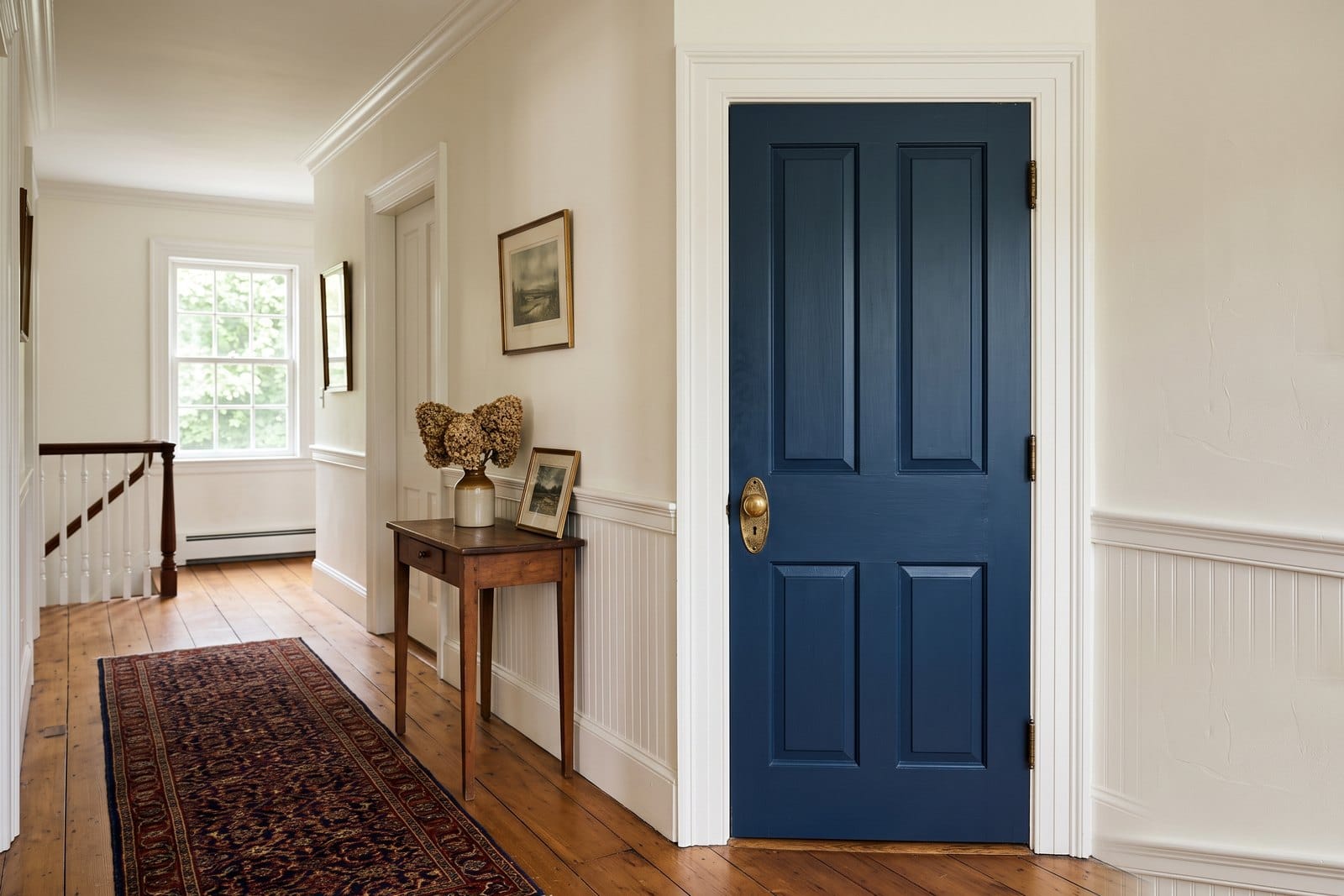
TL;DR: Painting your interior doors a bold or deep color is one of the highest-impact, lowest-cost upgrades in 2026 design — a small surface that completely changes how a room reads. Inky blues, forest greens, warm blacks, espresso browns, and soft clays are all having a moment, whether you paint every door in the house one color or make a single showpiece door. The finish is what makes it look custom: doors should be sprayed or finely brushed in satin or semi-gloss for a smooth, furniture-grade result. In MetroWest's older homes, paneled doors take color beautifully. Expect roughly $80–$200 per door done right, depending on style and prep.
Want to see a door color in your own hallway before you commit? Call or text Dave for a free consult — (774) 217-9567. We'll help you pick the shade and give it a smooth, professional finish.
Ask most homeowners what they'd repaint to freshen a room and they'll say the walls. But some of the best designers in 2026 are pointing at something smaller and far cheaper: the doors. A painted interior door is the kind of change that makes people walk in and say “something looks different” without being able to name it. After fifteen years in MetroWest homes, here's why we love it and how to get it right.
Why are statement interior doors trending in 2026?
Doors are having a moment because they're the perfect mix of impact and restraint. In 2026, designers see the door not as a purely functional object but as a chance to make a statement — a bold color that pops against neutral walls, or a rich tone that adds quiet depth. It fits the year's broader appetite for warmth, personality, and architectural interest over flat, all-white minimalism. And unlike a full room repaint, it's a small commitment: if you want to test whether you're brave enough for color, a door is the low-risk place to start.
What colors work best for interior doors?
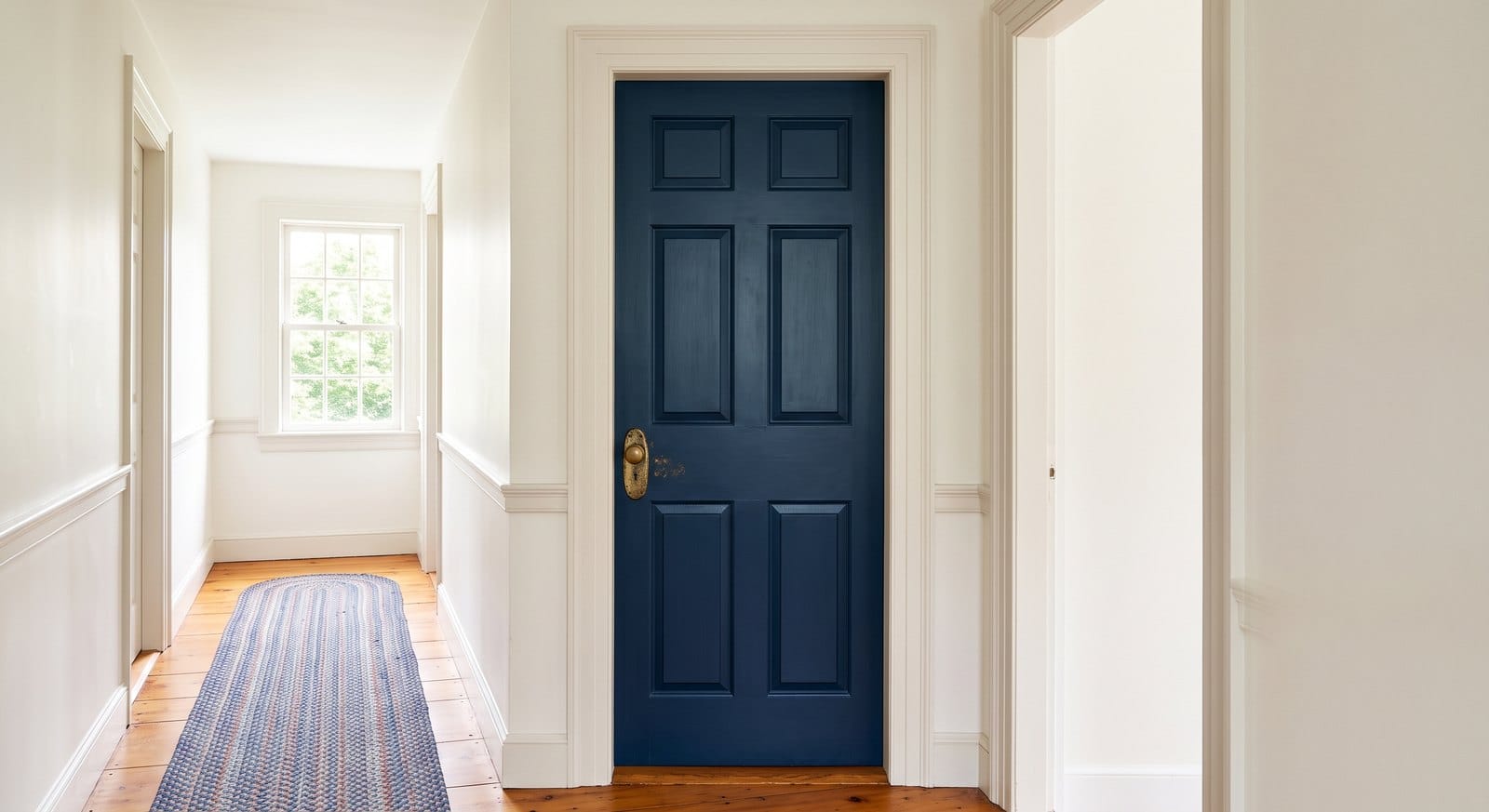
The winning palette leans deep and grounded, right in step with the 2026 Colors of the Year:
- Inky navy and deep blue — classic, versatile, and dramatic in a hallway or against warm white walls.
- Forest and olive greens — natural and calming, especially at home in New England.
- Warm black and charcoal — the crisp, high-contrast choice that makes trim and hardware look intentional.
- Espresso and chocolate brown — the surprise favorite of 2026, cozy and rich.
- Soft clay and terracotta — warmer and more unexpected, lovely on a bedroom or study door.
You have two strategies: paint every interior door in the house one consistent color for a cohesive, designed feel, or pick a single showpiece door — a study, a powder room, a pantry — as a jewel-like accent. Both work; the whole-house approach reads more custom, while the single door is the easiest weekend-scale upgrade.
Why do MetroWest's older-home doors take color so well?
New builds tend to have flat, hollow-core doors. MetroWest's Colonials, Victorians, and antique capes usually have solid, paneled doors — two-, four-, five-, and six-panel styles with real profiles. Those recesses and raised panels are exactly what makes a painted door look rich: color settles into the profiles and catches light along the edges, giving depth a flat slab can't. It's the same reason paneled trim and crown moulding reward a careful hand. Painting the doors to match a color-drenched room, or to contrast a neutral one, both play beautifully with this architecture.
How do you get a smooth, furniture-grade finish?
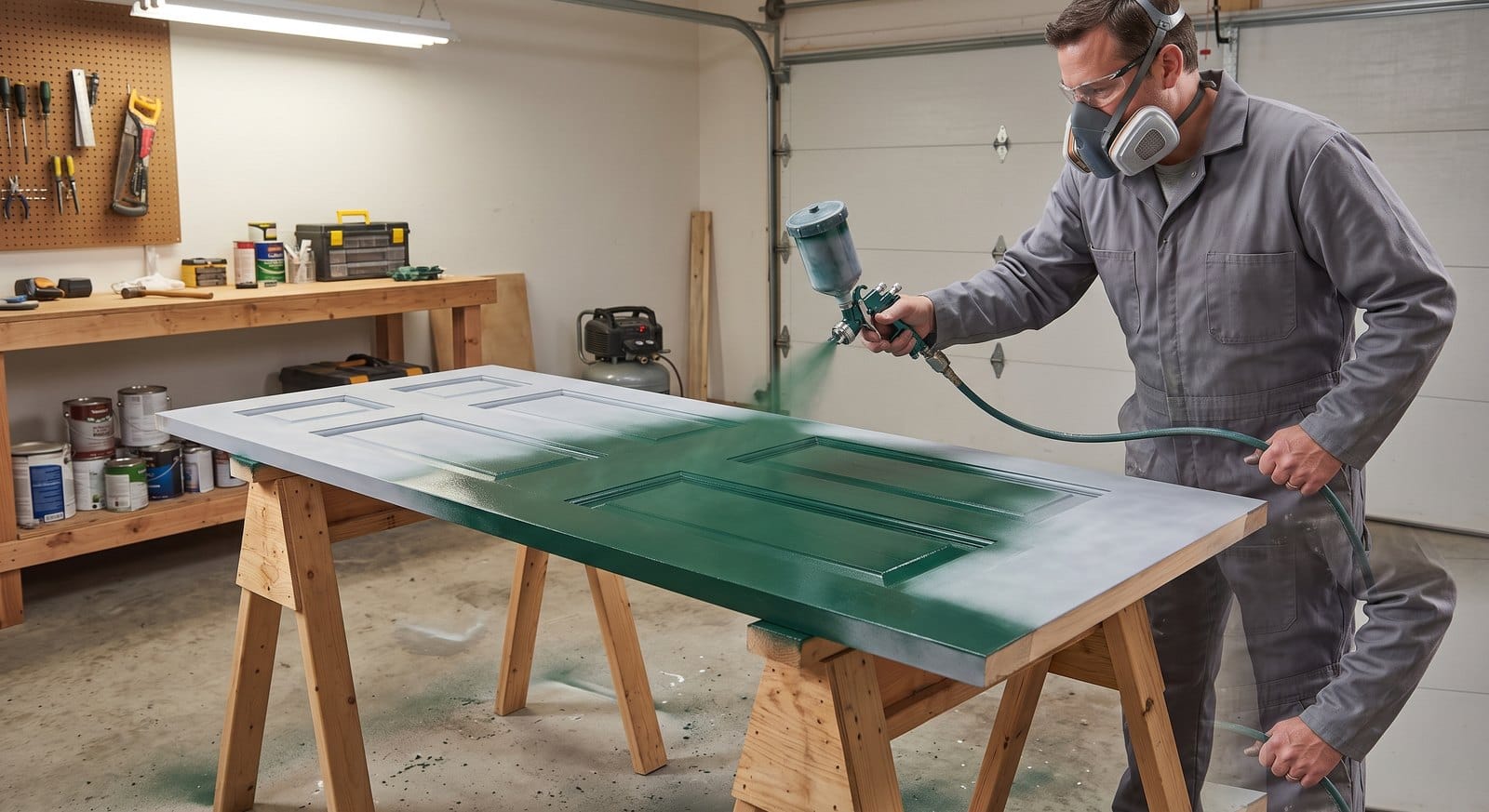
This is where doors are won or lost. A door is at eye level, touched constantly, and lit from the side, so brush marks and drips show more than they ever would on a wall. The professional approach:
- Clean and de-gloss. Doors collect hand oils; paint won't bond to a dirty or glossy surface without proper prep.
- Fill, sand, and prime. A smooth, primed base is what lets deep colors cover evenly.
- Spray or brush finely, ideally off the hinges. Spraying gives the smoothest, factory-like result; skilled brush-and-roll with a fine finish can also look excellent. Taking the door down and laying it flat prevents drips in the panels.
- Choose satin or semi-gloss. Doors need a wipeable, durable sheen — not flat. Our guide to choosing the right paint finish for every room covers where each sheen belongs.
- Don't forget the edges and hardware. Clean lines at the latch edge and either fresh or carefully-protected hardware are what make it read custom rather than casual.
How much does it cost to paint interior doors in MetroWest?
Done to a smooth, durable standard, plan on roughly $80–$200 per door, depending on the door's style (a six-panel takes more time than a flat slab), how much prep and priming it needs, and whether it's sprayed off the hinges or finished in place. Doing several at once — or folding them into a room repaint — brings the per-door cost down. For the full planning picture, see our Massachusetts house painting cost guide.
The bottom line
Statement doors are the smartest small move in 2026 design: a fraction of the cost of a full repaint, a fraction of the disruption, and a genuinely transformative result. In MetroWest's older homes, where solid paneled doors were made for exactly this, a deep, well-finished color turns an overlooked surface into the detail everyone notices. Start with one door you walk past every day — you'll want to do the rest.
Paint Pro New England has finished interior doors, trim, cabinets, and full rooms — sprayed and hand-brushed to a smooth, durable standard — across Holliston, Medway, Hopkinton, Sherborn, Dover, Wellesley, Natick, and the rest of MetroWest Boston for 15 years. EPA Lead-Safe certified, fully insured, 2-year warranty, 5.0 stars across 60+ reviews. For a free consult and itemized estimate, call (774) 217-9567.
Dave Griffiths
Dave Griffiths is the owner of Paint Pro New England, a professional painting company serving MetroWest Boston since 2011. With 15+ years of interior and exterior painting experience across the region, he leads every project with thorough prep, premium Benjamin Moore and Sherwin-Williams paints, and a 2-year warranty.

