



TL;DR: You can tell a painter is good before you hire them from three things you can check yourself: the estimate (they inspect every surface and put prep, primer, product and number of coats in writing), their finished work in side light (straight cut lines, even sheen, no lap marks, sags or old color showing through) and their paperwork (a current certificate of insurance including workers' compensation, and for a pre-1978 home, a Massachusetts lead-safe renovation contractor license). Massachusetts also says to interview at least three contractors.
Comparing painters for an interior or exterior? Call or text Dave at (774) 217-9567. Put our estimate next to the others and hold every one of them to this checklist.
Most people judge a painter on a phone call and a total at the bottom of a page. Neither tells you how the walls will look in two years. The good news is that skill leaves evidence long before the first coat goes on, in the way a painter estimates, in work they have already finished, and in a few documents that take five minutes to check.
How can you tell if someone is a good painter?
Watch the estimate. A good painter spends time on the surfaces, not just the square footage, and writes down what they will do to each one. If the visit is a quick walk-through and a number, you have learned how the job will go.
At the estimate, a good painter usually:
- Looks closely. They check for nail pops, cracks, stains, glossy trim and peeling, and point them out to you.
- Names the product. The brand and line for each surface, not "good paint."
- States the coats and the primer. Two finish coats is the manufacturer baseline for walls; primer goes on bare surfaces, stains and big color changes. We explain why in what happens when you hire a painter for your interior.
- Lists the prep. Washing, patching, sanding, caulking and protection, in writing.
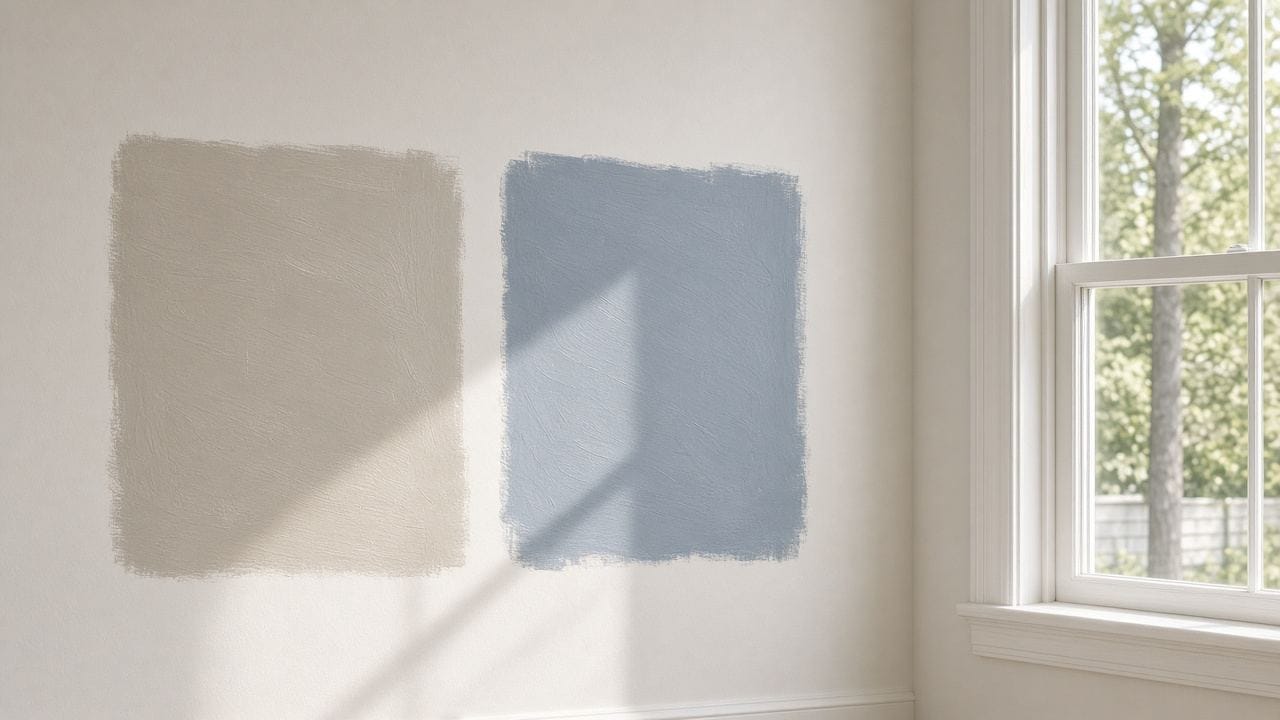
- Tests the color. We sample it on your wall first, because the same color reads differently in a north-facing Framingham bedroom than in a sunny Natick kitchen.
The Massachusetts consumer office says the same thing in plain terms: request "a written, detailed estimate" before you hire, according to its homeowner resources page.
What are the key qualities of a good painter?
Patience with prep, respect for the product's instructions, and a clean, predictable job site. Talent with a brush matters, but most paint failures trace back to steps that were skipped, not to a shaky hand.
- Prep discipline. Sherwin-Williams' data sheet for Duration Home Interior Latex Satin says "any surface preparation short of total removal of the old coating may compromise the service length of the system." A good painter treats prep as the job, not the warm-up. Our own promise, in the words on our site, is quality "which can only be achieved with proper preparation."
- Follows the data sheet. Recoat times, temperature limits and spread rates are printed for every product. Painters who respect them avoid most of the defects below.
- Clean and on time. Drop cloths down, hardware off, the room usable at day's end, and a crew that shows up when it says it will.
- Clear communication. One person you can reach, who tells you what is happening and what changed.
- Stands behind the work. A written warranty with real terms. What a painting warranty should cover is in our guide to painting warranties in Massachusetts.
What are the signs of a bad paint job?
Uneven sheen, old color showing through, drips and visible overlap lines are the classic signs, and each one has a known cause. When you look at a painter's past work, in person or in photos, these are what to check.
Look at a wall from the side, with window light raking across it, not straight on:
- Poor hiding. The old color or patches show through. Sherwin-Williams lists the causes on its poor hiding page, including "applying too thin of a paint film," thinning the paint and painting over a porous surface without primer.
- Flashing. Patchy shine across a flat wall. Sherwin-Williams defines paint flashing as "an uneven appearance of a paint coating's gloss, sheen or luster," often from unprimed patches or a coat applied too thin.
- Lap marks. Stripes where wet paint overlapped paint that had started to dry. Benjamin Moore says lap marks "appear as a deeper color or an increased gloss," and the fix is keeping a wet edge.
- Sags and drips. Curtains of paint below trim and outlets. Sherwin-Williams lists the causes of paint sagging as too heavy a coat, over-thinned paint, humid or cool conditions and painting over gloss.
- Sloppy edges. Wavy lines where wall meets ceiling or trim, paint on outlet covers, hinges or glass, and gaps left uncaulked.
Most of these trace back to application, not to the can. If a reference's walls look even in side light a few years on, that tells you more than any sales pitch.

What questions should you ask a painter before hiring?
Ask questions with answers you can check: what is included, what product, how many coats, who is insured, and who you call if something goes wrong. Vague answers to specific questions are the clearest warning you will get.
- What exactly is included? Walls, ceilings, trim, doors, closets. What a fair scope and market price look like for one room is in how much it costs to paint a room in Massachusetts.
- Which product and how many coats, in writing?
- Can I see your certificate of insurance? Massachusetts tells homeowners to ask for proof of liability and workers' compensation insurance.
- Can I talk to your three most recent customers? The state suggests written references for a contractor's three most recent projects, with names and phone numbers.
- What is the payment schedule? We cover what is normal in painting deposits and payment schedules in Massachusetts.
Our longer checklists are in how to hire a painting contractor in MetroWest and advice before you hire a painter.
How do you compare two painting quotes line by line?
Put the quotes side by side and compare the work before the totals. Two numbers only mean something when they price the same surfaces, the same prep, the same product and the same number of coats. Where one quote has a line the other lacks, ask the second painter to price it or explain why it isn't needed.
Here is the checklist, with published market figures to hold each line against. They are cost-guide figures, not our prices; Angi's Boston pages are national averages adjusted with a local price index.
| Line | What a fair scope says | Market figure to check it against |
|---|---|---|
| Surfaces | Each room, with walls, ceilings, trim, doors and closets marked in or out | Walls $2 to $3.50 per sq ft of wall; smooth ceilings $1 to $3 per sq ft (Angi Boston) |
| Trim | Which trim (baseboard, casings, crown), measured or listed | $3 to $5.35 per linear ft (Angi Boston) |
| Doors | How many, and whether frames are included | $75 to $150 per interior door and frame (Angi, national) |
| Prep | Washing, patching, sanding, caulking and stain sealing named | Sanding and patching $0.50 to $0.75 per sq ft (Angi) |
| Repairs | Drywall or plaster repair as its own line or allowance | Drywall $300 to $1,000 (Angi Boston); plaster averages $48 per sq ft (Angi) |
| Primer and coats | Where primer goes; number of finish coats | Each extra coat $50 to $70 per 300 to 400 sq ft of wall (Angi) |
| Product | Brand, product line and sheen for each surface | Boston paint per gallon: flat $25, semi-gloss $30, primer $20 (Angi Boston) |
| Exterior prep, if any | Scraping, stripping failing paint, mildew removal, caulking | Paint stripping $0.80 to $3.20 per sq ft (Angi Boston exterior) |
| Schedule and payments | Start date, finish date, deposit and payment stages | Deposit capped by law at one-third in most cases (see below) |
| Insurance and warranty | Certificate of insurance; written warranty terms | No dollar figure; ask for both in writing |
Sources, all Angi: Boston interior (August 4, 2026), Boston room (July 8, 2026), interior (October 14, 2026), room (July 8, 2026), doors (October 7, 2026), plaster (July 9, 2026), Boston exterior (November 18, 2025).
A rule of thumb for the totals: labor is most of the bill. Angi's national interior guide puts labor at 75 to 95 percent of a professional interior painting project. So a quote far below the others usually means fewer hours: fewer coats, lighter prep or surfaces left out. Ask which. For the whole job, Angi's Boston pages put an average interior at $2,167 (most pay $1,039 to $3,304) and an average exterior at $5,285 (most pay $3,198 to $7,782). One room is broken down in how much it costs to paint a room in Massachusetts, and town-level figures are in our Framingham and Natick interior cost guides.
What changes the price of a painting job?
Condition, prep, height and how much trim is included move a painting price far more than the brand of paint. They explain most gaps between honest quotes.
- Season and scheduling. The guides disagree for interiors. Angi's national interior page says late fall or winter is the best time to paint inside, while its Boston page favors late spring through early fall, because cold winters and humid summers "can slow drying" and "increase labor hours." For exteriors, HomeAdvisor's exterior guide suggests booking off-season but also says "working in extreme heat or cold can increase labor costs by 50%," and Sherwin-Williams' Duration exterior data sheet says not to apply below 35°F or when temperatures may drop below 35°F within 48 hours. No source we checked puts a number on seasonal savings.
- Existing condition. HomeAdvisor says that if remedial work is necessary, exterior labor "can increase by 100% or more." Inside, drywall and plaster repairs are priced as in the table above.
- Prep add-ons. Popcorn ceilings need an asbestos test before removal, which Angi puts at an average of $483. Wallpaper removal averages $793.
- Color changes and extra coats. Dark to light needs extra coats at $50 to $70 each per 300 to 400 square feet of wall, and Angi says an accent wall adds 20 to 30 percent to a room budget.
- Hard-to-work areas. Angi's exterior guide (July 20, 2026) adds about 30 percent for work above 8 feet, 60 percent above 13 feet, 90 percent above 17 feet and 120 percent above 19 feet. Inside, its ceiling guide says ceilings above 10 feet can add $100 to $500, and stairwells and two-story foyers cost more for the same reason.
- Trim, doors and ceilings priced separately. If one quote is "walls only" and the other includes ceilings, trim and doors, they are different jobs. Price each painter on the same list.
Massachusetts costs more to paint in. Federal Bureau of Labor Statistics data for May 2025 put the mean wage for Massachusetts painters at $30.81 an hour, against $26.64 nationally. Those are wages, not billed rates. And in the Census Bureau's American Community Survey (2024 1-year, via Census Reporter), 66.2 percent of Massachusetts homes were built before 1980, against 48.1 percent nationally, so repairs and careful prep come up often here.
What are the red flags in a painting quote?
The clearest red flags are a single total with no detail, a deposit above what the law allows, and pressure to sign before you can compare. Each one is easy to spot on paper.
- One number, no lines. If you can't tell what is included, you can't compare it or hold anyone to it.
- "Premium paint" with no name. The brand and product line belong in writing.
- A total far below the others. With labor at 75 to 95 percent of an interior job, a much lower number usually means less work. Ask what is missing.
- A large deposit. For work under the home improvement contractor law, the deposit can't exceed the greater of one-third of the price or the cost of special-order materials.
- Full payment before the work is done. The same law says "no final payment shall be demanded until the contract is completed to the satisfaction of the parties."
- Blank spaces or no dates. A contract under that law must carry the notice "Do not sign this contract if there are any blank spaces," and list start and completion dates.
- Same-day pressure. A price good "only if you sign today" blocks the comparison the state recommends.
- Silence on lead in an older home. For a home built before 1978, a quote that never mentions lead-safe work practices is silent on rules that apply once paid work disturbs more painted surface than the state's thresholds, set out below.
Does a painter need insurance and an HIC registration in Massachusetts?
Insurance, yes: ask for a current certificate showing liability and workers' compensation. HIC registration depends on the work, because the state's own list of work that does not require it includes interior painting.
That detail matters. Massachusetts requires Home Improvement Contractor registration for anyone who bids on or performs contracting work on an existing owner-occupied home of one to four units, but its HIC homeowner resources page lists interior painting among the exemptions. The statute behind it, M.G.L. chapter 142A, section 14, exempts a contractor who works exclusively in interior painting or wall covering. Exterior painting is not on that list. The page also says that if you hire an unregistered contractor, you cannot use the state's arbitration program or the Guaranty Fund, which pays eligible homeowners up to $25,000 of actual losses on an unpaid award. You can look up any registration on the MA Contractor Hub. State law requires home improvement contracts over $1,000 to be in writing, and a contractor cannot collect more than one-third up front unless special-order materials are needed.
For a home built before 1978, the EPA's Renovation, Repair and Painting program applies to "anyone paid to perform work that disturbs painted surfaces," and the EPA recommends hiring a lead-safe certified contractor. Massachusetts runs its own EPA-authorized program, so here that means a contractor licensed by the state as a lead-safe renovation contractor. The full credential checklist is in do painters need a license in Massachusetts.
What other protections do Massachusetts homeowners have?
Massachusetts gives homeowners written-contract rules, a three-day right to cancel some agreements, and lead-safe rules for older homes. How each applies depends on the work and where you sign.
- What the contract must say. For residential contracting covered by the law, M.G.L. chapter 142A, section 2 requires every agreement over $1,000 to be in writing and to include "a detailed description of the work to be done and the materials to be used," the start and substantial completion dates, the total price, a payment schedule with each amount in dollars and the contractor's registration number. No work should begin before you have a signed copy.
- Three days to cancel. Under M.G.L. chapter 93, section 48, an agreement for household services over $25 that is signed somewhere other than the seller's place of business, such as your kitchen table, can generally be canceled by the buyer until midnight of the third business day after signing, and the agreement must include a notice of that right.
- Lead-safe thresholds. The state's Department of Labor Standards says paid work in housing built before 1978 that disturbs more than 6 square feet of painted surface per room inside, or more than 20 square feet outside, must be done by a licensed lead-safe renovation contractor, with a certified supervisor "on site at all times while renovation work is in progress," according to its guide for homeowners.
Our guides to lead paint for Massachusetts homeowners and painting deposits and payment schedules go deeper on both.
Frequently asked questions
How can you tell if a painter is good before hiring them?
Judge the estimate, the past work and the paperwork: a good painter inspects every surface, writes down prep, primer, product and coats, shows finished work that looks even in side light, and hands over a current insurance certificate without hesitation.
What are the signs of a bad paint job?
The main signs of a bad paint job are old color showing through, patchy sheen, lap marks, sags and drips, and messy edges, and Sherwin-Williams and Benjamin Moore trace most of them to thin coats, skipped primer or poor technique.
Does a painter need an HIC registration in Massachusetts?
It depends on the work, because Massachusetts lists interior painting among the jobs that do not require Home Improvement Contractor registration, while exterior painting on an owner-occupied one-to-four-unit home is not on that exempt list.
How many painters should I get quotes from?
Massachusetts advises homeowners to interview at least three contractors and request a written, detailed estimate from each, so you can compare scope, prep and product line by line rather than only the total.
What should a painting estimate include?
A good painting estimate names every surface included, the prep steps, where primer goes, the paint brand and line, the number of coats, the schedule and the payment terms, so two quotes can be compared on the same work.
How do you compare two painting quotes?
Compare the lines before the totals: surfaces, trim, doors, prep, repairs, primer, number of coats and the named product, so both quotes price the same job. With labor at 75 to 95 percent of an interior job, according to Angi, a much lower quote usually means less work.
How much deposit can a painter ask for in Massachusetts?
Under Massachusetts home improvement law, a deposit can't exceed the greater of one-third of the contract price or the cost of special-order materials, and no final payment can be demanded until the work is completed to both parties' satisfaction.
Can you cancel a painting contract in Massachusetts?
Often, yes: Massachusetts law generally lets you cancel a household services agreement over $25 that was signed somewhere other than the seller's place of business, such as your home, until midnight of the third business day after signing.
The bottom line
A good painter is easy to spot if you look in the right places: an estimate that describes the work line by line, past jobs that hold up in side light, and paperwork that checks out. Compare quotes on the same scope, and treat a missing line, an oversized deposit or same-day pressure as a reason to ask more.
How we price: Paint Pro New England is an expert, quality-first painter. Dave works with each customer on the price, built around the job after a free estimate, so the quote reflects your rooms, your surfaces and the prep they need. Paint Pro is an expert painter, not a bargain shop: thorough prep and premium Benjamin Moore and Sherwin-Williams paints, priced for the work your home actually needs.
We have painted homes across our 18 MetroWest towns for more than fifteen years. We are fully insured, including workers' compensation, use Benjamin Moore and Sherwin-Williams paints, back our work with a 2-year warranty, and have more than 60 five-star reviews on Houzz. Dave personally oversees each project, from the initial estimate through the final walkthrough. See our interior painting in Framingham and interior painting in Natick pages, or request your free, no-obligation estimate. Call or text Dave at (774) 217-9567.
Dave Griffiths
Dave Griffiths is the owner of Paint Pro New England, a professional painting company serving MetroWest Boston since 2011. With 15+ years of interior and exterior painting experience across the region, he leads every project with thorough prep, premium Benjamin Moore and Sherwin-Williams paints, and a 2-year warranty.

