



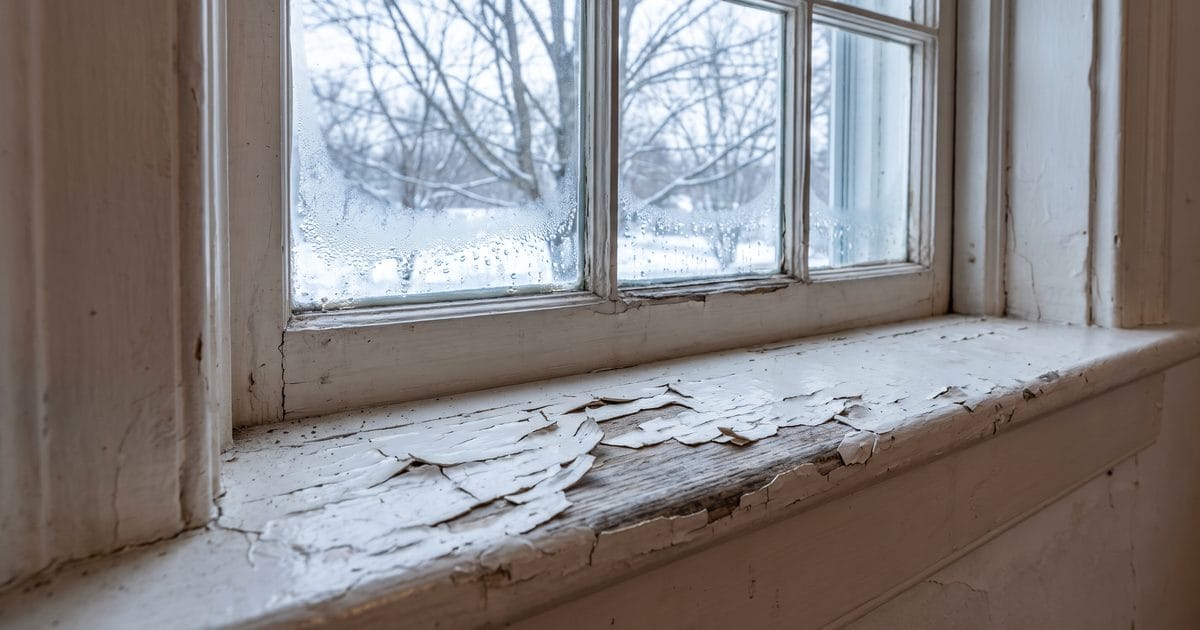
TL;DR: Window sill paint peeling every winter is almost always condensation. Warm, humid indoor air hits cold glass, water runs down onto the sill, soaks into the wood and pushes the paint off as it dries. Lower the indoor humidity first, then dry, scrape, sand, prime and repaint the sill with a hard enamel.
Want the sills fixed so they stay fixed? Call or text Dave at (774) 217-9567. We'll look at the windows, the humidity in the house and the paint that's on there now.
Once the heat comes on, we hear about window sill paint peeling from MetroWest homeowners every week. The walls look fine, but the paint on the inside sill is cracked, blistered or curling up in strips. Repaint it in spring and it looks great all summer. By February it's back. The cause is measurable, and once you deal with it, the repair holds.
The short version
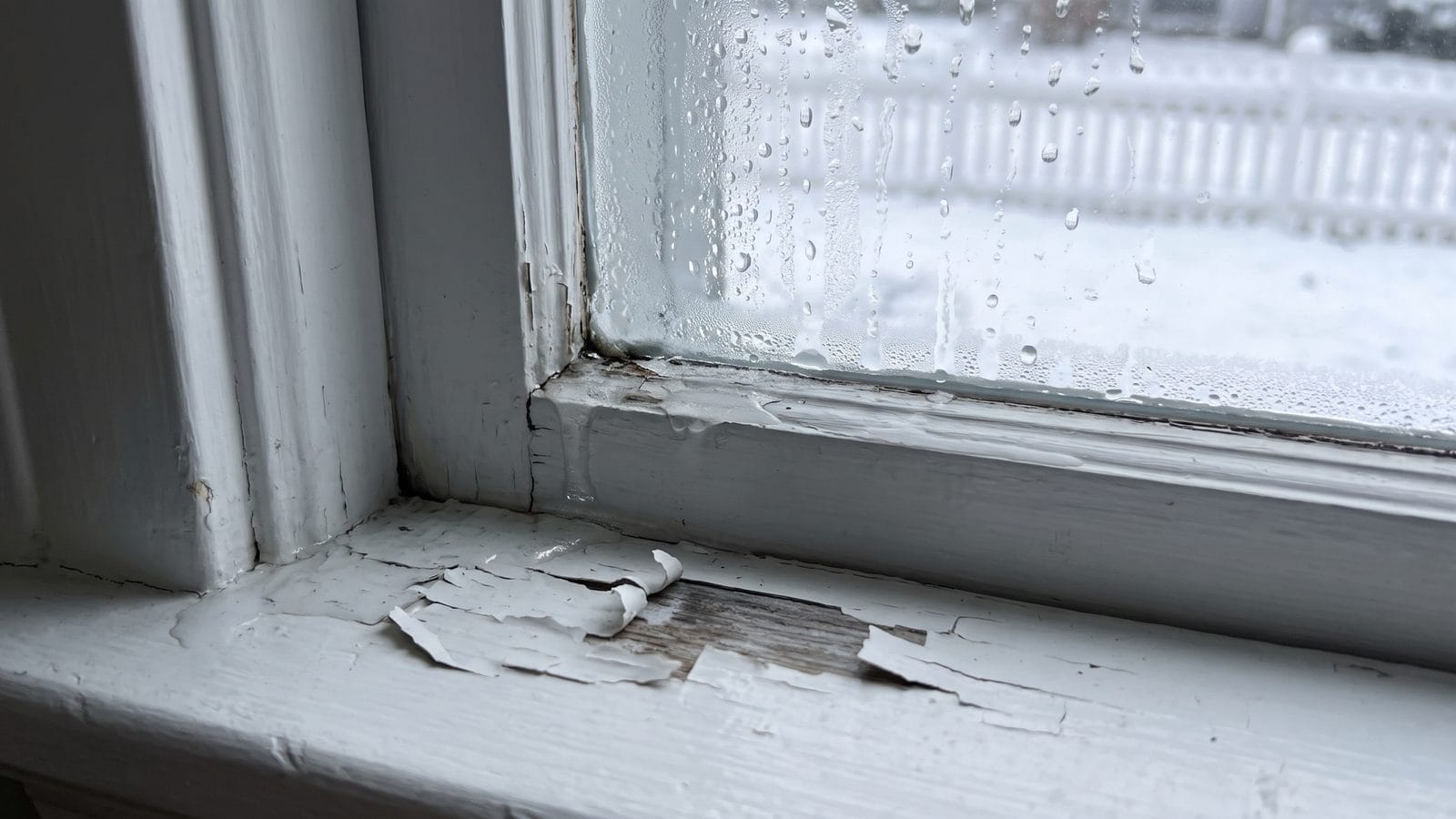
Window sill paint peeling in winter is a moisture problem that shows up as a paint problem. The glass is the coldest surface in the room, so water in the air condenses there first, drains to the bottom of the sash and sits on the sill. The wood drinks it in at every crack, and when it dries back out it lifts the paint from underneath. Here's our checklist for window sill paint peeling that keeps coming back.
- Measure the indoor humidity with a hygrometer and compare it to the outdoor temperature using the numbers below.
- Look at the glass on a cold morning. Water running down the pane means the humidity is too high for those windows.
- Bring the humidity down with exhaust fans, a vented dryer, a lower humidifier setting and a dehumidifier where needed.
- Warm the glass with storm windows, open blinds and air moving across the window.
- Let the sill dry out. Wet wood won't hold paint.
- Mind the lead. In a pre-1978 home, assume old sill paint may contain lead until it's tested.
- Scrape, sand and feather back to sound, well-bonded paint.
- Prime bare wood and caulk the joints where the sill meets the sash and the casings.
- Finish with a hard trim enamel and give it the full cure time.
Why is window sill paint peeling every winter?
Because the sill gets wet and dries out over and over, and paint can't hold onto wood that's doing that. Sherwin-Williams explains the mechanism in its guide to fixing peeling window sill paint: "Water standing on the sills eventually penetrates the paint film. When it later evaporates, the pressure from under the film causes peeling. This moisture may be condensation on the interior, or rain and snow on the exterior."
The same page names the second cause we see all the time: paint "also peels from window sills due to poorly sealed framing that was not properly caulked, or the caulk has cracked or peeled away, allowing water to undermine the coating." On an interior sill, those joints are where the sill meets the bottom rail of the sash, where it meets the side casings, and the end grain at each end.
Winter stacks everything up at once. The house is closed, the glass is cold, and wood trim shrinks as the indoor air dries, opening the joints that let water in. Our post on why gaps open between trim and walls every winter covers that seasonal movement.
How does the condensation cycle cause window sill paint peeling?
It runs on a daily schedule. The National Weather Service defines the dew point as "the temperature to which air must be cooled in order to reach saturation," and on a January night the inside of the glass is often colder than the dew point of the room. The EPA's moisture control page says it simply: "Excess moisture condenses on window glass because the glass is cold."
- Overnight, the glass cools and water beads up on the lower part of the pane, worst in the bottom corners.
- Early morning, the beads run together and drain onto the bottom rail of the sash and the sill.
- During the day, the water sits in the corner and soaks into any hairline crack, open joint or bare spot.
- By afternoon, the sun or the heat dries the surface, and moisture in the wood works out through the paint, lifting it as it goes.
Repeat that for sixty or ninety mornings and the paint lets go. That's why the damage shows up in late winter, worst at the corners and along the back edge of the sill against the sash.
What indoor humidity causes window sill paint peeling?
It depends on how cold it is outside and what kind of windows you have. There's no single safe number for the whole winter. The colder it gets, the lower the indoor humidity has to be to keep the glass dry.
The clearest data comes from the University of Minnesota. Its Cold Climate Housing Information Center published "Home Indoor Winter Relative Humidity: What Is Acceptable?" by William J. Angell, with a table of the indoor relative humidity at which condensation is expected, by window type and outdoor temperature, assuming 70° indoor air and a 15 mph wind. It makes a point every homeowner with peeling sills should know: "Window condensation is frequently cited as the key visible indicator of excessive indoor relative humidity."
Here are the numbers from that table for the temperatures a Massachusetts winter brings:
- Single glazing. Condensation expected at 43% indoor humidity when it's 40 °F outside, 32% at 30 °F, 24% at 20 °F, 18% at 10 °F and 12% at 0 °F.
- Window plus the usual storm window. 58% at 40 °F, 48% at 30 °F, 40% at 20 °F, 32% at 10 °F and 27% at 0 °F.
- Sealed double glazing. 63 to 68% at 40 °F, 54 to 58% at 30 °F, 47 to 50% at 20 °F, 40 to 43% at 10 °F and 32 to 37% at 0 °F.
The author warns: "THE VALUES IN THIS TABLE MUST BE INTERPRETED WITH CAUTION." Window tightness, wind and airflow at the glass all shift them. Treat each number as the point where trouble starts and aim lower.
The EPA's version is a little stricter. Its table, credited to Anne Field, Extension Specialist Emeritus, lists recommended maximum indoor humidity of 35% at 20 °F outside, 30% at 10 °F, 25% at 0 °F, 20% at -10 °F and 15% at -20 °F. The EPA also gives the rule of thumb we use on every winter visit: "Your humidistat is set too high if excessive moisture collects on windows and other cold surfaces."
What does that mean on a January night in MetroWest?
It means a house that feels comfortable can still be too humid for its windows. NOAA's 1991-2020 climate normals for Natick put the normal daily low at 22.9 °F in December, 17.5 °F in January and 17.6 °F in February. On a normal January night, the glass sits between the 20 °F and 10 °F columns of the Minnesota table.
Run the numbers. A window with old sashes and exterior storms starts to sweat at about 32 to 40% indoor humidity on that night. Sealed double-pane windows have more room, roughly 40 to 50%. A single pane with no storm, like an old porch or basement window, sweats at 18 to 24%, which almost any lived-in house reaches. On the coldest nights, when it drops toward 0 °F, every one of those numbers falls further.
That's why window sill paint peeling shows up on the same windows every year: the oldest glass, the north-facing windows, the ones behind heavy curtains, and the bathrooms and kitchens where humidity spikes every day.
How do you lower indoor humidity in winter?
Cut the moisture at its source, move it outside and keep the glass warmer. The EPA's advice is short: "Use exhaust fans in bathrooms and kitchens to remove moisture to the outside (not into the attic)," and "Vent your clothes dryer to the outside." Here's what we suggest before anyone picks up a scraper:
- Turn down the humidifier on the furnace as the outdoor temperature drops, using the numbers above.
- Run the bath fan through the shower and after it, and make sure it vents outdoors.
- Use the range hood when you cook, especially when boiling water.
- Skip the indoor drying racks in the coldest weeks, and check that the dryer vent is connected.
- Dry out the basement. A dehumidifier there can lower the humidity upstairs too.
- Open the blinds and curtains at night. The Minnesota report lists "curtains, blinds, and interior screens" as coverings that may increase condensation.
- Keep the register under the window clear so warm air moves across the glass.
- Wipe the sill dry on cold mornings until the humidity is under control.
Do storm windows help with window sill paint peeling?
Yes. The EPA says "Storm windows and caulking around windows keep the interior glass warmer and reduce condensation of moisture there," and "A storm window installed on the inside works better than one installed on the outside." The Minnesota table shows the difference: at 20 °F outside, single glazing sweats at 24% humidity, a window with the usual storm at 40%, and one with a tight storm at 58%.
One caution from Sherwin-Williams: "Do not seal or paint shut any vent holes in the window trim of storm windows." Those small holes let water drain out. If you see water between the panes of a sealed double-pane window, that's a failed seal, and the window itself needs repair.
Is it window sill paint peeling, mold or rot?
Check before you scrape, because each gets a different fix. Plain peeling leaves sound wood under the loose paint.
- Black or gray spots in the corners are often mildew feeding on the moisture. Sherwin-Williams' ProClassic data sheet says "Mildew must be removed before painting, or it will grow through any new coat of paint." Our guide to painting over mold and mildew covers cleaning it.
- Soft, dark or spongy wood that a screwdriver sinks into is rot, and paint won't fix it. Our post on repairing or replacing rotted trim walks through that decision.
Could the old paint on my window sills contain lead?
In a home built before 1978, it might, and sills are a place to be careful. Older sills and sashes often carry layers of original paint under the newer coats, and peeling and friction turn it into chips and dust right where kids and pets reach.
Benjamin Moore and Sherwin-Williams print nearly identical warnings on the data sheets for the sill enamels we use. The Benjamin Moore Advance 793 data sheet reads: "If you scrape, sand, or remove old paint, you may release lead dust. LEAD IS TOXIC. EXPOSURE TO LEAD DUST CAN CAUSE SERIOUS ILLNESS, SUCH AS BRAIN DAMAGE, ESPECIALLY IN CHILDREN." It adds: "Clean up carefully with a HEPA vacuum and a wet mop."
Have the sill paint tested before anyone dry-sands or heat-guns it. Our guide to lead paint in Massachusetts explains testing and where to find the state's own information. We use lead-safe methods on every pre-1978 home: containment, HEPA vacuums, wet scraping and proper disposal.
How do you fix window sill paint peeling for good?
Dry it, remove the loose paint, sand, prime the bare wood, seal the joints and finish with a hard enamel, in that order, after the humidity is under control. Skip a step and the sill peels again next winter.
Step 1: Let the sill dry out
Benjamin Moore's sheet says surfaces "must be clean, dry" and free of scaling paint and mildew. After weeks of condensation, a sill can stay damp under the paint for days. We check with a moisture meter. For a target, the Minnesota report cites the U.S. Forest Products Laboratory's recommended moisture content for interior woodwork: "an average of 8 percent MC (6 to 10 percent MC range)." Well above that, we wait.
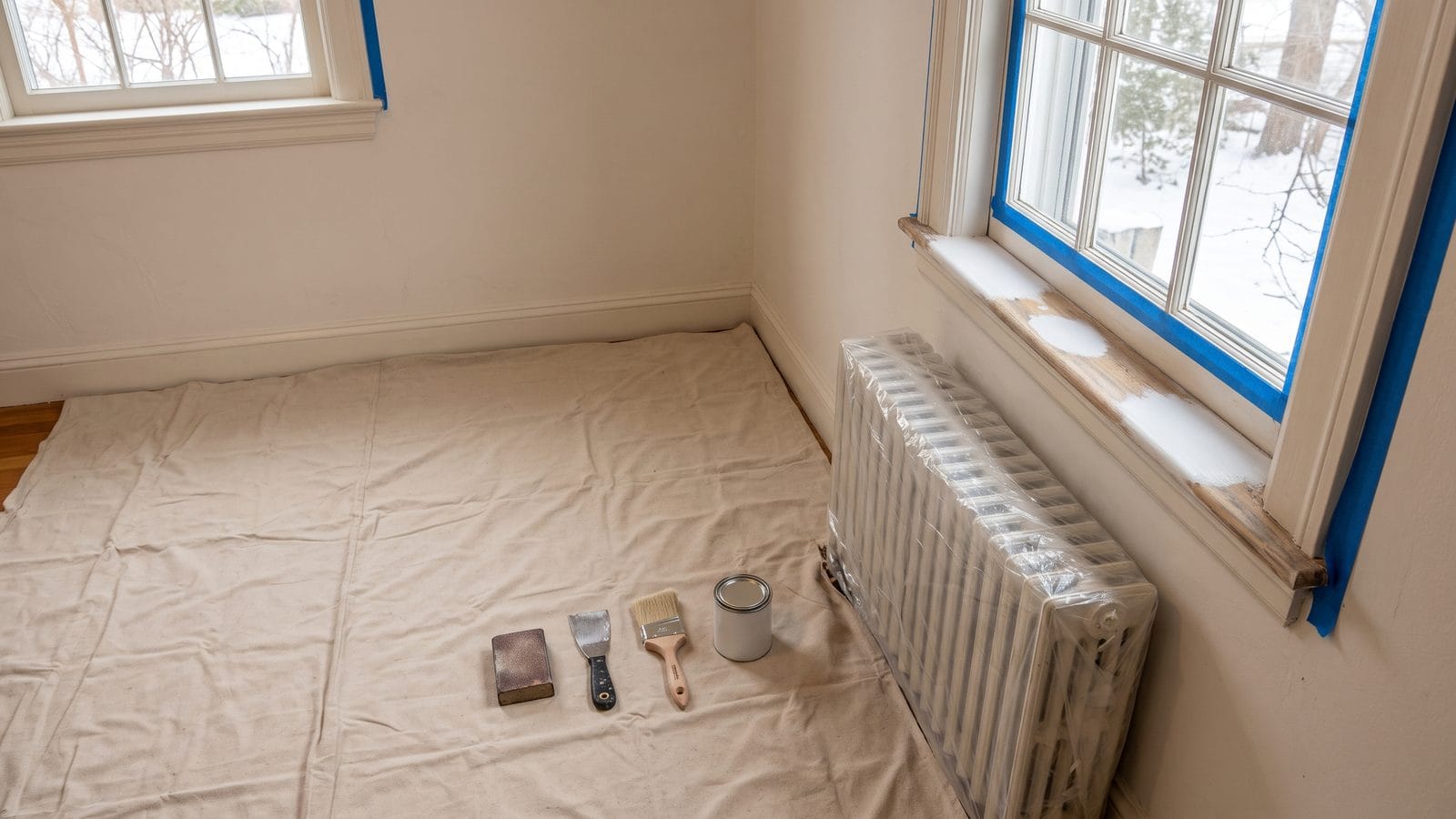
Step 2: Protect the room and scrape
We lay drop cloths flat under the window, move or cover furniture and cover the radiator or register below. Then we scrape everything that isn't firmly stuck. Sherwin-Williams says to "Test the coating in a six to 12 inch radius around any peeled areas to be sure the adhesion is adequate." On a pre-1978 sill, that scraping is done wet, with containment and a HEPA vacuum.
Step 3: Sand and feather the edges
The Advance sheet says to "Remove any peeling or scaling paint and sand these areas to feather edges smooth with adjacent surfaces. Glossy areas should be dulled." The ProClassic sheet is honest about the limits: "any surface preparation short of total removal of the old coating may compromise the service length of the system." On a sill with many failing layers, stripping to bare wood is often the better long-term job.
Step 4: Prime bare wood and seal the joints
Every bare spot and all the end grain gets primer. For interior sill repairs, Sherwin-Williams' sill guide names its Multi-Purpose Interior Oil-Based Primer, and Benjamin Moore's Advance sheet lists Fresh Start High-Hiding All Purpose Primer (046) for wood. Then we caulk the joints between the sill, the sash and the casings. The ProClassic sheet says gaps in interior trim "can be filled with the appropriate caulk after priming the surface." Don't caulk a sash shut on a window you want to open.
Step 5: Two coats of hard enamel
Sills take more abuse than any other trim, and wall paint is too soft for them, so we use a trim enamel in satin or semi-gloss.
- Benjamin Moore Advance Waterborne Interior Alkyd Semi-Gloss (793). The sheet describes "a tough, semi-gloss finish that stands up to repeated washing," lists it as "Ideal for interior doors, trim, cabinets," and gives 4 to 6 hours to touch and 16 hours to recoat at 77 °F and 50% humidity.
- Sherwin-Williams ProClassic Waterborne Interior Acrylic Semi-Gloss. The ProClassic product data sheet lists "Cabinets, Doors, Windows" among its uses, with 1 hour to touch and 4 hours to recoat at 77 °F and 50% humidity, and says "Apply at temperatures above 50°F."
Both sheets warn that cool, damp conditions slow drying. A sill next to cold glass in January runs cooler than the room, so we give it longer between coats than the label says.
Step 6: Give it time before the plants go back
Dry to the touch isn't cured. The Advance sheet says "Do not expose to heavy abrasion or return shelves/tabletops to service for at least 5 – 7 days to prevent damage to the finish," and that "it could take up to 30 days to reach optimum hardness and final sheen." Give it at least a week, and put a waterproof tray under anything that gets watered.
Should you fix window sill paint peeling yourself?
One or two sills in a newer home, with no lead and no rot, make a fair weekend project. Call a painter for an untested pre-1978 house, a dozen windows, soft wood, or sills that keep failing after repeated repaints. If the sashes are failing too, our guide to painting wood window sashes in older Massachusetts homes covers that work.
Window sills in MetroWest homes
Across Holliston, Sherborn, Medway, Millis and Medfield, we see the most trouble in older homes with original wood sashes, exterior storms, deep sills and many layers of paint. Newer homes in Hopkinton, Franklin and Bellingham usually have sealed double-pane windows and drier sills, but their bathrooms and kitchens still sweat. Either way, the first tool we bring to a sill job is a hygrometer.
Frequently asked questions
What causes window sill paint peeling in winter?
Condensation. Warm, humid indoor air meets cold glass, water drains onto the sill and soaks into the wood through cracks and open joints. When it dries out, it pushes the paint off from underneath. Failed caulk between the sill, sash and casing makes it worse.
Can you paint over window sill paint peeling?
No. New paint over loose paint fails along with it. Scrape off everything that isn't firmly bonded, sand the edges smooth, prime bare wood and then repaint. Benjamin Moore and Sherwin-Williams data sheets both call for removing peeling paint and dulling glossy areas first.
What humidity should my house be in winter to stop window condensation?
It depends on the outdoor temperature and your windows. The EPA lists a recommended maximum of 35% at 20 °F outside, 30% at 10 °F and 25% at 0 °F. If water collects on the glass, the EPA says the humidistat is set too high.
What is the best paint to stop window sill paint peeling?
A hard trim enamel in satin or semi-gloss over a proper primer, applied after the humidity is fixed. We use Benjamin Moore Advance and Sherwin-Williams ProClassic, both made for trim and windows. Flat wall paint is too soft for a surface that gets wet.
Is window sill paint peeling a sign of lead paint?
Not by itself, but in a pre-1978 home, old sill paint may contain lead, and peeling makes chips and dust. Have it tested before sanding or using a heat gun. Paint makers' data sheets warn that scraping or sanding old paint may release lead dust.
How long before I can put plants back on a painted window sill?
Give it at least five to seven days. Benjamin Moore's Advance data sheet says not to return shelves and tabletops to service for at least 5 to 7 days, and full hardness can take up to 30 days. Use a waterproof tray under plants.
Do dehumidifiers help with window sill paint peeling?
Yes, when the house is too humid for its windows. Sherwin-Williams says storm windows and dehumidifiers may help prevent peeling from coming back. Exhaust fans that vent outdoors and a lower humidifier setting help too.
Why is window sill paint peeling on only some of my windows?
Those windows are the coldest or the most humid. Single-pane glass, north-facing windows, windows behind heavy curtains and windows in bathrooms and kitchens sweat first. The University of Minnesota report notes curtains and blinds may increase condensation.
The bottom line
Window sill paint peeling every winter means the glass is getting wet. Bring the humidity down to what your windows can handle at that outdoor temperature, warm the glass, then repair the sill properly: dry wood, loose paint gone, edges feathered, bare wood primed, joints caulked and two coats of enamel given time to cure. Do it in that order and the sill stays smooth through February.
Talk to Paint Pro
Paint Pro New England is based in Holliston and has painted homes across MetroWest for more than fifteen years. We are fully licensed and insured, including workers' compensation, use premium Benjamin Moore and Sherwin-Williams paints, back our work with a 2-year warranty on all work, and have more than 60 five-star reviews on Houzz. See our interior painting services for walls, ceilings, trim, windows and doors. Call or text Dave at (774) 217-9567. You can also request a free, no-obligation estimate online.
Dave Griffiths
Dave Griffiths is the owner of Paint Pro New England, a professional painting company serving MetroWest Boston since 2011. With 15+ years of interior and exterior painting experience across the region, he leads every project with thorough prep, premium Benjamin Moore and Sherwin-Williams paints, and a 2-year warranty.

