



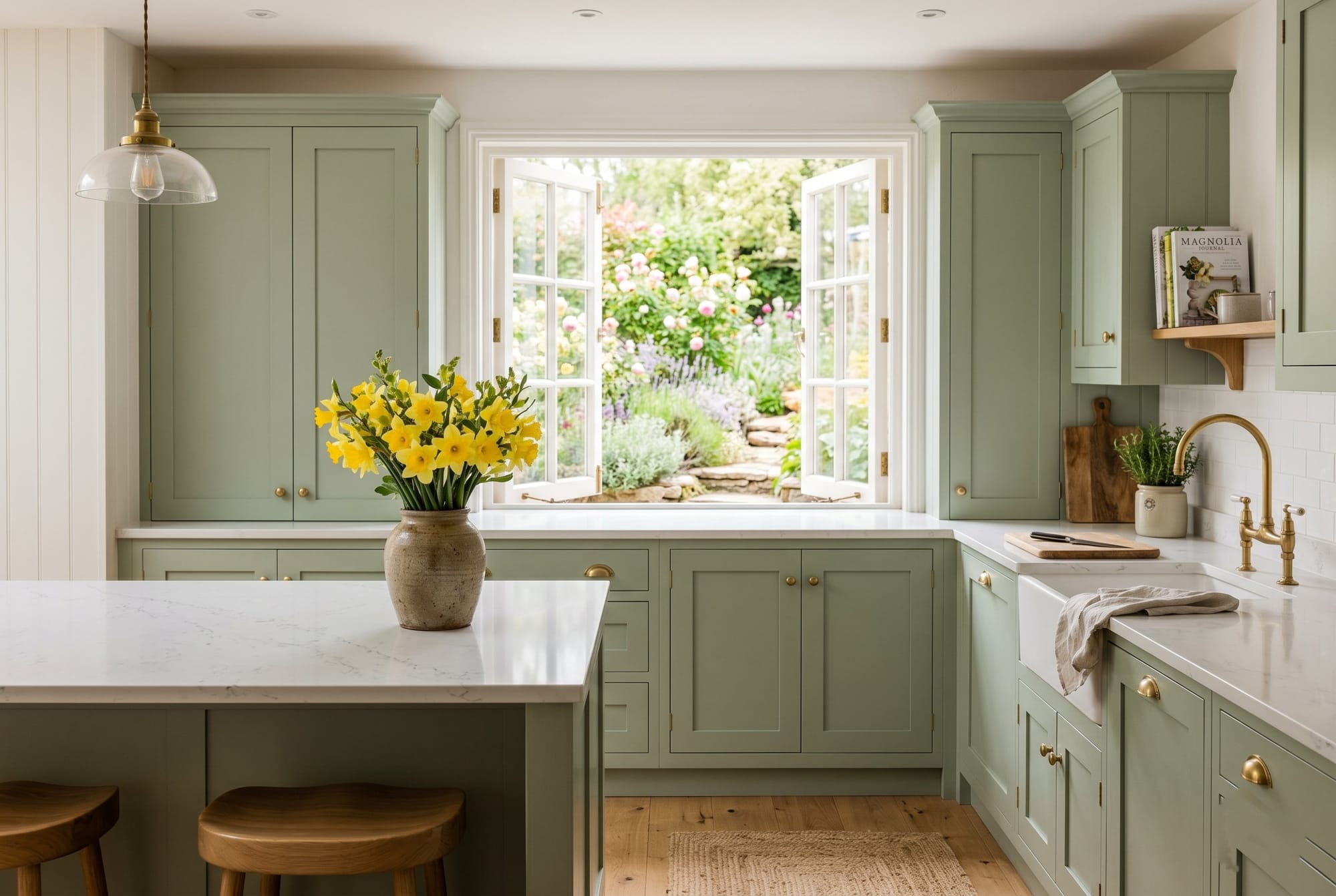
TL;DR: Sage green is the #1 requested kitchen cabinet color in MetroWest Boston — earthy, calming, and easy to pair with brass, wood, and white. Professional refinishing takes about a week and costs far less than replacement. The shades that age best lean soft and muted, not bright or hunter green.
You walk into a kitchen with sage green cabinets and brass hardware, and something just clicks. The room feels warmer, calmer, more intentional. That reaction is why sage green has become the single most requested cabinet color we see in MetroWest Boston kitchens right now.
According to the National Kitchen & Bath Association's 2026 Design Trends Report, over 63% of homeowners now prioritize health and tranquility in their kitchen layouts. Sage green hits that mark — it's earthy without being dark, colorful without being loud, and it pairs with almost everything already in a New England home.
Why Sage Green Took Over
For years, the default was white. Every kitchen renovation, every cabinet refinishing project — white, white, white. And white still works. But homeowners are ready for something with a little more personality, and sage green is the answer that doesn't require a leap of faith.
In a 2026 industry survey, 76% of kitchen professionals named green as the top cabinet color of the year. Not emerald. Not hunter. The soft, muted sage and olive tones that feel like they've always belonged in the room. It's the kind of color that looks intentional without looking trendy — which matters when you're investing in a finish you'll live with for the next decade.
Here in MetroWest, we're seeing sage green work especially well in colonial and Cape Cod kitchens. The color complements the warm wood tones, wide-plank floors, and natural light that these homes already have. Add brass cup pulls and a marble or quartz countertop, and it looks like a spread from Architectural Digest — without the renovation price tag.
What Sage Green Cabinet Refinishing Actually Involves
Refinishing cabinets isn't a weekend DIY project — at least not if you want results that hold up to daily kitchen use. Here's what we do on a typical sage green cabinet job:
- Remove all doors, drawers, and hardware. Everything gets labeled so it goes back exactly where it came from.
- Clean and degrease. Kitchen cabinets collect years of cooking residue. If you paint over grease, the finish peels within months.
- Sand to create adhesion. We're not stripping to bare wood — just scuffing the surface so the primer grips.
- Prime with a bonding primer. This is the step most DIY jobs skip, and it's the step that makes or breaks the finish.
- Apply two coats of cabinet-grade paint. We use Benjamin Moore Advance or Sherwin-Williams Emerald Urethane — both are self-leveling, hard-curing paints designed specifically for cabinetry.
- Reinstall with new hardware if the homeowner wants an upgrade.
The whole process takes 4-7 days depending on kitchen size. We work in sections so you're never completely without a kitchen.
The Best Sage Green Paint Colors for Cabinets
Not all sage greens are created equal. The wrong shade can look washed out under kitchen lighting or clash with your countertops. After painting hundreds of cabinet sets, here are the Benjamin Moore and Sherwin-Williams colors we recommend most:
Benjamin Moore
- Saybrook Sage HC-114 — The classic. Warm gray-green undertones that read as a true sage in almost any light. This is our most-painted sage green by a wide margin.
- October Mist 1495 — Slightly warmer than Saybrook, with more gray. Almost reads as a neutral. Great if you want sage without making a strong color statement.
- Cushing Green HC-125 — Deeper olive undertones for homeowners who want more drama. Works beautifully on lower cabinets with a warm white upper.
Sherwin-Williams
- Evergreen Fog SW 9130 — Their 2022 Color of the Year, and still going strong. A sophisticated gray-green that's easy to live with.
- Clary Sage SW 6178 — Warmer and more golden than most sages. Pairs well with oak floors and butcher block counters.
We always recommend testing 2-3 colors on a cabinet door before committing. Paint a sample on the actual cabinet material and live with it for a few days — check it in morning light, afternoon light, and under your kitchen fixtures at night. Colors shift dramatically between natural and artificial light, especially greens. If sage is already on every listing photo on your street, the next set we are sampling is in cabinet colors beyond sage for MetroWest kitchens in 2026.
Cost: Refinishing vs. Replacing
This is where cabinet refinishing really makes sense. A professional refinishing job on a medium-sized MetroWest kitchen runs $3,000 to $6,000. Full cabinet replacement? That's $15,000 to $30,000 — and that's before countertops, backsplash, or any plumbing changes.
The ROI tells the story. According to the 2025 Zonda Cost vs. Value Report, a minor kitchen remodel — which includes cabinet refinishing, new hardware, and cosmetic updates — returns 112.9% of the project cost at resale. That's the highest ROI of any interior home improvement project in the country.
Compare that to a major kitchen remodel, which returns about 50% of costs. Refinishing your cabinets in sage green with new brass hardware gives you a magazine-worthy kitchen for a fraction of what most people assume it costs. For a deeper breakdown of the numbers, we put together a full cost comparison of refinishing vs. replacement.
What to Pair with Sage Green Cabinets
The color is only half the equation. What you put next to it matters just as much.
- Hardware: Brass, brushed gold, or unlacquered brass are the standout choices. The warm metal against the cool green creates contrast without competing. Matte black works too if you want something more modern.
- Countertops: White marble or marble-look quartz is the classic pairing. Warm whites (not stark, blue-tinted whites) complement sage best. Butcher block adds warmth for a more farmhouse feel.
- Backsplash: Cream or warm white subway tile keeps things clean. Natural stone with warm undertones adds texture. Avoid high-contrast patterns that fight with the cabinet color for attention.
- Walls: A warm white like Benjamin Moore White Dove or Chantilly Lace lets the cabinets be the focal point.
- Flooring: Natural oak or wide-plank hardwood in warm tones. Most MetroWest homes already have this — one less thing to change.
If you're curious about how different paint finishes affect the final look, we've covered that in detail. For cabinets, we typically recommend semi-gloss or satin — durable enough for daily wiping, smooth enough to look refined.
Is Sage Green a Trend That Will Date Your Kitchen?
Fair question. Nobody wants to invest in a color that looks tired in three years.
Here's our honest take: sage green isn't a flash-in-the-pan trend. Green cabinetry has been gaining momentum since 2020 and shows no signs of slowing down. The 2026 shift is actually toward deeper greens — olive, forest, moss — which means sage is settling into "established classic" territory rather than peaking.
Compare that to the gray cabinets that dominated 2015-2019. Those dated faster because they leaned cool, and design moved warm. Sage green already sits on the warm side of the spectrum, which gives it more staying power.
That said, if you're planning to sell within two years, a warm white is still the safest bet for maximum buyer appeal. If you're staying? Paint what you love. You'll be looking at those cabinets every morning over coffee — pick the color that makes you happy, not the one a resale calculator told you to pick.
Frequently Asked Questions
How long does cabinet refinishing take?
Professional cabinet refinishing takes 4 to 7 days for a standard kitchen, depending on the number of cabinets and the condition of the existing finish. We work in sections to minimize disruption to your daily routine.
Can you paint over previously painted cabinets?
Yes, previously painted cabinets can be refinished as long as the existing paint is in reasonable condition. We sand, clean, and prime the surface to ensure the new coat bonds properly. If the old paint is heavily chipped or peeling, additional prep work may be needed.
What paint finish is best for kitchen cabinets?
Semi-gloss and satin finishes are the best choices for kitchen cabinets because they resist moisture, clean easily, and provide a smooth, professional look. We use Benjamin Moore Advance or Sherwin-Williams Emerald Urethane, both formulated specifically for cabinetry.
Does sage green work in a small kitchen?
Sage green works well in small kitchens because it's a muted, mid-tone color that doesn't visually shrink the space the way darker colors can. Pairing sage green cabinets with light countertops and warm white walls keeps the room feeling open and airy.
How much does it cost to paint kitchen cabinets in Massachusetts?
Professional cabinet painting in Massachusetts costs $3,000 to $6,000 for a medium-sized kitchen, including prep, primer, two coats of cabinet-grade paint, and reinstallation. This is roughly 80% less than full cabinet replacement and delivers the highest ROI of any kitchen update.
If you've been thinking about giving your kitchen a new look this summer, sage green is worth considering. We're happy to talk through colors, show you samples on your actual cabinets, and give you an honest number on what it would cost. Give us a call at (774) 217-9567.
Dave Griffiths
Dave Griffiths is the owner of Paint Pro New England, a professional painting company serving MetroWest Boston since 2011. With 15+ years of interior and exterior painting experience across the region, he leads every project with thorough prep, premium Benjamin Moore and Sherwin-Williams paints, and a 2-year warranty.

