



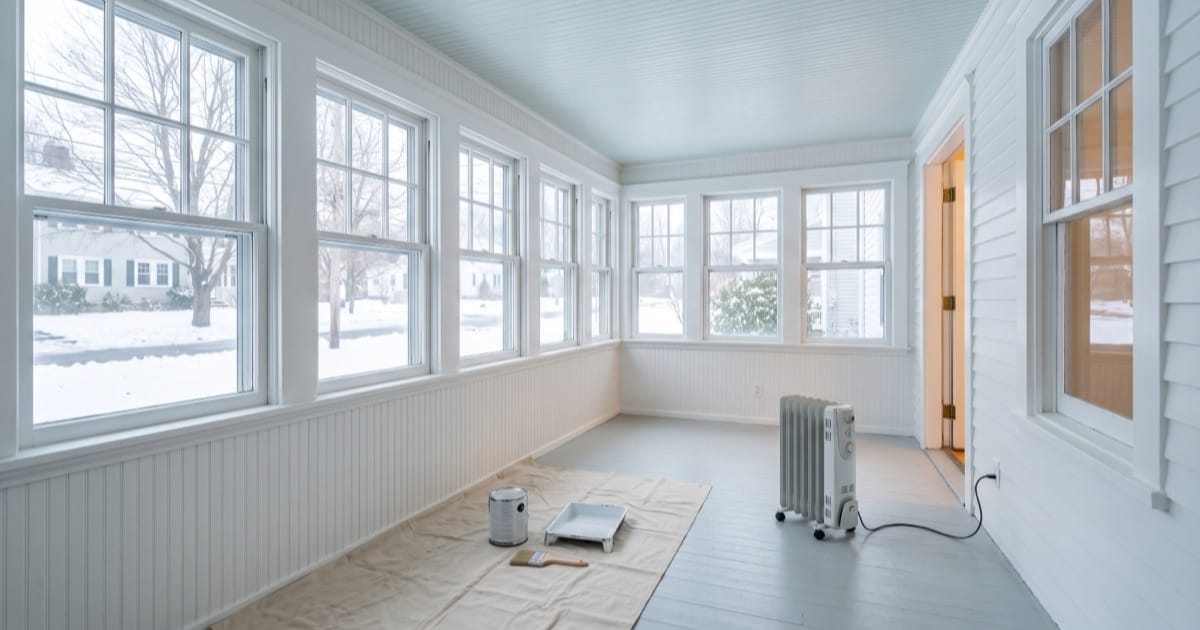
TL;DR: Painting an unheated room in winter works only if you heat it first. Most interior paints, including Benjamin Moore Regal Select and Sherwin-Williams Emerald Interior, need temperatures above 50 °F, and the wall counts as much as the air. Warm the room a day ahead, keep it warm until the paint dries, and check cold walls for condensation.
Want the porch or mudroom done this winter? Call or text Dave at (774) 217-9567. We'll look at the room, how it's heated and what it's made of, and tell you whether it makes sense now or in spring.
Every winter we get the same question from MetroWest homeowners: can the enclosed porch, the mudroom, the three-season sunroom or the attached garage be painted in December or January? Often, yes. The paint doesn't care what month it is. It cares about the air temperature, the wall temperature, the moisture in the room and how long those conditions hold. This guide to painting an unheated room covers all four, with the numbers printed on the data sheets.
The short version
Painting an unheated room comes down to one rule: the room has to reach the paint's minimum temperature, at the surface as well as in the air, and stay there until the paint has dried. For most interior paint that minimum is 50 °F. A few exterior lines go down to 35 °F, but they're made for siding and trim, not for mudroom walls. Here's our checklist before painting an unheated room.
- Read the data sheet. Find the minimum air and surface temperature for the exact product, not the brand.
- Heat the room a day ahead. Walls, ceilings and floors take far longer to warm than the air does.
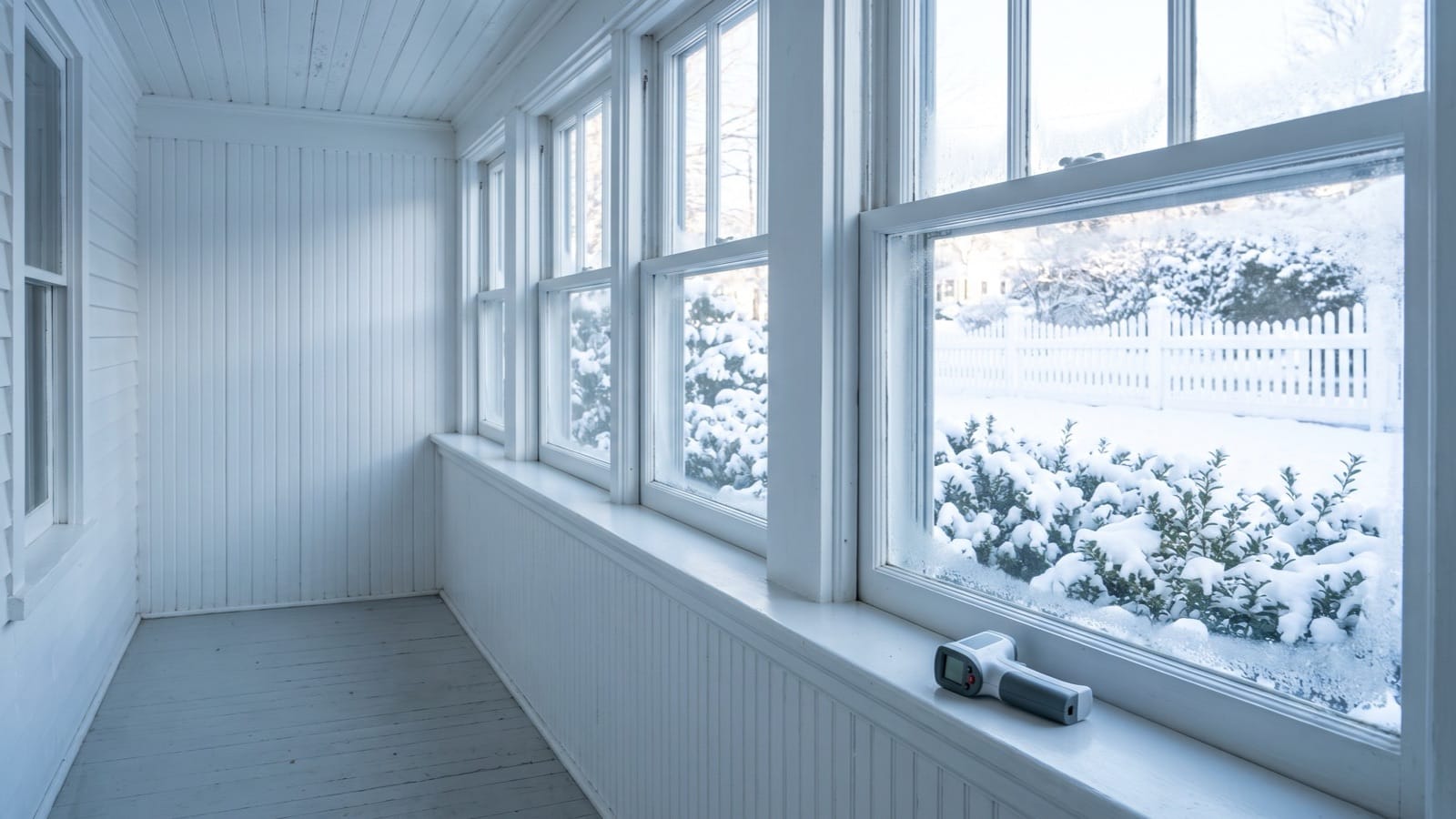
- Measure the surface, not just the air. An infrared thermometer on the coldest wall tells you more than the thermostat.
- Check the dew point. Keep the surface at least 5 °F above it so no moisture forms on the wall.
- Warm the paint. Cans stored in the garage need to come inside overnight.
- Use safe heat. Electric heaters with clearance, never a portable propane heater indoors.
- Hold the heat through drying. Keep the room warm overnight, not just while the crew is there.
- Allow longer recoat times. Cool, damp air slows every step on the label.
Can you paint an unheated porch, mudroom or garage in winter?
Yes, as long as you can bring the room up to the paint's minimum temperature and hold it there through drying. As latex paint dries, its acrylic resin has to fuse into a continuous film. Below the temperature the paint is designed for, it doesn't fuse properly, and you get a coat that looks fine on day one and lets go later.
Benjamin Moore's temperature guide lists what you may see when it's too cold: "Extended dry times," "Peeling," and "Inability for latex paint to form a film." That last one is the problem you can't fix with another coat. A film that never formed has to come off before the room can be painted again.
So the real question for painting an unheated room is whether it can be made warm enough, for long enough, without making it damp or unsafe. An uninsulated porch with single-pane windows on three sides fights you the whole way.
How cold is too cold for painting an unheated room?
For most interior paints, anything under 50 °F is too cold, and that limit applies to the surface as well as the air. Here's what the current technical data sheets for paints we use say, word for word where it matters.
- Benjamin Moore Regal Select Eggshell (N549), interior. The N549 technical data sheet lists a minimum surface temperature during application of 50 °F and says: "Do not paint when air or surface temperature is below 50 °F (10 °C)." It also lists a minimum storage temperature of 40 °F.
- Sherwin-Williams Emerald Interior Latex Satin (K37), interior. The Emerald Interior product data sheet says: "Apply at temperatures above 50°F."
- Benjamin Moore Aura Exterior Satin (N631), exterior. The N631 data sheet lists "Low temperature application down to 35 °F" and says: "Do not apply when air or surface temperatures are below 35 °F (1.7 °C)."
- Sherwin-Williams SuperPaint Exterior Latex Low Lustre (A78), exterior. The A78 product data sheet says to check that "the air, surface, and material temperature are above 35°F (1.7°C) and at least 5° above the dew point," and not to apply "when air or surface temperatures may drop below 35°F (1.7°C) within 48 hours."
Two things jump out. The 35 °F products are exterior paints, built for clapboards, trim and railings. Walls inside an enclosed porch, mudroom or sunroom usually get interior paint, which stops at 50 °F. And every sheet names the surface: when painting an unheated room where the air reads 52 °F and the outside wall reads 44 °F, you're below the line.
Sheets get revised, so pull the current data sheet for the exact product before painting an unheated room, and if two numbers disagree, use the higher one.
Why does the wall temperature matter more than the thermostat?
Because paint dries on the wall, and in a cold room the wall is almost always colder than the air. Sherwin-Williams says so on its low-temperature data sheets: "When the air temperature is at 35°F (1.7°C), substrates may be colder." The same is true at 50 °F.
In an unheated room, the cold surfaces are predictable:
- Outside walls, especially uninsulated ones on an old porch, stay close to the outdoor temperature long after the air inside has warmed up.
- Glass in a sunroom or a porch with a wall of windows pulls heat out of the room and chills the trim and sashes around it.
- Concrete, like a garage slab, a foundation wall or a mudroom floor, holds the cold for a long time.
Benjamin Moore's advice is simple: "If you have any questions about surface temperature, measure it with an infrared thermometer." We check the coldest surface, usually an outside wall near the floor or a window frame, before each coat.
What does the dew point have to do with it?
The National Weather Service defines the dew point as "the temperature to which air must be cooled in order to reach saturation." When a surface is at or below the dew point of the air touching it, moisture condenses on it. It can happen on a cold wall where you can't see it.
Benjamin Moore's guide calls the margin the industry standard: paint "on a surface whose temperature is more than 5 ºF above the dew point." Sherwin-Williams prints the same 5° margin on its SuperPaint sheet. This is where painting an unheated room gets tricky. Heat a cold room quickly and warm air can carry more moisture than the cold walls can tolerate, and a fuel-burning heater adds water vapor to the room as it burns. A temperature and humidity meter shows the dew point; if the wall is within 5 °F of it, wait or add heat.
How do you heat an unheated room safely before painting?
Use electric heat, start early and close the room off. The Consumer Product Safety Commission is blunt about the alternative: "Do not use portable propane space heaters indoors or in any confined space," from its winter heating safety release. A propane or kerosene heater in a closed porch or garage also puts carbon monoxide and moisture into the air you're trying to dry paint in.
Here's how we set up a cold room:
- Start the day before. We bring the heat up at least 24 hours ahead so the walls, ceiling and trim catch up with the air.
- Close the room off. Shut the door to the outside, hang plastic over a wide opening and block the gap under an exterior door.
- Use the house heat when you can. An open door to a heated room and a fan on low can beat a space heater.
- Give the heater room. The CPSC says to "Keep the heater at least three feet from bedding, drapes, furniture, and other flammable materials." On a job, that includes drop cloths, plastic and rags.
- Don't leave it alone. The same CPSC release says "NEVER leave a space heater on when you go to sleep" and to "Turn the heater off if you leave the area." For heat that runs overnight, a room's own baseboard or the house system is the safer choice.
- Ventilate a little. Paint needs moving air to dry, as long as the surface stays warm.
If painting an unheated room would mean babysitting a heater all night to hold 50 °F, we schedule it for a warmer stretch instead.
How long does paint take to dry in a cold room?
Longer than the label's headline number, sometimes a lot longer. Data sheet dry times are measured in a warm room. The Regal Select sheet lists 1 hour to touch and 1 to 2 hours to recoat at 77 °F and 50% relative humidity, then adds: "High humidity and cool temperatures will result in longer dry, recoat and service times." The Emerald Interior sheet lists 1 hour to touch and 4 hours to recoat at 77 °F and 50% humidity, and says those times are "temperature, humidity, and film thickness dependent."
The clearest example of how much cold matters comes from the SuperPaint exterior sheet, because it prints two columns. At 45 °F and above, the recoat time is 4 hours. At 35 to 45 °F, it's 24 to 48 hours. Same paint, same humidity, six to twelve times as long between coats.
A room at 50 °F won't be that slow, but it won't behave like a 70-degree bedroom either. When painting an unheated room we plan fewer coats per day, test the first coat in a hidden spot before recoating, and keep the heat on overnight after the last coat. Dry to the touch isn't cured: Regal Select's sheet says painted surfaces "can be washed after two weeks."
If you're curious how paint dries in a normal heated room in winter, our guide to winter interior painting and the off-season covers it.
What's different about each kind of unheated room?
Each has its own cold spot and its own trap. Painting an unheated room in a New England house usually means one of these four.
The enclosed porch
Many MetroWest enclosed porches were open porches once, closed in with windows later and never insulated, with beadboard or old clapboard walls. Glass on three sides means the surface temperature near the windows lags far behind the air, and they often carry the oldest paint in the house. We use lead-safe methods on every pre-1978 home: containment, HEPA vacuums, wet scraping and proper disposal. For ideas on the ceiling itself, see our post on painting porch ceilings and beadboard.
The mudroom
A mudroom is usually small and attached to the heated house, which makes it the easiest of the four. The traps are moisture and wear. Wet boots bring water in all winter, so the dew point check matters most here. Pick a washable finish and give it the full cure time.
The unheated sunroom
An unheated sunroom can be warm at noon and well below freezing by evening, so paint applied in the afternoon sun can sit on glass-cold trim overnight. If it can be heated around the clock for a few days, it can be painted. If not, it's a spring job.
The garage
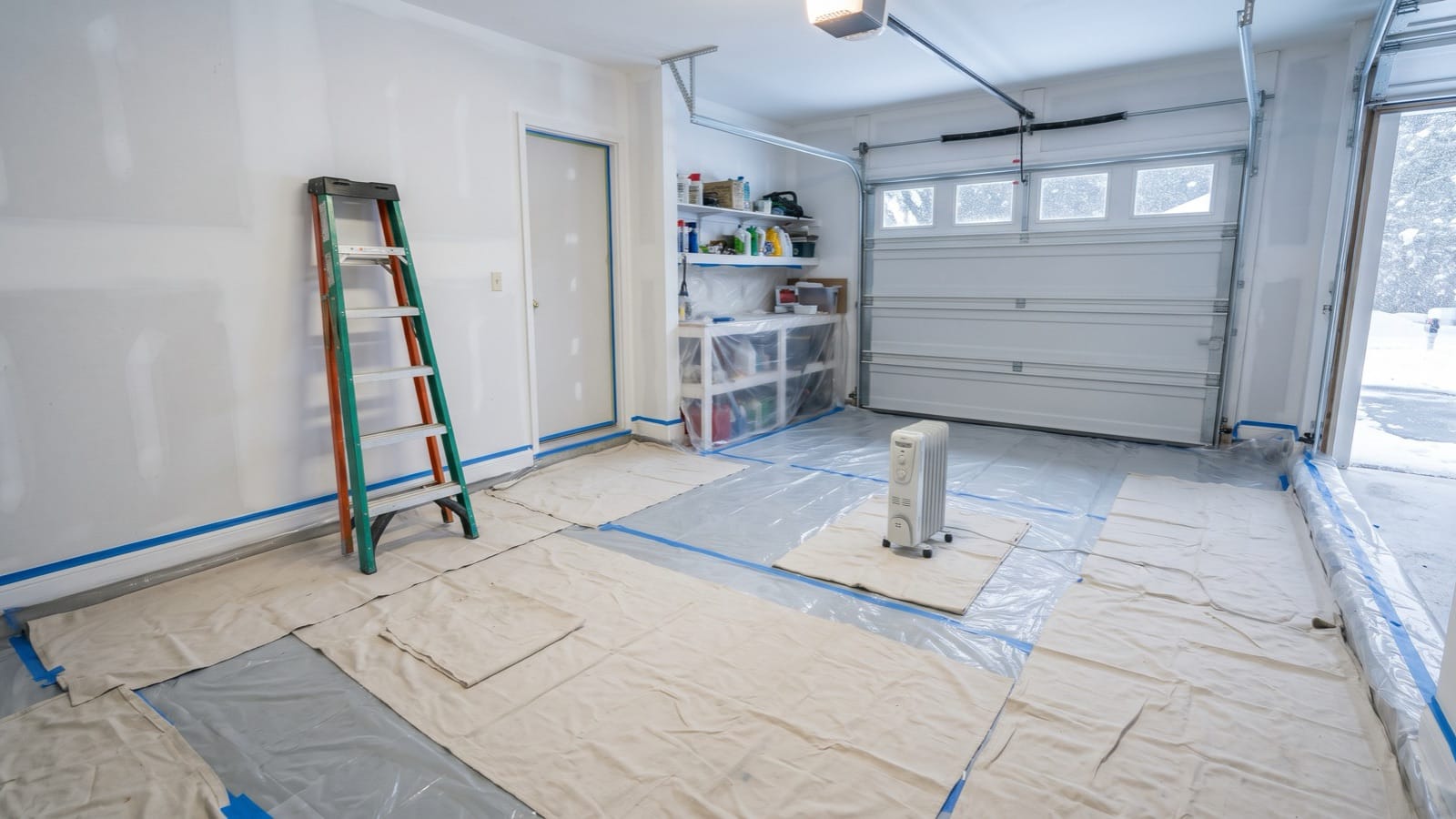
Trying to paint in a cold garage means facing the biggest surfaces and the hardest heat: a concrete slab, often a block or poured foundation wall, and an overhead door that leaks air. Attached garages that share a wall with the house warm up better than detached ones. Floors are a separate project (see garage floor epoxy), and for the door, see our guide to painting garage doors in New England. If the walls are concrete or block that stays damp, read whether to paint a basement wall or fix the moisture first.
One more garage note. The paint itself needs to be warm. If your cans spent the winter on a garage shelf, Benjamin Moore says to "Bring it inside overnight so the paint can warm up to a temperature within its specified acceptable range." If a can froze solid, our post on whether frozen paint from the garage is still usable explains how to tell.
When should you wait for spring instead?
Wait when the room can't be held at the paint's minimum, at the surface, safely, around the clock. In a Massachusetts winter, the weather is working against you most of the time. NOAA's 1991-2020 climate normals for Natick put the normal daily high at 40.7 °F in December, 35.2 °F in January, 38.2 °F in February and 46.1 °F in March. The normal January low is 17.5 °F. An unheated room in MetroWest is below every paint minimum listed above for most of the winter, day and night.
The same NOAA station's annual normals count 143 nights a year with a low of 32 °F or colder, and 31.1 days a year when the high never gets above freezing, 28 of them in December through February.
Here's how we decide:
- Go ahead if the room is insulated or attached to heated space, it can be heated safely for a day before and a day or two after, and the walls read above the paint's minimum with a 5 °F margin over the dew point.
- Wait if the room is uninsulated with lots of glass, the only heat would be a fuel-burning heater, or the surfaces are damp masonry.
- Split it when part of the job is outside. Mudroom walls now, porch floor and steps in spring.
Caulk is a common part of these jobs, and it has its own cold limits. Our post on whether you can caulk outside in cold weather has the numbers for the caulks we use.
Painting an unheated room in MetroWest
We work across Holliston, Hopkinton, Ashland, Sherborn, Medway, Millis, Framingham, Natick and Milford and the rest of MetroWest, where enclosed porches, mudrooms built onto farmhouses and attached garages are common. Older homes often have porches closed in decades ago with little insulation, while newer houses tend to have insulated mudrooms and attached garages that warm up easily. Either way, the visit starts with a thermometer, not a color card.
Frequently asked questions
Is painting an unheated room in winter a bad idea?
Not if you heat it first. Painting an unheated room works when the air and every surface reach the paint's minimum, 50 °F for most interior paints, and stay there until the paint dries. It's a bad idea when the room can't be held warm safely overnight.
How cold is too cold to paint inside?
For most interior latex paint, below 50 °F. Benjamin Moore's Regal Select data sheet says "Do not paint when air or surface temperature is below 50 °F (10 °C)," and Sherwin-Williams' Emerald Interior sheet says "Apply at temperatures above 50°F." Check the current sheet for your product.
Can I use a space heater when painting an unheated room?
An electric heater, yes, kept at least three feet from drop cloths, plastic and open cans and never left on unattended. The Consumer Product Safety Commission says not to use portable propane space heaters indoors or in any confined space.
How long should a room be heated before and after painting?
We heat a cold room at least 24 hours before we start so the walls catch up with the air, and keep it warm through drying. Sherwin-Williams' low-temperature exterior sheets warn against painting when temperatures may drop below the minimum within 48 hours.
What happens if you paint in a room that is too cold?
Benjamin Moore lists extended dry times, peeling and the inability of latex paint to form a film. A film that never formed properly can look fine at first and fail later, and it has to come off before the room is repainted.
Does paint dry slower in a cold room?
Yes. Sherwin-Williams' SuperPaint Exterior sheet lists a 4-hour recoat at 45 °F and above, but 24 to 48 hours at 35 to 45 °F. Benjamin Moore's Regal Select sheet says cool temperatures and high humidity lengthen dry, recoat and service times.
Can you paint a garage in the winter in Massachusetts?
Yes, if you can heat it safely and hold the walls above the paint's minimum through drying. Attached garages are easier than detached ones. NOAA's normal January high in Natick is 35.2 °F, so an unheated garage is too cold without heat.
What is the minimum surface temperature for painting an unheated room?
Whatever the data sheet lists, and for most interior paint it's 50 °F. The surface also needs to be at least 5 °F above the dew point, the margin Benjamin Moore calls the industry standard, so moisture doesn't condense on the wall.
The bottom line
Painting an unheated room in winter is a temperature job before it's a painting job. Read the current data sheet, heat the room a day ahead with safe electric or house heat, measure the coldest wall, keep it 5 °F above the dew point and hold the heat until the paint is dry. A heated mudroom or attached garage usually passes. An uninsulated porch lined with windows usually waits for spring.
Talk to Paint Pro
Paint Pro New England is based in Holliston and has painted homes across MetroWest for more than fifteen years. We are fully licensed and insured, including workers' compensation, use premium Benjamin Moore and Sherwin-Williams paints, back our work with a 2-year warranty on all work, and have more than 60 five-star reviews on Houzz. See our interior painting services for walls, ceilings, trim and doors. Call or text Dave at (774) 217-9567. You can also request a free, no-obligation estimate online.
Dave Griffiths
Dave Griffiths is the owner of Paint Pro New England, a professional painting company serving MetroWest Boston since 2011. With 15+ years of interior and exterior painting experience across the region, he leads every project with thorough prep, premium Benjamin Moore and Sherwin-Williams paints, and a 2-year warranty.

