



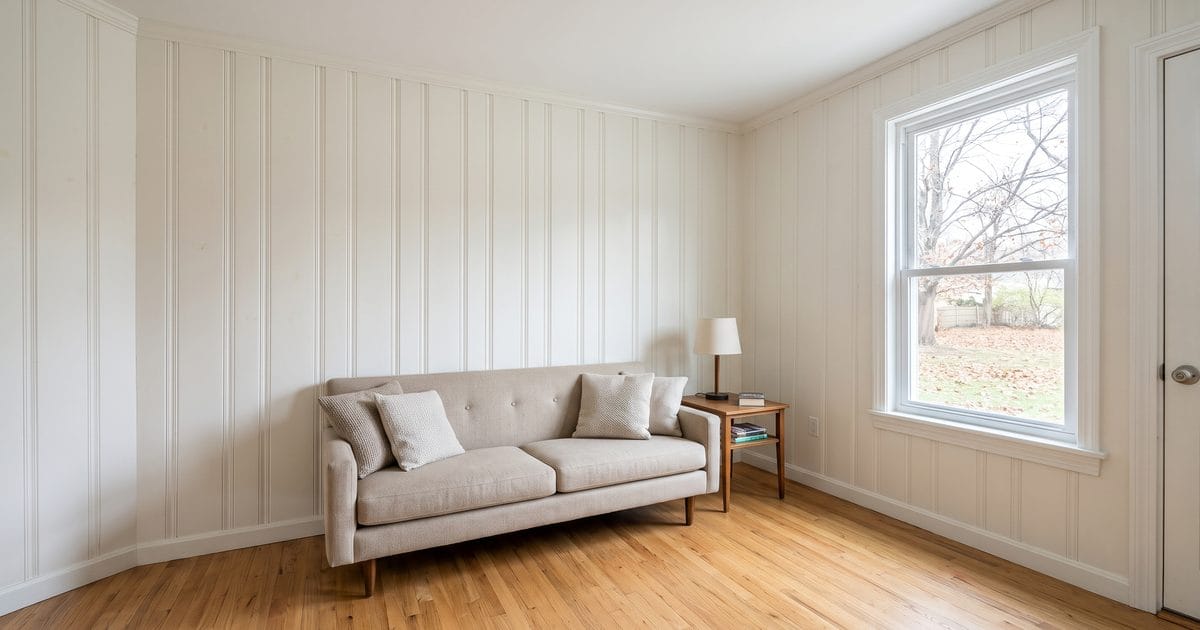
TL;DR: Painting knotty pine paneling works when you seal the knots before any paint goes on. Clean off grime and wax, scuff or degloss the old finish, spot-prime every knot with a shellac-based primer like Zinsser B-I-N, prime the whole wall, then finish with two coats of quality interior paint in eggshell or satin.
Thinking about the paneled den or the upstairs of your Cape? Call or text Dave at (774) 217-9567. We'll look at the paneling, the finish on it and the age of the house, and tell you whether to paint it, refresh it or leave it alone.
Knotty pine shows up all over MetroWest: the finished basement of a 1960s ranch, the den off the kitchen, the knee-wall bedrooms upstairs in a Cape. Some homeowners love it. Plenty of others are tired of a room that reads orange and dark by 4 p.m. in December. This guide to painting knotty pine covers the decision, the knots, the primer data sheet, the grooves, sheen and color, and pre-1978 homes.
The short version
Painting knotty pine is a priming job more than a painting job. The resin and natural stain in pine knots will push through latex paint, sometimes weeks or months later, so the knots have to be sealed with a shellac-based primer and the whole wall primed before the color goes on. Here's our checklist for painting knotty pine.
- Decide paint or keep. Painted pine is very hard to take back to wood.
- Check the age of the house. Pre-1978 and ever painted? Test before anyone sands.
- Check the humidity, especially in a basement.
- Clean with ammonia and water, then rinse and dry. Skip TSP.
- Scuff-sand glossy varnish or polyurethane.
- Spot-prime every knot with shellac-based primer, then prime the entire surface.
- Fill and caulk after priming, nail holes and trim joints only, not the board grooves.
- Brush the grooves, then roll the faces, or spray and back-brush if the room is empty.
- Before the color, spot-prime any knot that shows through.
- Two finish coats in eggshell or satin for walls, semi-gloss for trim.
Should you paint knotty pine paneling or keep it?
Paint it if the room feels dark and dated and the boards are sound; keep it if the wood is in great shape and you'd miss it. Painting knotty pine is hard to reverse, since getting back to clear wood means stripping paint out of every groove. So decide before anyone opens a can.
- Keep and refresh when the boards are solid, evenly toned and the room gets good light.
- Keep one wall: painting knotty pine on three walls and leaving the fireplace or bar wall natural is a common middle ground.
- Paint it when the finish is yellowed, patched or water-stained, or the room is a dark basement or north-facing den.
- Replace it when thin sheet paneling is delaminating or water-damaged.
To tell solid tongue-and-groove boards from sheet paneling, pull a switch plate and look at the edge. Solid boards are real wood all the way through and give you the choice to refinish; sheet paneling has a thin face layer. Both take paint well once primed.
Why do knots bleed through paint when painting knotty pine?
Knots bleed because they're packed with resin and natural wood stains that water-based paint can't hold back. A knot is where a branch grew out of the trunk, so the wood is dense and full of pitch. Those compounds migrate through latex paint and most water-based primers, leaving amber or yellow-brown rings over every knot, sometimes right away and sometimes the next summer.
That's why the primer matters more than the paint when painting knotty pine. Zinsser's B-I-N Shellac-Base Primer technical data sheet lists among its performance characteristics: "Seals bleeding knots and sap streaks." Its interior uses include wood, "pine, fir, cedar, redwood, and plywood," and the list of stains it seals ends with "knots, sap streaks, tannin bleed, etc." Its solvents are listed as denatured alcohol and water, and it dries to the touch in 20 minutes, so it fits into a day of painting knotty pine without holding up the job.
Knot bleed isn't only an old-house problem. Brand-new pine paneling bleeds too, and fresh boards can be worse because the pitch hasn't had decades to settle down.
How do you prep knotty pine before painting?
Protect the room, clean the paneling, dull the old finish and fix damage. Most knotty pine in a mid-century house has a clear finish on it: varnish, shellac, lacquer or a later polyurethane. Decades of cooking, wood stoves, cigarette smoke and furniture polish sit on top of that finish. Primer can only grip what's underneath if that layer comes off.
Cleaning: why not TSP?
A lot of how-to guides say to wash paneling with TSP. The B-I-N data sheet says otherwise. Its surface preparation section says: "If unsure of cleanliness, always wash surface with household ammonia and water solution, appropriate cleaning solution or solvent (do not use TSP as a cleaner)." Surfaces need to be "clean, dry, sound and free of dust, dirt, excessive chalky material, grime, grease, oil, wax, mildew," and anything else that "may interfere with adhesion."
So we wash with an ammonia and water solution, rinse with clean water and let the paneling dry fully. Focus on light switches, the wall behind a bar or table and anywhere near a wood stove. Furniture polish with wax or silicone looks clean and still makes paint crawl.
Dulling the old finish
The B-I-N sheet lists "Excellent adhesion to glossy surfaces without scuff sanding," and that's true of the primer itself. We still scuff-sand glossy varnish or polyurethane with a fine sanding sponge, because the paint system is only as strong as the old finish under it. The sheet also says to "Remove any peeling and/or unsound coatings" and to "Sand any remaining paint film edges smooth with the surface." Run a fingernail across a few spots. If the finish lifts or powders, it has to come off before painting knotty pine.
If you aren't sure whether the existing coat is an old oil-based paint rather than a clear finish, our post on painting over oil-based paint in older homes walks through the test.
Protecting the room
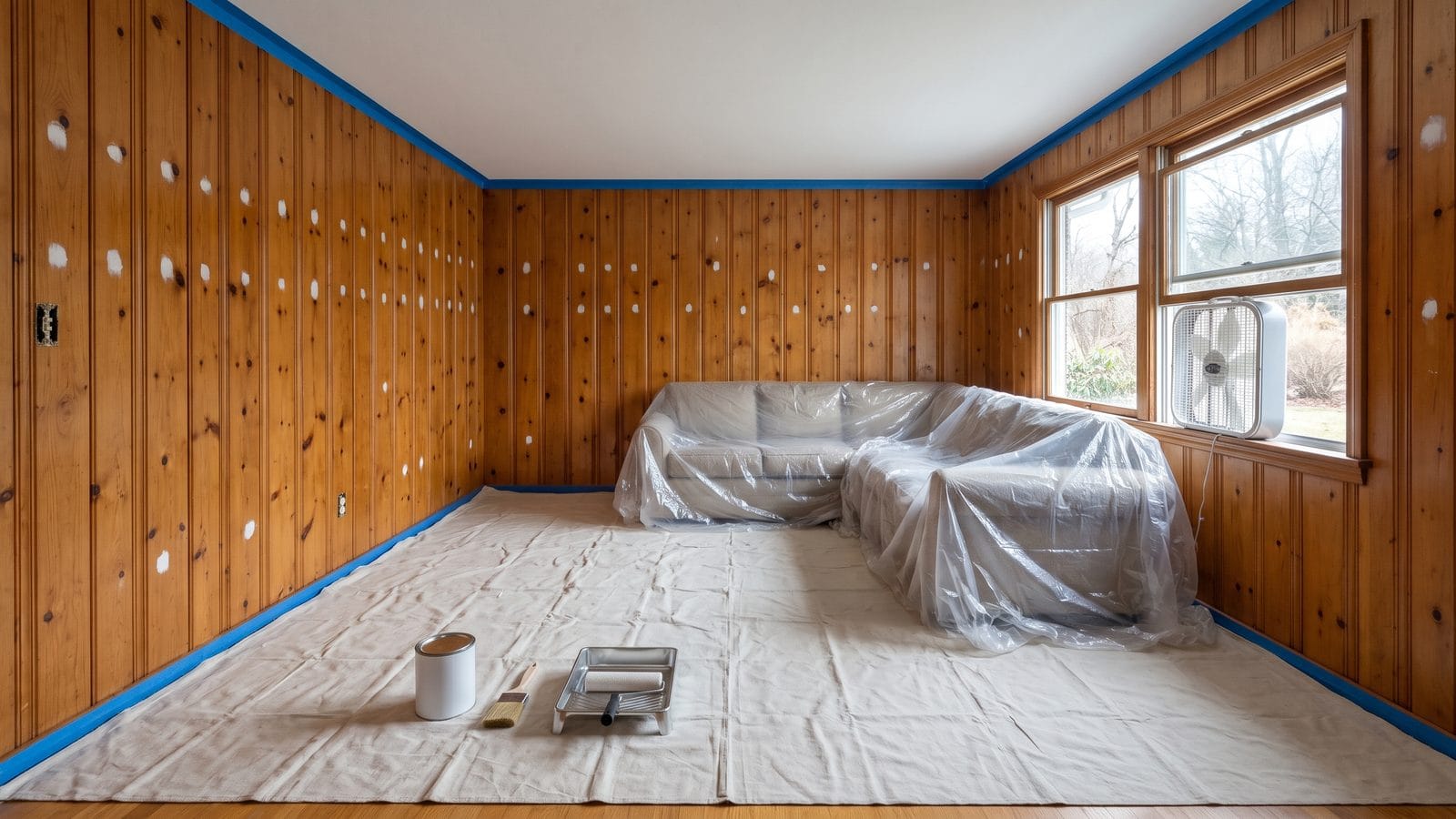
Before painting knotty pine, we lay drop cloths flat from wall to wall, move furniture out or wrap it completely, tape the floor and any trim staying natural with straight, pressed lines, and pull outlet covers and switch plates. Shellac primer is thin and fast, so ventilation goes in before the first can opens.
What primer should you use for painting knotty pine?
A shellac-based primer on every knot, then a full coat of primer over the whole wall. For most of the paneling we see, that full coat is shellac-based too. The B-I-N data sheet is direct about it: "Spot priming is recommended only under high-hiding topcoat finishes. For best results, prime entire surface before painting." A wall of pine that has been spot-primed in dozens of places and then painted will often show those spots through the finish as dull patches, called flashing, even when no stain comes through.
Here are the numbers from the B-I-N sheet that matter for painting knotty pine indoors:
- Dry and recoat. "Dries to the touch in 20 minutes, can be recoated in 45 minutes." The film "develops full adhesion and hardness after it cures in 1 to 3 days," and "Lower temperatures, higher humidity, and the addition of tint will prolong dry and cure time."
- Coverage. "Approximately 500 sq.ft./gal." at the recommended film thickness, "depending on application method and surface porosity." Grooved boards have more surface than a flat wall.
- Coats. "In most cases only one coat is necessary to prime most surfaces," but "Some stains require a second coat." Heavy knots often need two.
- Tinting. It "may be tinted with up to 2 ounces of universal colorant per gallon," and "Tinting the primer toward the color of the topcoat helps hide in one coat."
Some painters spot-prime knots with shellac and then prime the wall with a water-based stain blocker to save money and odor. On older, darker paneling with a lot of knots, we prefer the full shellac coat, because a knot that was missed in the spot coat gets a second chance.
Humidity, dew point and the knotty pine basement
This is where MetroWest basements get people in trouble. The B-I-N sheet says to apply it "only when air, material, and surface temperatures are between 0 and 90ºF (-18 and 32ºC) and the relative humidity is below 70%." It also says: "Do not apply B-I-N if surface temperature is within 15°F of the dew point. Substrate moisture should not exceed 12%."
A paneled basement in a ranch, especially one built against a foundation wall, can run humid in summer. Before painting knotty pine below grade, we check the humidity with a meter and the boards with a moisture meter. If the room is damp, run a dehumidifier first, and fix any water problem behind the boards before priming. Our post on whether to paint a basement wall or fix the moisture first covers the signs.
The sheet lists a flash point of 54ºF and says to "Wear NIOSH approved respirator and provide adequate ventilation." Keep wood stoves and space heaters off while you prime.
How do you paint the grooves in knotty pine paneling?
Brush the grooves first, then roll the flat faces while the grooves are still wet, one or two boards at a time. A roller skips across the V-grooves and leaves bare lines, and if you go back with a loaded roller to force paint in, it pools at the bottom of the groove and runs. So the order matters.
- Brushing and rolling. Work top to bottom, a few boards at a time: brush into the groove with an angled sash brush, roll the face, then lay off along the grain. Check each groove for drips before moving on.
- Spraying. In an empty room, an airless sprayer gets primer into every groove fast. The B-I-N sheet allows "bristle brush, roller, or airless sprayer," with "a 0.011"-0.013" tip at 800 to 1200 psi." The tradeoff is masking: everything that isn't getting primer has to be fully covered. We back-brush sprayed paneling so the grooves don't hold a thick bead.
- Keep coats thin. Two thin coats in a groove dry harder and crack less than one heavy one.
Should you caulk the grooves when painting knotty pine?
Usually no. Solid tongue-and-groove boards swell and shrink with the seasons, and a Massachusetts house swings from dry winter heat to humid summer air every year. Caulk in the V-grooves tends to crack or pull into a jagged line as the boards move, and it erases the board lines that make paneling look like paneling. We caulk where paneling meets trim, ceilings and inside corners, and we fill nail holes after the primer coat so the filler sticks to a sealed surface. If you want a flat, drywall-smooth look, that's a different project.
What sheen and color work best for painted knotty pine?
Eggshell or satin on the paneling, semi-gloss on the trim. Eggshell hides more grain and small dents in old boards; satin wipes down more easily in a playroom or basement bar. Our comparison of eggshell vs satin for interior walls goes deeper on the tradeoffs.
On color, here's what to weigh when painting knotty pine in older houses:
- Soft, warm whites and light neutrals brighten a dark den the most. Very cool, bright whites can look bluish in a north-facing basement.
- Mid-tone greens, blues and grays make a paneled study or Cape bedroom look deliberate and cozy, and they forgive small shadows in the grooves.
- Tint the primer toward the finish color, within the 2-ounce limit, so the last coat covers evenly.
- Test on the wall. Paint a sample board or two after priming and look at it morning and night before committing.
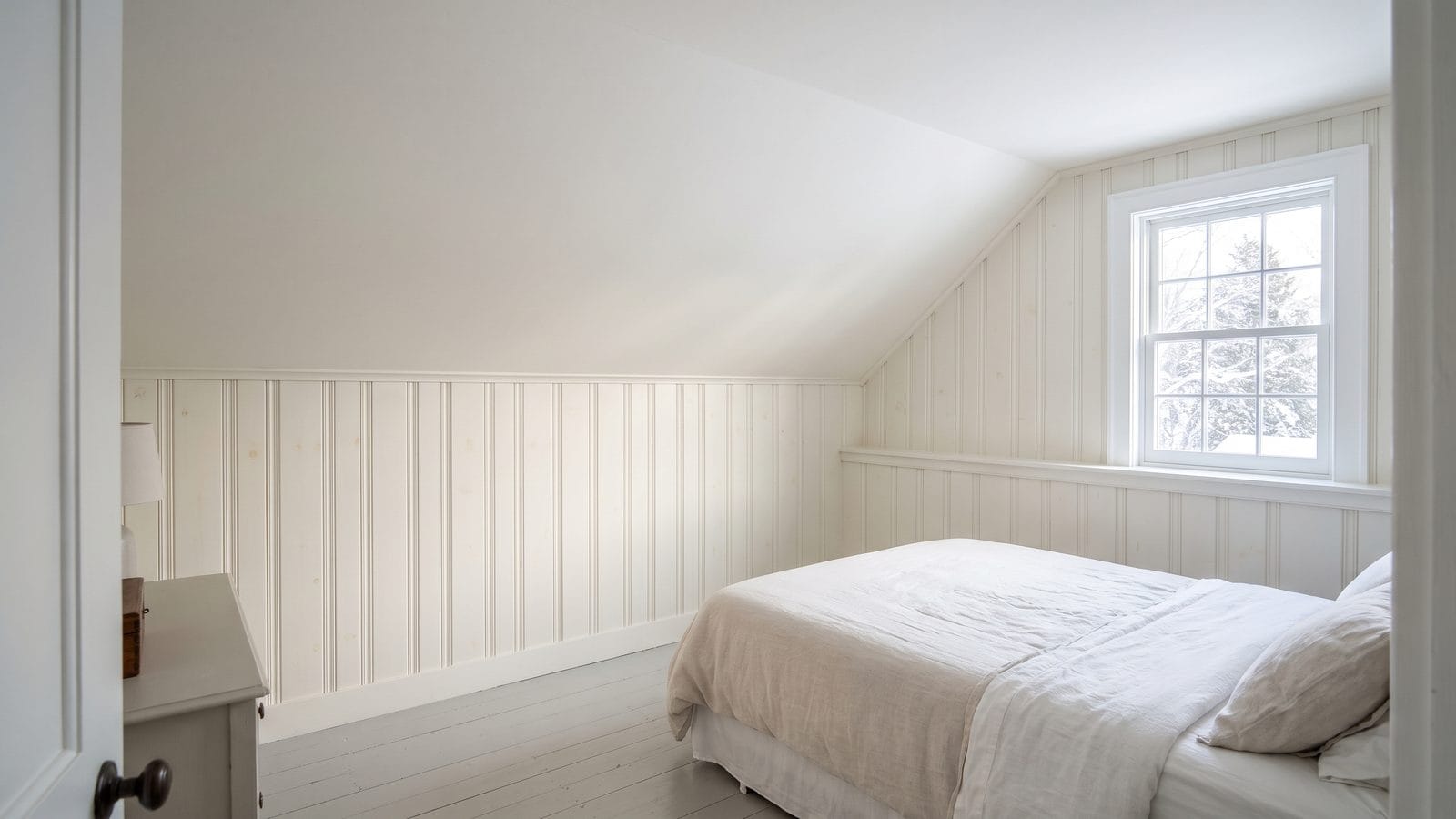
- Cape upstairs. When painting knotty pine on the slope and knee walls, one color for both makes the room feel taller.
What if the house was built before 1978?
Test before anyone sands or scrapes. Paneling that was painted at some point needs a lead test before sanding, and in a pre-1978 house it's better to test any old finish than to guess. EPA's Renovation, Repair and Painting page for consumers says: "Homes built before 1978 are more likely to have lead-based paint." It also says: "The federal government banned consumer use of lead-based paint in 1978, but it is still present in millions of homes."
The B-I-N data sheet carries its own warning: "If you scrape, sand or remove old paint, you may release lead dust." We use lead-safe methods on every pre-1978 home: containment, HEPA vacuums, wet scraping and proper disposal. For testing options and the Massachusetts rules, read our lead paint guide for Massachusetts homeowners. This is general information, not legal advice; the Mass.gov home improvement contractor resources for homeowners are a good place to start.
What are the most common mistakes when painting knotty pine?
Most problems with painting knotty pine trace back to one of these:
- Using a water-based primer alone. The knots look sealed for a few weeks, then the rings come back.
- Flooding the grooves. Heavy coats sag at the bottom of each V and crack as the boards move.
- Priming a damp basement. The B-I-N sheet calls for relative humidity below 70%.
Painting knotty pine in Medway, Millis and Bellingham
These three towns are full of the house types where painting knotty pine comes up most. The American Community Survey's year-built table, the ACS 2020-2024 5-year estimates as shown on Census Reporter, shows how much housing went up from the 1950s through the 1970s, when many MetroWest ranches and Capes were built. The ACS groups years by decade, so "built before 1980" is the closest cut to the 1978 lead line, and each figure is an estimate with a margin of error.
Medway
Of an estimated 4,768 housing units in Medway, 1,564 were built from 1950 through 1979, about 33%, and 927, about 19%, were built in 1939 or earlier. In all, 2,574 units, about 54%, were built before 1980. Another 1,705 units date from the 1980s and 1990s. If your home is in the older village areas, our post on painting Rabbit Hill's historic homes in Medway has more, and our Medway painting page covers the services we offer there.
Millis
Millis has an estimated 3,471 housing units. Of those, 1,581, about 46%, were built from 1950 through 1979, and 2,103, about 61%, were built before 1980. The older homes near the center are a different story, covered in our guide to painting mill village homes in Millis.
Bellingham
Bellingham has the most postwar housing of the three, by count and by share. Of an estimated 6,691 housing units, 3,168, about 47%, were built from 1950 through 1979, including 1,333 from the 1960s alone, and 4,141, about 62%, were built before 1980. Our post on repainting 1970s homes in Bellingham covers what the 1978 lead line changes for houses from that decade.
Frequently asked questions
Do you have to prime knotty pine before painting?
Yes. Without primer, the resin and natural stain in the knots bleed through latex paint as yellow-brown rings. Spot-prime every knot with a shellac-based primer, then prime the whole wall. Zinsser's B-I-N data sheet says: "For best results, prime entire surface before painting."
What is the best primer for painting knotty pine?
A shellac-based primer such as Zinsser B-I-N. Its data sheet lists "Seals bleeding knots and sap streaks" among its performance characteristics. It recoats in 45 minutes, so the knot coat and the full prime coat often fit in one day.
Why do knots bleed through paint?
Knots are dense, resin-rich wood where a branch grew from the trunk. Water-based primers and paints let that resin and the wood's natural stain migrate through the film as it dries, sometimes weeks or months later, leaving amber rings over each knot.
Do you have to sand knotty pine before painting?
Scuff-sand it, yes. B-I-N bonds to glossy surfaces, but the paint system is only as good as the old varnish under it. A light scuff with a fine sanding sponge dulls the gloss and shows you whether the old finish is sound. Peeling finish has to come off first.
Should you caulk the grooves when painting knotty pine paneling?
Usually not. Solid tongue-and-groove boards move with the seasons, and caulk in the grooves tends to crack. Caulk where the paneling meets trim, ceilings and inside corners, and fill nail holes after the primer coat instead.
What color should I paint knotty pine paneling?
Soft, warm whites and light neutrals brighten a dark den or basement the most. Mid-tone greens, blues and grays look deliberate in a study or Cape bedroom. Tint the primer toward the finish color and test samples on the primed wall before choosing.
Should I paint knotty pine or keep it?
Keep it if the boards are solid, evenly colored and the room gets good light; a cleaning and a fresh clear coat may be enough. Paint it if the finish is yellowed, patched or water-stained, or the room is too dark. Painted pine is very hard to take back to wood.
How long does painting knotty pine take?
A typical paneled room takes two to four days of work: a prep day, a priming day, then filling, touch-up primer on any knot that shows and two finish coats. B-I-N recoats in 45 minutes, but its data sheet says the primer reaches full adhesion and hardness after 1 to 3 days, and cool, humid rooms take longer.
The bottom line
Painting knotty pine succeeds or fails at the primer. Decide first, test for lead in a pre-1978 house, clean with ammonia and water, scuff the old finish, seal every knot with shellac-based primer, prime the whole wall, then brush the grooves and finish in eggshell or satin.
Talk to Paint Pro
Paint Pro New England is based in Holliston and has painted homes across MetroWest for more than fifteen years. We are fully licensed and insured, including workers' compensation, use premium Benjamin Moore and Sherwin-Williams paints, back our work with a 2-year warranty on all work, and have more than 60 five-star reviews on Houzz. See our interior painting services for walls, ceilings, trim and paneling. Call or text Dave at (774) 217-9567. You can also request a free, no-obligation estimate online.
Dave Griffiths
Dave Griffiths is the owner of Paint Pro New England, a professional painting company serving MetroWest Boston since 2011. With 15+ years of interior and exterior painting experience across the region, he leads every project with thorough prep, premium Benjamin Moore and Sherwin-Williams paints, and a 2-year warranty.

