



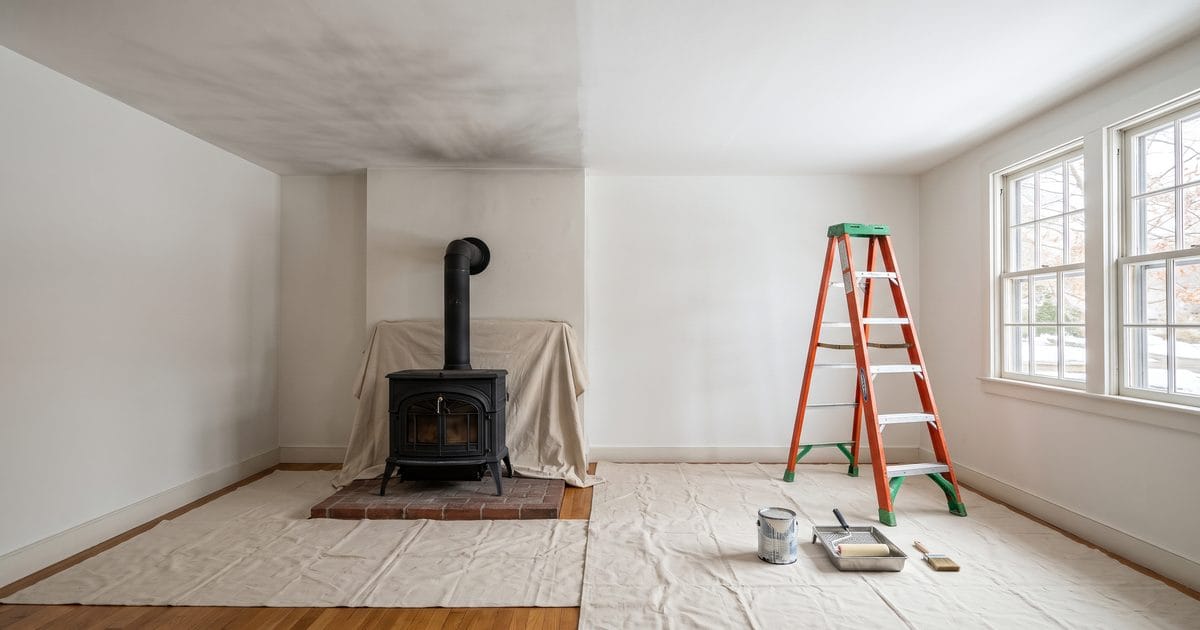
TL;DR: You can paint over smoke stains, but only after you clean the soot off and seal what's left with a shellac-based stain-blocking primer such as Zinsser B-I-N. Latex paint on its own lets soot and nicotine bleed back through. Prime and repaint the whole ceiling, and if the stove or fireplace keeps spilling smoke, get that fixed first.
Got a gray haze over the wood stove? Call or text Dave at (774) 217-9567. We'll look at the stain, where it's coming from and what the ceiling is made of, and tell you whether it's a cleaning job, a priming job or a chimney question first.
Wood stove season runs long in MetroWest. NOAA's 1991-2020 climate normals for Natick put the normal daily high at 51.3 °F in November, 40.7 °F in December and 35.2 °F in January. By spring, the ceiling over a busy stove often has a gray cloud on it and the chimney breast has a dark shadow above the opening. This guide covers why soot comes back through ordinary paint, how we clean and seal it, why the whole ceiling gets repainted, and when the stain is really a stove question.
The short version
To paint over smoke stains so they stay gone, you remove as much soot as you can, seal the rest with a primer made to block smoke, and repaint the whole surface. The primer is the step most people skip, and it's the one that decides whether the stain shows up again. Here's our checklist.
- Find the cause. Soot that comes back every winter means the stove, fireplace or chimney needs a look before the ceiling does.
- Let the stove go cold. No fire, no pilot flame and no hot ash in the room while you clean and prime.
- Dry clean first. A dry soot sponge lifts loose soot without smearing it into the paint.
- Wash with the right cleaner. A TSP substitute or ammonia and water, per the primer's data sheet, then rinse and dry.
- Prime with a shellac-based primer. Zinsser B-I-N Shellac-Base is what we reach for on soot stains and nicotine stains.
- Ventilate. Open windows, run a fan out of the room and wear a respirator, as the data sheet says.
- Prime the whole plane. Corner to corner on the ceiling, and the full wall if the wall is stained.
- Topcoat twice. Two coats of a good flat ceiling paint once the primer is dry.
Why do smoke and soot stains bleed through latex paint?
Because soot and tobacco residue are oily, and water-based paint picks them up. When you paint over smoke stains with latex, the wet paint softens the residue, mixes with it and carries the discoloration to the surface as it dries. A ceiling can look clean while you're rolling it and show the stain again once the paint dries, and more coats of the same paint usually repeat the problem.
There's a bonding problem too. The Zinsser B-I-N Shellac-Base Primer technical data sheet says surfaces "should be clean, dry, sound and free of dust, dirt, excessive chalky material, grime, grease, oil, wax, mildew, wallpaper adhesive, or any contamination that may interfere with adhesion." Loose soot is that kind of contamination. Paint rolled over it sticks to the soot, and the soot doesn't stick to the ceiling. Smoke odor behaves the same way: it lives in the film, and a coat of latex doesn't seal it in.
Can you paint over smoke stains without cleaning first?
No. Even the best stain-blocking primer needs a clean, dry surface to grab, so cleaning always comes first. The goal isn't a ceiling that looks new. It's getting the loose soot and greasy film off so the primer bonds to paint instead of residue.
How do you clean soot off a ceiling before painting?
Dry first, then wet. This is the order we follow:
- Cover everything. Drop cloths over the whole floor and the hearth, furniture moved out or covered, stove doors closed.
- Vacuum the loose soot. A soft brush attachment held just off the surface takes the dust that would otherwise smear.
- Use a dry soot sponge. The vulcanized rubber kind, wiped in one direction, lifts a lot of soot without water. When a face turns black, switch to a fresh one.
- Then wash. Water on loose soot spreads it into streaks, which is why the dry steps come first. Then wash with a degreasing cleaner, rinse with clean water and let the ceiling dry fully.
Pick the cleaner carefully. Plenty of advice online says to wash with TSP. The B-I-N data sheet says: "If unsure of cleanliness, always wash surface with household ammonia and water solution, appropriate cleaning solution or solvent (do not use TSP as a cleaner)." When the primer maker says which cleaner goes under its product, we follow it. And never mix ammonia with bleach.
Fireplace ceilings in older MetroWest houses often have old paint underneath. If a stained ceiling also needs scraping or sanding, that's a lead question on any house built before 1978. We use lead-safe methods on every pre-1978 home: containment, HEPA vacuums, wet scraping and proper disposal.
A sprayed popcorn texture can't be scrubbed without coming apart, so a vacuum and a dry sponge are about all it can take, and the primer has to do more of the work. A badly stained popcorn ceiling is a good time to read our guide on whether to remove or cover a popcorn ceiling.
What primer should you use to paint over smoke stains?
A shellac-based stain-blocking primer. The B-I-N data sheet says: "One coat effectively blocks stains, including water, nicotine, ink, crayon, marker, rust and smoke stains so they will not bleed into the topcoat. Some stains require a second coat." On smoke specifically: "B-I-N is recommended for permanently sealing heavy fire and water stains and odors caused by fires." It also says it "is recommended for sealing nicotine stains and odors from tobacco."
Zinsser sells more than one primer under the B-I-N name, and the sheet quoted here is for B-I-N Shellac-Base Primer (BIN-03), so check that the can says shellac-base. Solvent-based oil primers also block stains and make sense when a room can't take the alcohol smell of shellac. A standard latex primer is the one we don't use on soot, for the same reason latex paint fails over it. For a colored wall, the sheet says "Tinting the primer toward the color of the topcoat helps hide in one coat."
How long does primer take to dry before you paint over smoke stains?
Fast, by paint standards. The B-I-N sheet says it "Dries to the touch in 20 minutes, can be recoated in 45 minutes," and that "The primer film develops full adhesion and hardness after it cures in 1 to 3 days." It adds: "Allow more time at cooler temperatures."
The application limits matter in a New England winter. The sheet says to apply "only when air, material, and surface temperatures are between 0 and 90ºF (-18 and 32ºC) and the relative humidity is below 70%," and not when the surface temperature is within 15 °F of the dew point. The primer handles cold well. The ceiling paint over it usually won't, so the room has to be warm for the topcoat. For a cold porch or sunroom, our guide to painting an unheated room in winter has the finish-coat limits.
Is shellac primer safe to use indoors?
Yes, with fresh air and a respirator. The data sheet says to "Wear NIOSH approved respirator and provide adequate ventilation." We open windows, run a fan blowing out of the room and keep kids and pets out until it's dry. Shellac primer is flammable, and the same sheet lists its flash point at 54ºF, so on a soot job the stove or fireplace stays out and cold until the primer is dry and the room has aired out.
Should you repaint the whole ceiling or just the stain?
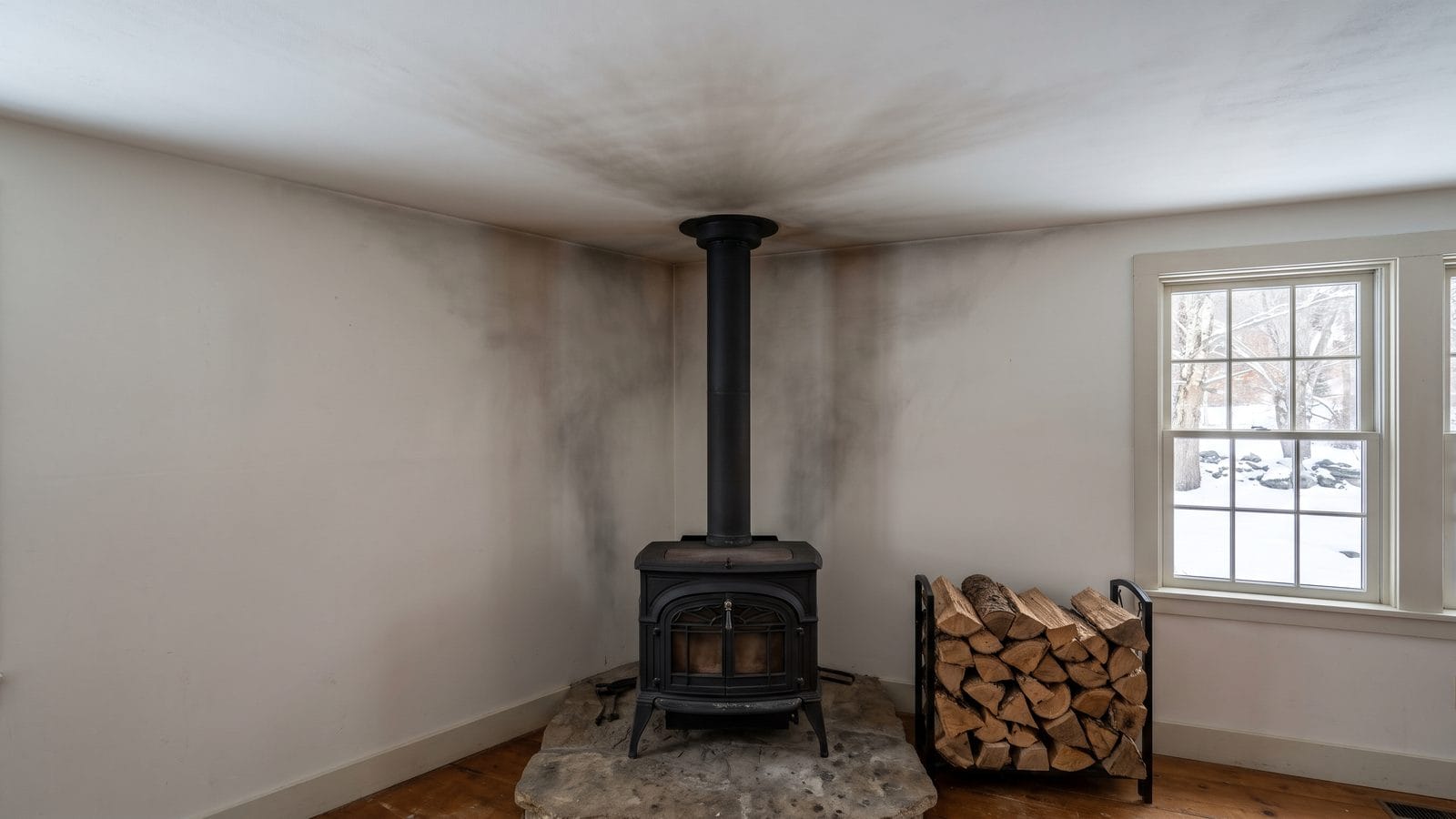
The whole ceiling, almost every time. The darkest patch sits over the stove, but a thinner film covers the rest of the ceiling and the upper walls, and the paint around the stain has dulled along with it. A spot of fresh primer and paint in the middle shows up as a bright patch as soon as window light hits it.
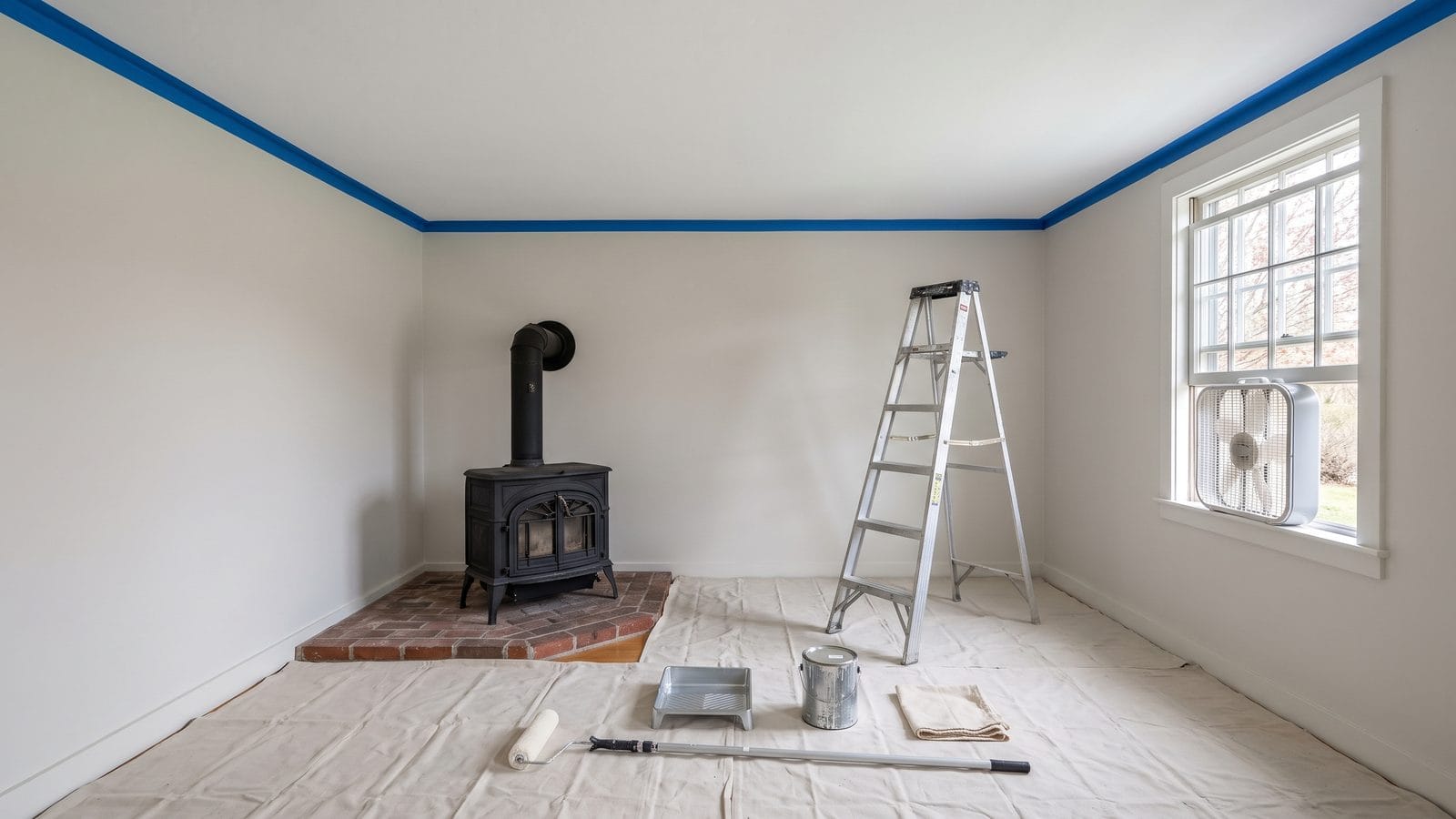
The B-I-N sheet backs this up: "Spot priming is recommended only under high-hiding topcoat finishes. For best results, prime entire surface before painting." So when we paint over smoke stains, we prime the full ceiling, wall to wall, then roll two coats of flat ceiling paint over the whole thing. Flat hides the small dips that a soot cleanup tends to reveal. If a wall carries a film too, it gets the same treatment corner to corner.
If you're budgeting, our guide to what it costs to paint a ceiling in Massachusetts explains what moves the price. The same primer-first approach works on a brown ring after a roof leak; see painting over an ice dam ceiling stain.
Is a soot stain a sign of a draft or chimney problem?
Often, yes, and it's worth sorting out before you paint over smoke stains, since a stove that keeps putting smoke in the room will stain new paint too. The EPA's Burn Wise frequent questions page says: "If you smell smoke in your home, something may be wrong," and recommends having the appliance "checked annually by a certified chimney sweep" or similar certified professional. Its best wood burning practices page says: "If you regularly see or smell smoke, you may have a problem."
We're painters, not chimney sweeps, so we don't diagnose drafts or flues. Here's what the EPA points to:
- Opening the door fast. Burn Wise tips for a better burn say to "slowly open the door to reduce the chance of wood smoke spilling back into the room."
- Wet wood. "Wood burns best at a moisture content of less than 20 percent," the best practices page says, along with "Season wood for at least six months."
- Not enough air. "If you see smoke that usually means the fire needs more air."
- A cold flue. Natural fire-starters "help warm your flue so it starts drafting sooner (pulling the smoke up your chimney)."
- Ash handling. The Burn Wise health and safety tips say to "open your wood stove door slowly and remove ash after it has cooled down."
That page also explains why the gray film matters: "Smoke from wood-burning stoves and fireplaces contains a mixture of harmful gases and particle matter (PM2.5)." It says to "Install smoke and carbon monoxide detectors on every floor of the house and outside each bedroom."
Where the soot lands is a useful clue to bring to your chimney sweep. A dark fan right above a fireplace opening or stove door usually means smoke rolling out the front. An even haze across the ceiling means smoke is getting into the room's air, and frequent candles add to it. Thin dark lines that follow the joists or studs are soot settling on the coldest strips of the surface, which is an insulation question as much as a smoke one.
How do you paint over smoke stains from cigarettes?
The same way, with more washing and more surface. Tobacco leaves a sticky yellow-brown film rather than dry soot, and it spreads through the house. Where someone smoked for years, we expect it on every ceiling, the walls, the trim, the window sashes and the inside of closets.
- Test the film. Wipe a white cloth with a little cleaner across the wall. If it comes back yellow, the room needs a full wash.
- Wash twice when it's heavy. Nicotine film is greasy, and one pass rarely gets it all. Rinse after each wash.
- Prime every surface that gets paint. Ceilings, walls and trim all carry the film, so they all get primed.
- Do the trim and doors too. Fresh white walls make old yellowed trim look worse.
Be realistic about cigarette smoke odor. Primer seals what it covers, but the smell also lives in carpet, upholstery, curtains and ductwork, so the walls are one part of getting it out of a house.
When is smoke damage too much for paint?
After a real fire, paint is the last step. If a chimney fire or a house fire filled the rooms with smoke, the job usually starts with a fire restoration company and your insurer, who handle soot in insulation, wall cavities, ducts and contents. We paint once that work is done. Some stains also look like smoke and aren't: gray-green spotting on a cold outside wall or in a bathroom can be mold. Our guide to painting over mold and mildew explains the difference.
When is the best time to paint over smoke stains in New England?
Right after the burning season ends, or in early fall after the chimney has been serviced. A ceiling painted in January over a stove you'll light again that night starts collecting soot on day one. NOAA's Natick normals show why the stove runs so long here: the normal high is still 38.2 °F in February and 46.1 °F in March, and doesn't reach 58.0 °F until April.
- Spring. The stove is done for the year, windows can open for shellac fumes, and you can see everything that needs priming.
- Early fall. Have the chimney checked, then paint before the first fire.
- Midwinter. Possible if the stove can stay out for a few days, the room stays warm by other means and you can ventilate. The primer cures in 1 to 3 days per the sheet.
Smoke and soot stains in MetroWest homes
We work across Holliston, Hopkinton, Sherborn, Medway, Millis, Ashland and the rest of MetroWest. Older farmhouses and colonials here often have a center chimney with a stove insert in the old fireplace, and the ceilings above carry decades of paint. Newer homes tend to have a family-room fireplace with a tall chimney breast that shows a shadow above the opening. If the brick or stone needs attention after the cleanup, see our guide to painting a brick or stone fireplace.
Frequently asked questions
Can you paint over smoke stains with regular paint?
Not if you want them gone. If you paint over smoke stains with regular latex, the paint softens the oily residue and lets it bleed back through. Clean the soot off, seal it with a shellac-based stain-blocking primer, and then use regular paint for the finish coats.
What is the best primer to paint over smoke stains?
A shellac-based stain-blocking primer. Zinsser's data sheet for B-I-N Shellac-Base Primer says one coat blocks smoke and nicotine stains so they will not bleed into the topcoat, and that some stains need a second coat. Oil-based stain blockers are the usual alternative.
How do you get soot off a ceiling before painting?
Vacuum the loose soot with a soft brush, then wipe with a dry soot sponge before any water touches it. Wash with a TSP substitute or ammonia and water, as the B-I-N data sheet calls for, rinse and let the ceiling dry fully before priming.
Will smoke stains come back if you paint over smoke stains?
They will through latex paint alone. They shouldn't through a properly applied shellac-based primer over a cleaned surface. If they do, the usual causes are a missed spot, a surface that wasn't clean, or new smoke from a stove or fireplace that still needs attention.
Does it get rid of the smell when you paint over smoke stains?
It helps on the surfaces you prime. The B-I-N data sheet says the primer is recommended for sealing odors caused by fires and from tobacco. Smoke odor also lives in carpet, fabric and ductwork, which paint can't reach, so those need cleaning too.
Can you paint over nicotine stains on a ceiling?
Yes. You paint over smoke stains from cigarettes the same way: wash the ceiling, twice if the film is heavy, prime the whole ceiling with a shellac-based primer and finish with two coats of flat ceiling paint. The walls and trim usually need the same treatment.
Do you need to repaint the whole ceiling to paint over smoke stains?
Almost always. The B-I-N data sheet says spot priming is recommended only under high-hiding topcoats and that for best results you prime the entire surface. Smoke film also covers more of the ceiling than you can see, so a patch won't match.
Why does soot keep showing up on my ceiling?
Something is putting smoke into the room. EPA Burn Wise says that if you smell smoke in your home, something may be wrong, and recommends an annual check by a certified chimney sweep. Wet wood, a stove door opened too fast and candles can all add to it.
The bottom line
To paint over smoke stains for good, fix whatever is putting smoke in the room, clean the soot dry and then wet, seal the whole ceiling with a shellac-based primer and finish with two coats. Skipping the primer is why so many smoky ceilings show the stain again after they're painted.
Talk to Paint Pro
Paint Pro New England is based in Holliston and has painted homes across MetroWest for more than fifteen years. We are fully licensed and insured, including workers' compensation, use premium Benjamin Moore and Sherwin-Williams paints, back our work with a 2-year warranty on all work, and have more than 60 five-star reviews on Houzz. See our interior painting services for walls, ceilings, trim and doors. Call or text Dave at (774) 217-9567. You can also request a free, no-obligation estimate online.
Dave Griffiths
Dave Griffiths is the owner of Paint Pro New England, a professional painting company serving MetroWest Boston since 2011. With 15+ years of interior and exterior painting experience across the region, he leads every project with thorough prep, premium Benjamin Moore and Sherwin-Williams paints, and a 2-year warranty.

