



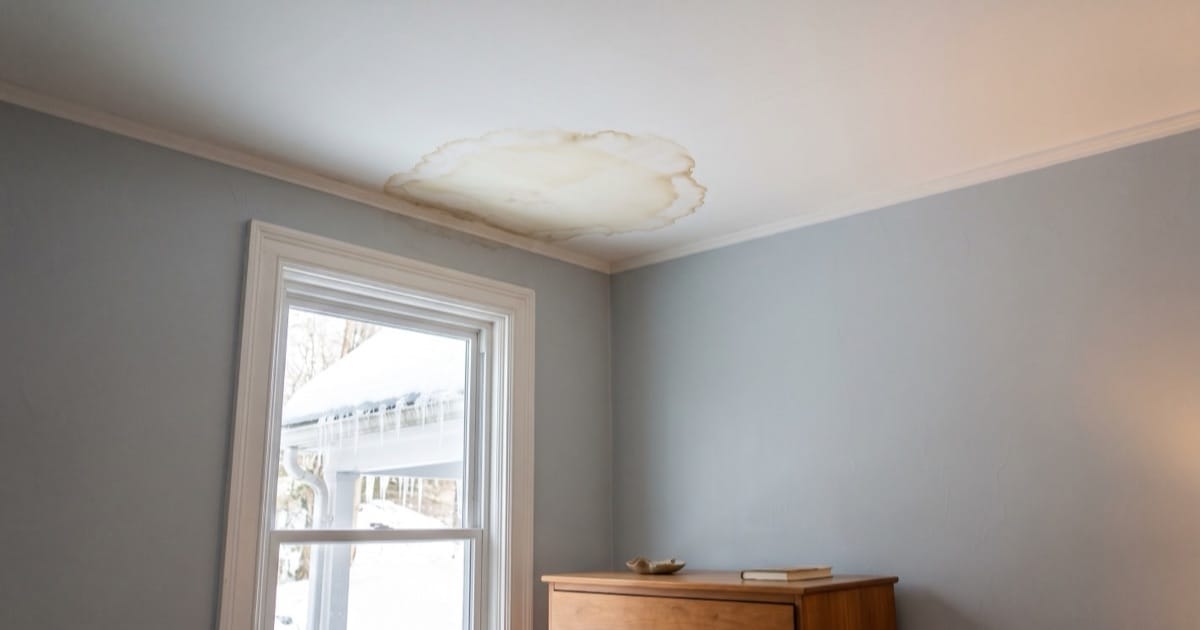
TL;DR: Yes, you can paint over an ice dam ceiling stain, but only after the leak is fixed and the ceiling is fully dry. Zinsser's B-I-N data sheet says substrate moisture shouldn't exceed 12%. Seal the stain with a shellac-based primer, then repaint the whole ceiling so the patch doesn't show.
Got a brown ring on the ceiling after the last thaw? Call or text Dave at (774) 217-9567. We'll look at the stain, check whether it's dry, and tell you honestly whether it's ready for primer or needs a roofer or a drywall repair first.
Every winter in MetroWest, the calls start after the first real thaw. A few days after the snow melts there's a yellow or brown water stain on ceiling drywall, usually right along an outside wall, and the question is always the same: can we just paint over it? Usually, yes. But paint is the last step, and the order matters more than the product.
The short version
An ice dam ceiling stain is a water stain, and water stains come back through ordinary paint. The fix has four parts: stop the water at the roof, let the ceiling dry, seal the stain with a stain-blocking primer, and repaint the full ceiling. Here's our checklist.
- Stop the source. Get the ice dam and any roof leak dealt with before anyone touches the ceiling.
- Wait out a thaw. Mark the edge of the stain lightly in pencil and see whether it grows the next time snow melts.
- Check for damage. Press gently. Soft, sagging or crumbling drywall or plaster gets repaired, not painted.
- Look for mold. Fuzzy or spotted growth is a different job. Don't paint it.
- Document it. Take dated photos and notes before anything gets covered.
- Measure moisture. Use a moisture meter and compare the stain to a dry part of the same ceiling.
- Prime with shellac. A shellac-based primer seals the stain so it won't bleed into the topcoat.
- Paint the whole plane. Repaint wall to wall so the repair doesn't flash.
What causes an ice dam ceiling stain?
An ice dam ceiling stain starts when heat escaping from the house melts snow on the roof, the water refreezes at the cold eave, and the melt that backs up behind that ridge of ice leaks inside. The University of Minnesota Extension's guide to dealing with and preventing ice dams defines it this way: "An ice dam is a ridge of ice that forms at the edge of a roof and prevents melting snow (water) from draining off the roof." It goes on: "The water that backs up behind the dam can leak into a home and cause damage to walls, ceilings, insulation and other areas." Once that water reaches the attic and soaks through the insulation, it can "stain the ceiling finish." That's the ring you're looking at.
The cause is warm air, not bad luck. The Extension says "Nonuniform roof surface temperatures lead to ice dams." The U.S. Department of Energy's Building America Solution Center, run by Pacific Northwest National Laboratory, puts it more directly in its guide to building roofs and attics to prevent ice dams: "Heat loss into the attic through air leakage that warms the roof deck is one of the greatest sources of ice dams."
It doesn't take a blizzard. The Solution Center's page on attic air sealing, insulating and ventilating for ice dam prevention says "Ice dams can form with as little as 2 inches of snow accumulation on a roof."
Where does the stain usually show up?
Most often within a few feet of an outside wall, under the eave. It's also common in closets on outside walls, under roof valleys and near skylights. Water can run along a rafter before it drips, so the stain isn't always right under the ice. A stain mid-room on a lower floor, or one that shows up in July, usually points to plumbing instead.
Do you have to fix the ice dam before painting the ceiling?
Yes. Paint over an active leak and you'll be painting the same spot again after the next thaw. The University of Minnesota Extension is clear about the order: "Do not repair interior damage until ceilings and walls are dry," and it can't stay dry while water is still getting in.
A painter can't fix an ice dam. That's a roof, attic and insulation job, and we'll say so. These long-term fixes decide whether your new ceiling stays clean:
- Seal the air leaks. The Extension's first step is to "make the ceiling air tight so no warm, moist air can flow from the house into the attic space." The Solution Center calls sealing air leaks "The most important step."
- Add insulation. After the air sealing, the Extension says to "consider increasing the ceiling or roof insulation to cut down on heat loss by conduction."
- Ventilate the roof properly. The Solution Center says "It's critical to vent the roof assembly in cold climates" and calls for "an air gap of at least 2 inches" between the top of the insulation and the underside of the roof deck.
- Protect the eaves. The Solution Center notes that "building codes often require that self-adhered membrane be installed on the roof deck along the eaves."
In the short term, the Extension says a roof rake can clear snow from the lower roof, though it can damage roofing. Stay off a snowy roof yourself.
How do you know the leak has really stopped?
Watch it through at least one more thaw. Mark the edge of the ice dam ceiling stain lightly in pencil. If the next melt passes and the stain hasn't grown past the line or turned damp, the source is probably handled. If it has spread, priming would just hide the evidence.
How long should a water-stained ceiling dry before painting?
Until it's dry all the way through, which you confirm with a meter, not a calendar. A small stain on a heated bedroom ceiling may dry in days. A ceiling with wet insulation on top of it can stay damp much longer, because the insulation keeps feeding moisture into the drywall or plaster.
The primer we use gives a hard number. The Zinsser B-I-N Shellac-Base Primer technical data sheet (BIN-03) says: "Substrate moisture should not exceed 12%." Its surface preparation starts with "Surfaces should be clean, dry, sound."
Here's how we check:
- Read the stain and a dry spot. We take a moisture meter reading in the middle of the stain, at its edge and on a part of the same ceiling the water never reached. Drywall and plaster read differently and meters read differently on each, so the dry spot is the baseline.
- Wait for them to match. We don't prime until the stained area reads like the dry area and is within the 12% the B-I-N sheet allows.
- Check from above. If the attic is reachable, wet insulation over the stain needs to come out or dry out.
- Help it along. Heat, a fan and a dehumidifier speed things up. The EPA's brief guide to mold, moisture and your home says "It is important to dry water-damaged areas and items within 24-48 hours to prevent mold growth."
That 24-48 hour window is about stopping mold, not about when to paint. A ceiling can feel dry to the touch and still be too wet to prime.
When is an ice dam ceiling stain more than a paint job?
When the ceiling is soft, sagging, crumbling or growing mold. Primer seals a stain on a sound surface. It doesn't fix a wet or moldy ceiling.
Sagging drywall and loose plaster
Press gently around the stain. Firm and dry means cosmetic. Soft, spongy or bowed means the material needs repair. The B-I-N sheet says "Damaged drywall should be repaired prior to priming." For torn facing paper or exposed gypsum, it says to spot prime with Zinsser GardZ Problem Surface Sealer and then skim coat with drywall mud "before priming the total area with B-I-N." Older MetroWest homes often have plaster ceilings, and wet plaster can lose its grip on the lath. Our post on plaster wall repair before painting covers what that repair involves.
If the home was built before 1978, scraping or sanding a damaged ceiling can disturb old lead paint. We use lead-safe methods on every pre-1978 home: containment, HEPA vacuums, wet scraping and proper disposal.
Mold
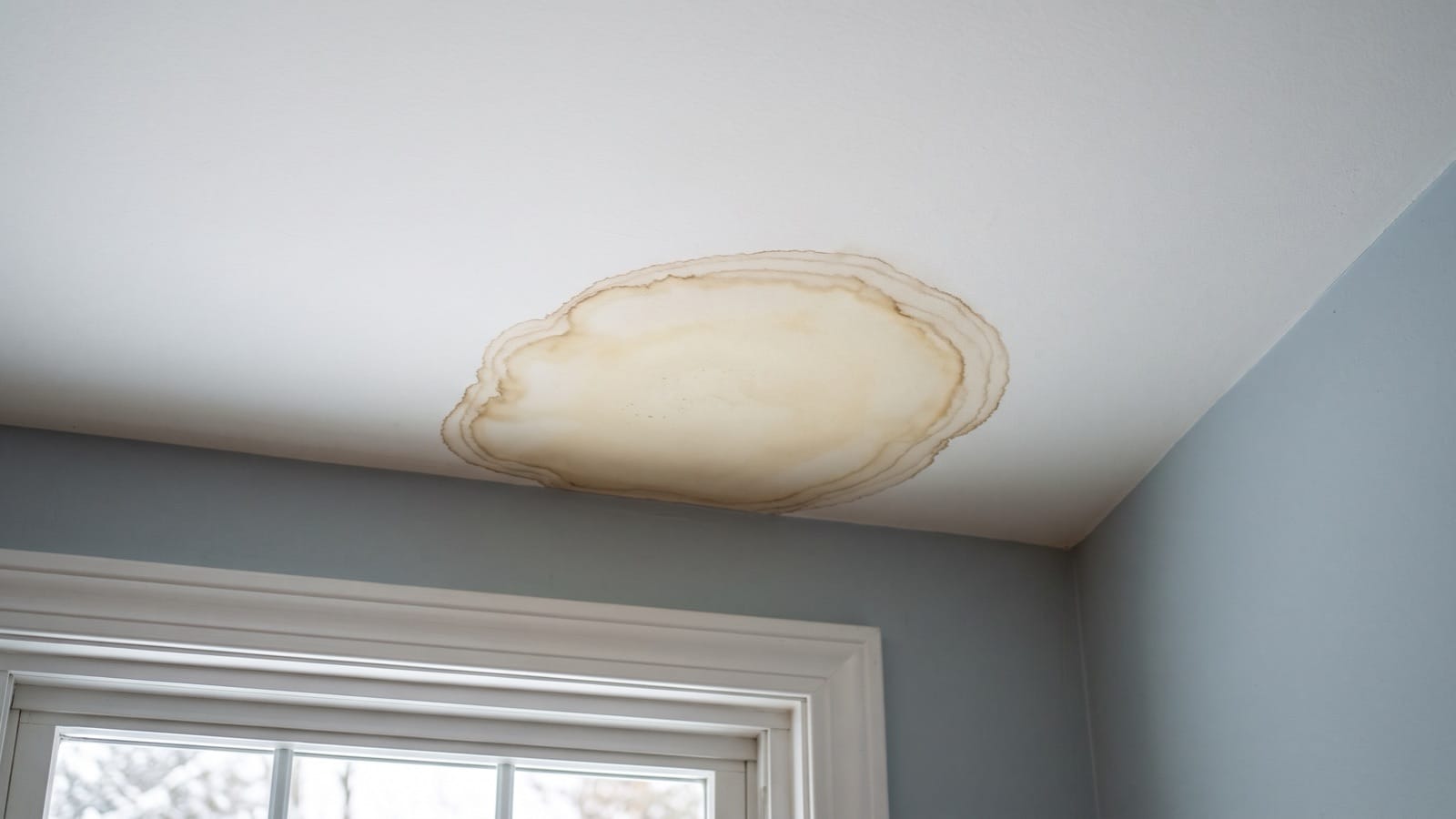
A water stain is a ring of residue left as water dries. Mold is a living growth, usually fuzzy or speckled, often with a musty smell. The EPA's guide says "Do not paint or caulk moldy surfaces," and that porous materials such as ceiling tiles "may have to be thrown away if they become moldy." The guide's cleanup advice draws a line at "less than about 10 square feet" (roughly 3 by 3 feet). Past that, call a mold professional. Our guide to painting over mold and mildew goes through it step by step.
Should you document the damage before painting?
Yes. Once primer goes on, the ice dam ceiling stain is gone, and so is the record of it. This isn't insurance or legal advice. It's good record-keeping, so you know later what the ceiling looked like and what was done.
- Photos of the stain. A wide shot that shows the room and a close-up with a tape measure in the frame, taken the day you find it.
- Photos of the cause. The ice along the eaves and icicles, taken from the ground, plus the attic above the stain if you can reach it safely.
- Dates. When you first saw it, the weather that week and the date of each thaw you watched it through.
- Readings. Moisture meter numbers with the date, from the stain and from the dry spot.
- Repairs. Who fixed the roof, attic or insulation and when, and the dates the ceiling was repaired, primed and painted.
Keep it all in one folder. If the ceiling ever stains again, that record shows where to start.
What primer covers an ice dam water stain on a ceiling?
A shellac-based primer. The residue in an ice dam ceiling stain bleeds right through water-based ceiling paint, and more ceiling paint usually just makes a bigger ring.
We use Zinsser B-I-N Shellac-Base Primer on water stains. Its data sheet says "One coat effectively blocks stains, including water, nicotine, ink, crayon, marker, rust and smoke stains so they will not bleed into the topcoat," and adds that "Some stains require a second coat." It's also "recommended for permanently sealing heavy fire and water stains."
Water-based "synthetic shellac" primers sit on the same shelf, but they're different products with different sheets. This post means the original shellac-base B-I-N.
Why shellac primer works in a New England winter
Shellac primer is unusually forgiving of cold. The B-I-N sheet lists "Can be applied in freezing temperatures" and gives the application window: "Apply only when air, material, and surface temperatures are between 0 and 90°F (-18 and 32°C) and the relative humidity is below 70%. Do not apply B-I-N if surface temperature is within 15°F of the dew point." That dew point margin matters on a cold ceiling under a drafty attic, so we check it with a thermometer and hygrometer before we open the can.
It dries fast. The sheet says it "Dries to the touch in 20 minutes, can be recoated in 45 minutes," and that "The primer film develops full adhesion and hardness after it cures in 1 to 3 days." It also warns that "Lower temperatures, higher humidity, and the addition of tint will prolong dry and cure time."
The trade-off is the solvent smell. The sheet lists cleanup with denatured alcohol and calls for a NIOSH-approved respirator and "adequate ventilation" when spraying. We ventilate the room and keep open flames away.
Should you repaint the whole ceiling or just the stain?
The whole ceiling, wall to wall. Paint over just the ice dam ceiling stain and the patch almost always shows. That's called flashing: the touched-up area reads as a different sheen or shade, because fresh paint on primer doesn't match paint that's aged for years. Window light skims across ceilings and shows it off.
The data sheet points the same way. On B-I-N, "Spot priming is recommended only under high-hiding topcoat finishes. For best results, prime entire surface before painting." Here's our usual order:
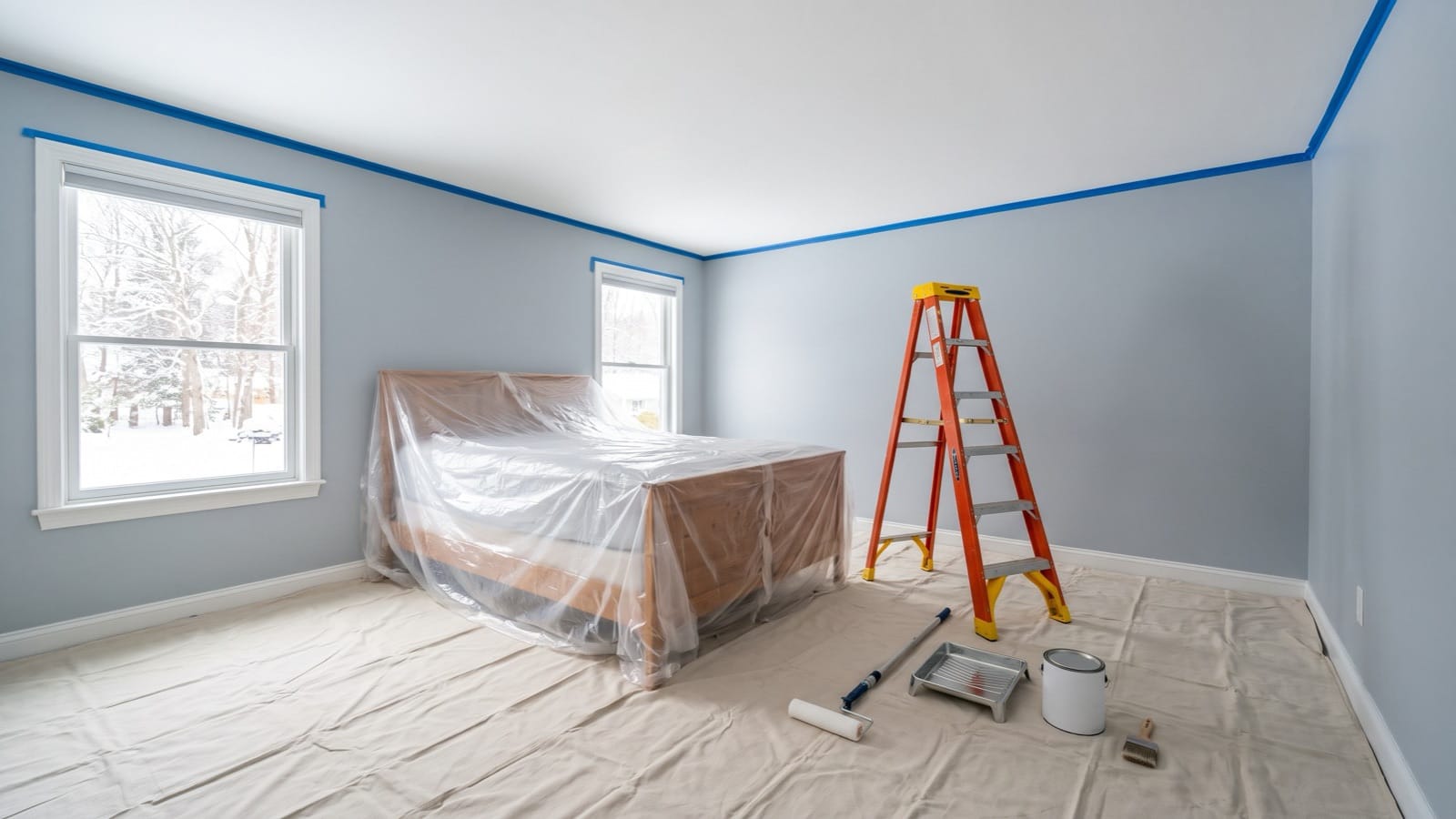
- Prep the room. Furniture out or wrapped, drop cloths wall to wall.
- Clean and repair. Wipe the stain, fix any cracks or loose paint, sand repairs smooth.
- Spot prime the stain with B-I-N. A second coat goes on if any color shows through the first.
- Prime the rest if it needs it. On a ceiling with repairs, patches or old dingy paint, we prime the full ceiling so the topcoat has one even surface.
- Two coats of flat ceiling paint over the whole plane, corner to corner, keeping a wet edge so there are no lap marks.
If the ceiling flows into a hallway or another room without a break, the whole run gets painted, because there's no natural place to stop. Curious what that runs? Our breakdown of the cost to paint a ceiling in Massachusetts covers sourced price ranges and what moves them.
Why does a water stain come back after painting?
Almost always because the leak wasn't fixed, the ceiling wasn't dry, the wrong primer was used, or the primer went on too thin. A ring that bleeds through in a day or two is a primer problem. An ice dam ceiling stain that comes back next winter is the roof.
- Latex paint straight over the stain. The stain bleeds through. More coats rarely fix it.
- Priming a damp ceiling. Trapped moisture pushes the stain and the paint film out. That's why the 12% limit is on the data sheet.
- Not enough primer. The B-I-N sheet says some stains need a second coat. If color shows through the first, it needs one.
Winter ceilings have other problems that look like water damage. Cracks that open every winter at the wall and ceiling joint are often truss uplift, which we explain in why ceiling cracks show up every winter. Small round bumps or popped screw heads are a different fix, covered in our post on nail pops in drywall before winter painting.
Ice dam ceilings in Framingham and Natick
Ice dams are a yearly event here. NOAA's 1991-2020 climate normals for the Natick station put normal snowfall at 45.7 inches a year, 34.2 inches of it in December through February, with 31.1 days a year when the high stays at or below freezing.
In Framingham and Natick we see the house types that tend to get them: Capes with finished rooms under the roof, older colonials with plaster ceilings, and ranches with long, low eaves. In a Cape, the ice dam ceiling stain often lands on the sloped part of an upstairs bedroom ceiling. We work from our base in Holliston across MetroWest.
If the room itself is cold, our guide to painting an unheated room in winter covers the topcoat's temperature limits. B-I-N handles the cold; most ceiling paint doesn't.
Frequently asked questions
Can you paint over an ice dam ceiling stain?
Yes, once the leak is fixed and the ceiling is dry. Seal the stain with a shellac-based primer such as Zinsser B-I-N, whose data sheet says substrate moisture shouldn't exceed 12%, then repaint the whole ceiling. Ceiling paint alone lets the stain bleed through.
Will an ice dam ceiling stain go away on its own?
No. The ring is residue left as the water dried, and it stays in the drywall or plaster. It needs a stain-blocking primer and new paint to disappear for good.
How long should an ice dam ceiling stain dry before painting?
Until a moisture meter shows the stain reads like a dry part of the same ceiling and within the 12% the B-I-N data sheet allows, ideally after one more thaw.
What is the best primer for an ice dam ceiling stain?
We use Zinsser B-I-N Shellac-Base Primer. Its data sheet says one coat blocks water stains so they won't bleed into the topcoat, that some stains need a second coat, and that it can be recoated in 45 minutes.
Why does the water stain keep coming back after I paint?
Usually it was painted with latex alone, primed while damp, primed too thin, or the leak came back. Shellac primer on a dry ceiling fixes the first three; roof and attic work fixes the last.
Is an ice dam ceiling stain dangerous?
The stain itself isn't, but what's behind it can be. A soft or sagging ceiling may be holding water, and damp materials can grow mold. The EPA says to dry water-damaged areas within 24-48 hours to prevent mold growth.
How can you tell if it's an ice dam ceiling stain or a plumbing leak?
Look at where and when. Ice dam stains show up in winter after a thaw, near outside walls. A stain mid-room, under a bathroom, or in a warm month points to plumbing.
Do I have to repaint the whole ceiling for an ice dam ceiling stain?
Almost always. Touch-up paint over primer flashes, showing as a different sheen or shade under window light. The B-I-N data sheet says that for best results you prime the entire surface before painting, and we paint the full ceiling plane.
The bottom line
An ice dam ceiling stain is the easy part of an ice dam. Fix what caused it, let the ceiling dry to the primer's 12% limit, photograph and date everything, seal it with shellac-based primer and repaint the whole ceiling. In that order, the ring stays gone.
Talk to Paint Pro
Paint Pro New England is based in Holliston and has painted homes across MetroWest for more than fifteen years. We are fully licensed and insured, including workers' compensation, use premium Benjamin Moore and Sherwin-Williams paints, back our work with a 2-year warranty on all work, and have more than 60 five-star reviews on Houzz. See our interior painting services for ceilings, walls, trim and doors. Call or text Dave at (774) 217-9567. You can also request a free, no-obligation estimate online.
Dave Griffiths
Dave Griffiths is the owner of Paint Pro New England, a professional painting company serving MetroWest Boston since 2011. With 15+ years of interior and exterior painting experience across the region, he leads every project with thorough prep, premium Benjamin Moore and Sherwin-Williams paints, and a 2-year warranty.

