



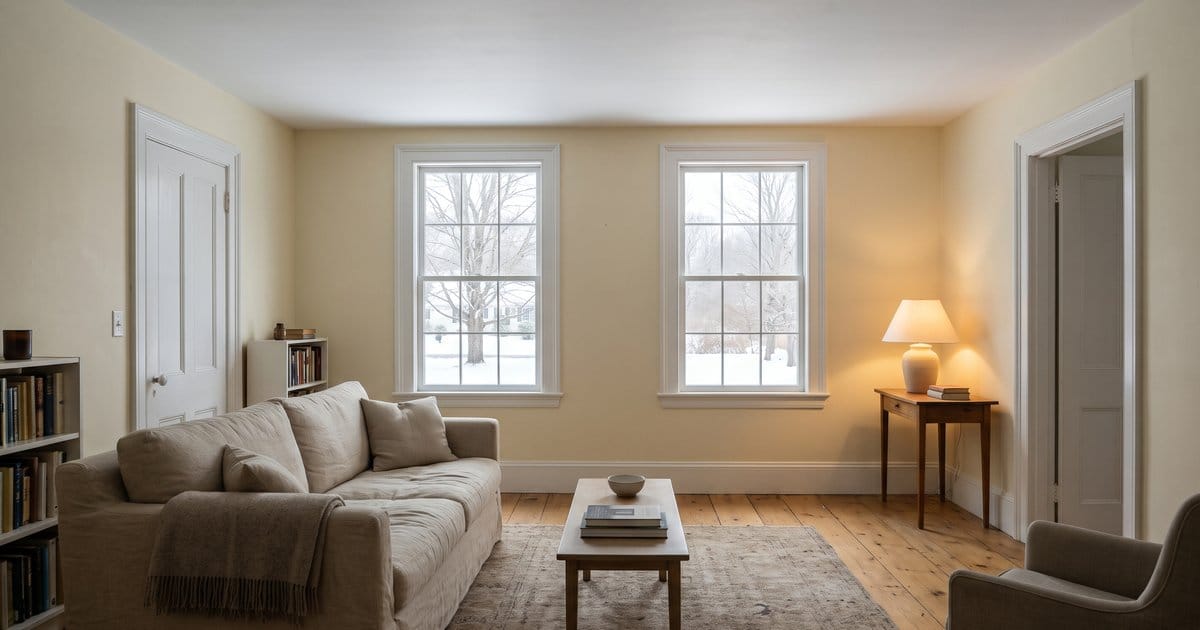
TL;DR: North-facing room paint colors need warm undertones and a fairly high light reflectance value (LRV). North light is cool sky light, so cool grays drift blue and stark whites go flat. Pick a warm white or warm neutral, light it with 2,700 to 3,000 K bulbs, and test samples morning, noon and after dark.
Choosing colors for a north-facing room this winter? Call or text Dave at (774) 217-9567. We'll look at the room in its own light, go through samples with you and talk about how they'll read in December and in July.
The gray that looked soft and warm on the chip turns slate blue on the wall. The white that looked clean in the store goes chalky and flat. We hear it from homeowners all over New England, and it's worst in December, when the sun stays low in the southern sky all day and a north window never sees it. This guide explains why it happens and how to choose north-facing room paint colors that hold up, with the LRV the paint maker publishes for every color we name. It also answers a question we get a lot: what's a softer, warmer white for a low-light room?
The short version
The light through a north window is sky light. It's cool and even, and it pulls out any blue, green or gray in a paint color. Good north-facing room paint colors push back with a warm undertone (yellow, red or orange) and reflect enough light to keep the room from feeling dim. Here's the checklist we work through before anyone buys a gallon.
- Check the undertone. Lean warm. Skip grays and whites with a blue, green or violet lean.
- Check the LRV. It runs from 0 to 100. For walls in a dim room, most homeowners are happiest from the high 50s into the 80s.
- Don't default to the brightest white. A white with almost no undertone often reads gray in cool, flat light.
- Match your bulbs. 2,700 K to 3,000 K bulbs warm the room after dark.
- Sample big. Two coats, about two feet square, on the window wall and the wall across from it.
- Look at every hour that matters. Morning, midday, late afternoon and after dark with the lamps on.
- Decide in winter if you can. A color picked on a July afternoon can look very different on a December morning.
Why do north-facing rooms make paint colors look cold?
Because a north window in the Northern Hemisphere looks at open sky most of the day and gets little or no direct sun, and sky light is blue. NASA's explanation of why the sky is blue puts it this way: "Blue light is scattered in all directions by the tiny molecules of air in Earth's atmosphere." The room behind a north window is lit by that scattered light, so everything in it takes on a slightly cool cast.
The paint makers agree. Benjamin Moore's continuing education course on light and paint says: "Light in north-facing rooms tends to be diffuse and cool." Sherwin-Williams' guide to choosing paint by room orientation says "North facing rooms receive the least amount of light throughout the day" and "It's best to avoid colors with cool undertones since those cool tones will make the room appear colder."
The upside is that north light is steady. Benjamin Moore's north-facing room color page notes that "A north-facing room tends to get consistent light throughout the day." Once you find north-facing room paint colors that work at 10 a.m., they'll usually still work at 2 p.m.
Why is it worse in a New England December?
Because the winter sun never gets around to the north side of the house. Timeanddate's Boston sun table for December 2026 shows that on December 21 the sun rises at a compass bearing of 122°, sets at 238° and climbs only 24.2° above the horizon at solar noon. The day is 9 hours and 4 minutes long, with sunset at 4:14 p.m. Sunrise and sunset are both well south of due east and west, so a north window gets no direct sun at all.
The June 2026 table is the opposite: on June 21 the sun rises at 57° and sets at 303°, both on the north side of east and west, so a north room catches a little low, warm sun early and late. Benjamin Moore's north-facing page says it outright: "Winter yields natural light that tends to be cooler and sharper than natural light during the summer." A color chosen in July is being judged in its best light of the year.
Why does gray paint turn blue in a north-facing room?
Gray turns blue because most grays carry a small amount of blue, green or violet, and cool north light has nothing warm to balance it. On a two-inch chip under store lighting, that lean is hard to see. On four walls lit by sky light, it's the first thing you notice.
Benjamin Moore answers the "perfect gray" question on its north-facing page with "It depends on the lighting," and says its grays for north rooms were chosen "for their warm undertones. Each one softens the crisp nature of northern light." Here's how a few well-known grays and greiges compare, using the LRV each maker publishes on its color page:
- Benjamin Moore Stonington Gray HC-170, LRV 59.36. The color page calls it "An all-purpose silvery gray with relatively neutral undertones." Neutral is exactly what north light pushes cooler.
- Benjamin Moore Edgecomb Gray HC-173, LRV 63.09. Its color page describes "A go-to neutral that can refresh a space, while providing a warm, welcoming feeling."
- Benjamin Moore Pale Oak OC-20, LRV 68.64. The Pale Oak page says "With its warm gray undertones, this versatile neutral conjures the quiet majesty of white oak."
- Sherwin-Williams Agreeable Gray SW 7029, LRV 60.386. The color page lists hex D1CBC1, which is red 209, green 203 and blue 193. Blue is the lowest of the three, which is what a warm lean looks like on paper.
What's the difference between a cool gray and a greige?
A cool gray leans blue, green or violet; a greige is gray with enough beige in it to lean warm. In north light a cool gray reads cooler still, while a greige tends to read as a quiet, true gray. If you love gray, a greige is usually the version that looks the way you expected.
Here's a quick check we use when narrowing down north-facing room paint colors online: look up the RGB or hex values on the maker's page. If blue is the lowest number, the color leans warm. If blue is the highest, it leans cool. It won't replace a sample, but it crosses a few off the list fast.
Why do white walls look flat or gray in north light?
A white looks flat when it has almost no undertone and the room has no direct sun to give it life. In soft north light, corners and ceiling lines read gray, and a very pure white makes that contrast easy to see. Benjamin Moore's guide to white and off-white paint colors describes Chantilly Lace OC-65 and Super White OC-152 as having "little to no visible undertone, making them two of our 'whitest white' paint colors." That's great on trim. On every wall of a north bedroom it can feel stark.
The same guide sorts whites into two families: "Warm white paint colors have red, orange and yellow undertones, evoking a soft glow and welcoming energy," while "Cool white paint colors have undertones of green, blue, and violet." Its north-facing page gives the fix in one line: "Counterbalance the cast of cool northern exposure with a clean, fresh white paint that has a hint of yellow."
What is a softer, warmer white for a low-light room?
A softer, warmer white for a low-light room is an off-white with a yellow or cream undertone and an LRV in the 80s. It still reflects most of the light in the room, with enough warmth to offset cool sky light. These are the whites we'd put on a sample board first:
- Benjamin Moore White Dove OC-17, LRV 83.16. The White Dove page calls it a "clean and classic white," and Benjamin Moore includes it on its north-facing page.
- Benjamin Moore Swiss Coffee OC-45, LRV 81.91. The Swiss Coffee page describes "An essential white paint color with just the right amount of warmth." It's on the north-facing page too.
- Benjamin Moore Simply White OC-117, LRV 89.52. The Simply White page says "The slightest hint of warmth makes this clean, crisp white a favorite to use anywhere in the home."
- Sherwin-Williams Alabaster SW 7008, LRV 82.215. The Alabaster page lists hex EDEAE0 (red 237, green 234, blue 224), so it leans warm.
- Sherwin-Williams Greek Villa SW 7551, LRV 84.223. The Greek Villa page lists hex F0ECE2 (red 240, green 236, blue 226), the same warm pattern a little brighter.
Chantilly Lace's color page lists an LRV of 90.04, barely above Simply White. In a north room, the undertone makes more difference than a point or two of LRV. Makers re-measure colors, so older LRVs float around online; every figure here comes from the maker's color page as of November 2026. For more on whites alone, see our guide to the best white paint for dark rooms in New England.
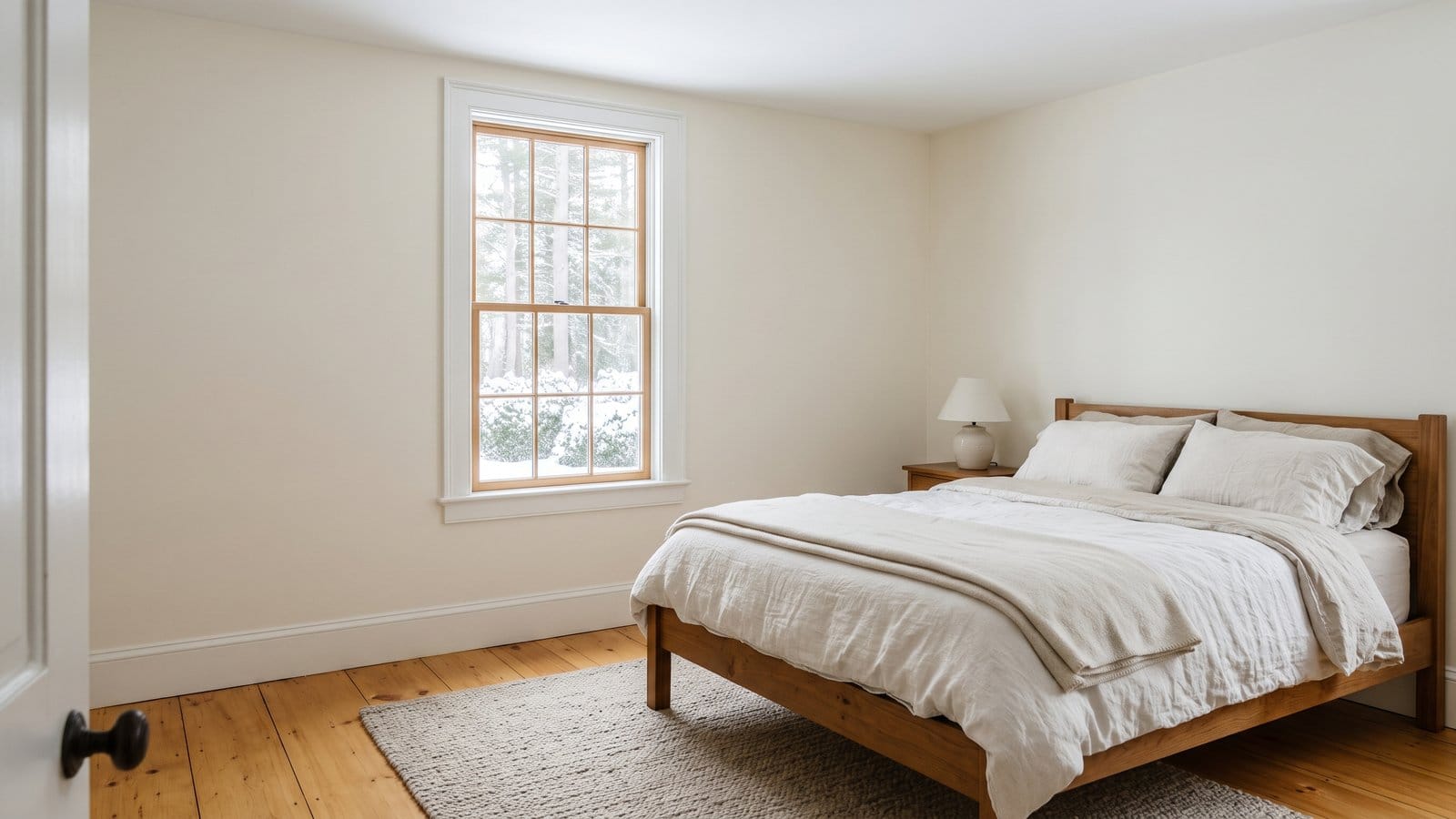
What is LRV, and what number should you look for?
LRV, or light reflectance value, tells you how much of the light hitting a color bounces back into the room. Sherwin-Williams' orientation guide says "LRV refers to the amount of light a color reflects," and "The scale ranges from 0-100 with zero reflecting no light and 100 reflecting all light." Benjamin Moore's course for architects adds that "A color with a high LRV will contribute most to daylighting and can reduce reliance on artificial light sources."
For north rooms, Sherwin-Williams says "you'll want to look at colors that have a higher LRV." The Benjamin Moore course gives targets for whole surfaces: for ceilings, "the recommended reflectance values are high at 80 percent or more," and "Reflectance values should be at least 50 percent for walls and at least 20 percent for floors." That matches what we see on the job. North-facing room paint colors in the 60s to 80s keep the walls feeling open, and a ceiling white above 80 helps most.
Do north-facing room paint colors with a higher LRV always look brighter?
They reflect more light, but they don't always look better. A cooler white at 90 can look grayer in north light than a warm one at 83, even though it measures brighter. Use LRV to set a floor, then let the undertone decide. A warm color at 70 often makes a north room feel brighter than a cool one at 75.
Which north-facing room paint colors work beyond white?
Warm neutrals, soft yellows, warm-leaning blue-greens and earthy reds and oranges all work, as long as the undertone leans warm. Benjamin Moore's north-facing page says its neutrals "provide soft yellow undertones that balance the coolness of a north-facing room." These three are on that page, with their published LRVs:
- Benjamin Moore Hawthorne Yellow HC-4, LRV 71.33. The color page calls it "A bold yet balanced yellow that is a popular accent choice for interiors and exteriors." Yellow is the most direct counterweight to blue sky light.
- Benjamin Moore Palladian Blue HC-144, LRV 60.4. The color page describes "this soft, airy blue-green." The green side keeps it from going icy the way a pure pale blue can.
- Benjamin Moore Potters Clay 1221, LRV 28.25. The color page says "this terracotta orange brings warmth to any space." It's deep, so it suits a dining room or study more than a small bedroom.
Sherwin-Williams gives the same advice for bold choices: "If you decide you want a bold, dark color to add a sense of drama, you'll still want to choose a color with warm undertones." Its article on light and finish says "A north-facing room painted in a warm orange-red color will appear brighter and warmer." If the deep, wrapped look appeals to you, our post on color drenching covers how it works in an older house, and our look at the 2027 colors of the year in a MetroWest home covers this year's deep green.
Be careful with pale icy blues, cool mint greens and blue-based grays. They can be lovely in a sunny south room and turn cold in a north one.
How do light bulbs change north-facing room paint colors?
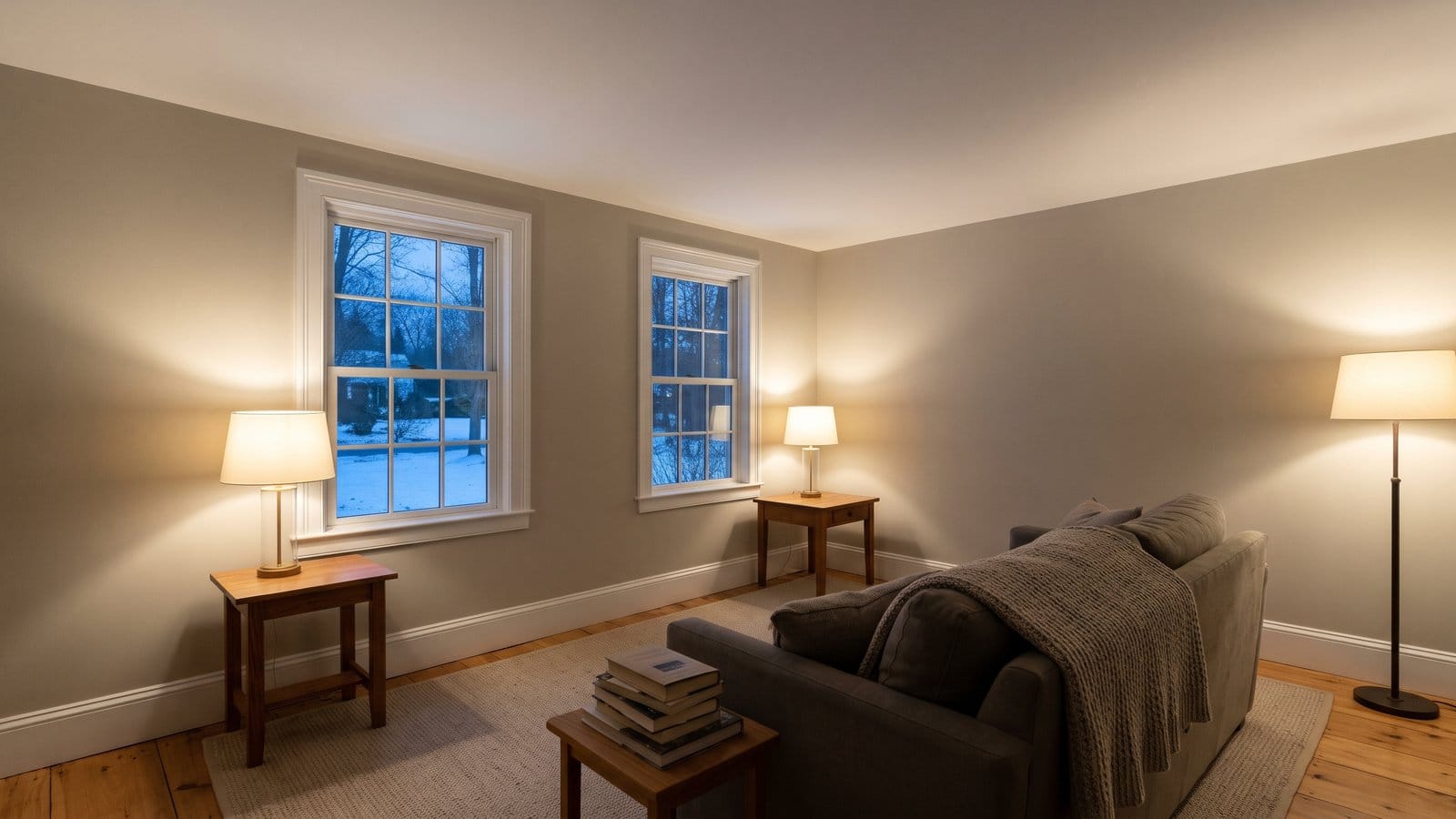
Bulbs matter more than most people expect, because in a New England December a north room spends much of the day on lamplight. With sunset at 4:14 p.m. on the shortest day, your bulbs are the main light from late afternoon on.
Bulb color is measured as color temperature in kelvins. The Department of Energy's guide to purchasing energy-efficient light bulbs says light "varies from a yellowish (i.e., warm) white to a bluish (i.e., cool) white," and lists typical values: Warm 2,700 K ("Friendly, personal"), Soft 3,000 K ("Warm, pleasing"), Neutral 3,500 K and Cool 4,100 K ("Neat, clean, efficient"). Benjamin Moore's course adds: "The higher the temperature, the bluer or 'cooler' the light."
- Use 2,700 K or 3,000 K bulbs in bedrooms, living rooms and dens. They add the warmth north daylight lacks.
- Keep every bulb in the room the same. The DOE guide warns that "Radically changing the CCT (e.g., from 2,700 K to 4,100 K) is noticeable and can result in occupant dissatisfaction." Mixed bulbs make one wall look like two colors.
- Check the color rendering index. The DOE guide notes that "ENERGY STAR-qualified light bulbs must have a CRI of 80 or greater." Higher CRI shows paint colors more accurately.
- Match the color to the light the room really uses. Sherwin-Williams says if you chose "white or cool toned lighting choose colors as you would for a north facing room." A home office under cool bulbs needs warm-leaning colors even more.
How should you test paint samples in a Massachusetts December?
Test big, on the right walls, at every time of day you use the room. Benjamin Moore's white guide says "White paint colors are especially prone to taking on different tonalities from morning to evening," and advises: "Test your paint colors from morning to evening, under both natural and artificial lighting conditions." Here's our routine with paint samples in a north room:
- Paint two coats, about two feet square. One coat lets the old color show through.
- Put one sample on the window wall and one on the wall facing it. The window wall sits in its own shadow and reads darker.
- Keep samples apart and off the old color's edges. Leave a band of white between them, or paint sample boards you can move.
- Look at 9 a.m., around solar noon, about 3:30 p.m. and after dark. In late December, solar noon in Boston is about 11:42 a.m. by the timeanddate table, and the light fades well before sunset.
- Look on a gray day and a bright one. Overcast skies flatten everything, and a clear blue sky makes north light cooler still.
- Look after it snows. The National Snow and Ice Data Center's snow science page says "Clean snow, however, reflects most of the visible sunlight." A snowy yard bounces extra light through a north window, and colors read brighter while it lasts.
- Live with them for a few days. Benjamin Moore suggests you "live with your options for a few days before you buy."
Should you pick north-facing room paint colors in summer or winter?
Winter, if you can. December is the hardest test a north room gets, so a color you like in December will almost always look good in July. If you're choosing in summer, look early on a cloudy morning and again with the lamps on, which is the closest you'll get to winter light.
What sheen and ceiling color work best in a north-facing room?
Eggshell or satin on the walls, a brighter sheen on trim and a light ceiling. Sherwin-Williams says a paint's finish, meaning its gloss or sheen, "can also drastically affect the appearance of color." Benjamin Moore's north-facing page suggests you "Consider using a higher finish on trim, like semi-gloss or high gloss," which adds a little shine where the light lands. Our comparison of eggshell vs satin for interior walls covers how each holds up.
The Benjamin Moore course calls the ceiling "the most important light-reflecting surface," so a white or a very pale tint of the wall color in the 80s is the safe choice. Our post on the painted ceiling trend covers when a darker ceiling works. In a north room, we'd usually keep it light.
North-facing rooms in MetroWest homes
We see a lot of north-facing rooms in the colonials and capes around Holliston, Hopkinton, Sherborn, Medway and Natick. Many have smaller, older windows, mature trees on the lot and center-hall layouts where a bedroom or two faces north year-round. A room under tall white pines or facing a neighbor's garage needs a higher LRV than a north room looking over an open field, which is why we'd rather see the room before suggesting north-facing room paint colors than guess over the phone. For whole-house palettes in this style of home, see our guide to interior paint colors for New England colonials.
Frequently asked questions
What are the best north-facing room paint colors?
Warm whites and warm neutrals with a fairly high LRV. Benjamin Moore lists White Dove OC-17 (LRV 83.16) and Swiss Coffee OC-45 (LRV 81.91) among its picks for north rooms, and warm greiges like Pale Oak OC-20 (LRV 68.64) suit people who want more color. Test samples in your own light first.
What color makes a north-facing room brighter?
A light color with a warm undertone. A higher LRV reflects more light, and a warm lean keeps that light from reading gray. Pair it with a ceiling white of 80 or above, which Benjamin Moore's course for architects recommends for ceilings, and 2,700 K to 3,000 K bulbs.
Should you paint a north-facing room white?
Yes, if it's a warm white. Benjamin Moore advises countering cool northern exposure with "a clean, fresh white paint that has a hint of yellow." Whites with little to no undertone, like Chantilly Lace OC-65, can look stark on every wall of a north room and are better used on trim.
Why do gray north-facing room paint colors look blue?
Most grays carry a slight blue, green or violet lean, and north light is cool sky light that brings that lean forward. A greige or a gray with warm undertones, such as Edgecomb Gray HC-173 (LRV 63.09), usually reads as a true gray there instead of a blue one.
What LRV is best for north-facing room paint colors?
For walls, most homeowners are happy from the high 50s into the 80s, with ceilings at 80 or more. Benjamin Moore's course for architects recommends at least 50 percent reflectance for walls and 80 percent or more for ceilings. Undertone matters as much as the number.
What light bulbs are best for north-facing room paint colors?
Warm bulbs at 2,700 K or 3,000 K, the Department of Energy's "Warm" and "Soft" categories, with a CRI of 80 or higher. Keep every bulb in the room the same color temperature so the walls don't look like two different colors.
Are dark north-facing room paint colors a good idea?
They can be, if you want a cozy room more than a bright one. Sherwin-Williams says a bold, dark color in a north room should still have warm undertones. A deep terracotta like Potters Clay 1221 (LRV 28.25) works well in a dining room or study with warm lamps.
How long should you test north-facing room paint colors before choosing?
At least two or three days, so you see a gray day, a bright day and the room after dark. Benjamin Moore suggests you "live with your options for a few days before you buy." Look at the samples in the morning, at midday and with the lamps on.
The bottom line
North light is cool, steady and at its weakest in a New England December. The north-facing room paint colors that work lean warm, reflect enough light for the room and get chosen under the bulbs you'll actually use. Start with a warm white or a greige, check the LRV on the maker's page, paint big samples on two walls and look at them across a full winter day before you commit.
Talk to Paint Pro
Paint Pro New England is based in Holliston and has painted homes across MetroWest for more than fifteen years. We are fully licensed and insured, including workers' compensation, use premium Benjamin Moore and Sherwin-Williams paints, back our work with a 2-year warranty on all work, and have more than 60 five-star reviews on Houzz. See our interior painting services for walls, ceilings, trim and doors. Call or text Dave at (774) 217-9567. You can also request a free, no-obligation estimate online.
Dave Griffiths
Dave Griffiths is the owner of Paint Pro New England, a professional painting company serving MetroWest Boston since 2011. With 15+ years of interior and exterior painting experience across the region, he leads every project with thorough prep, premium Benjamin Moore and Sherwin-Williams paints, and a 2-year warranty.

