



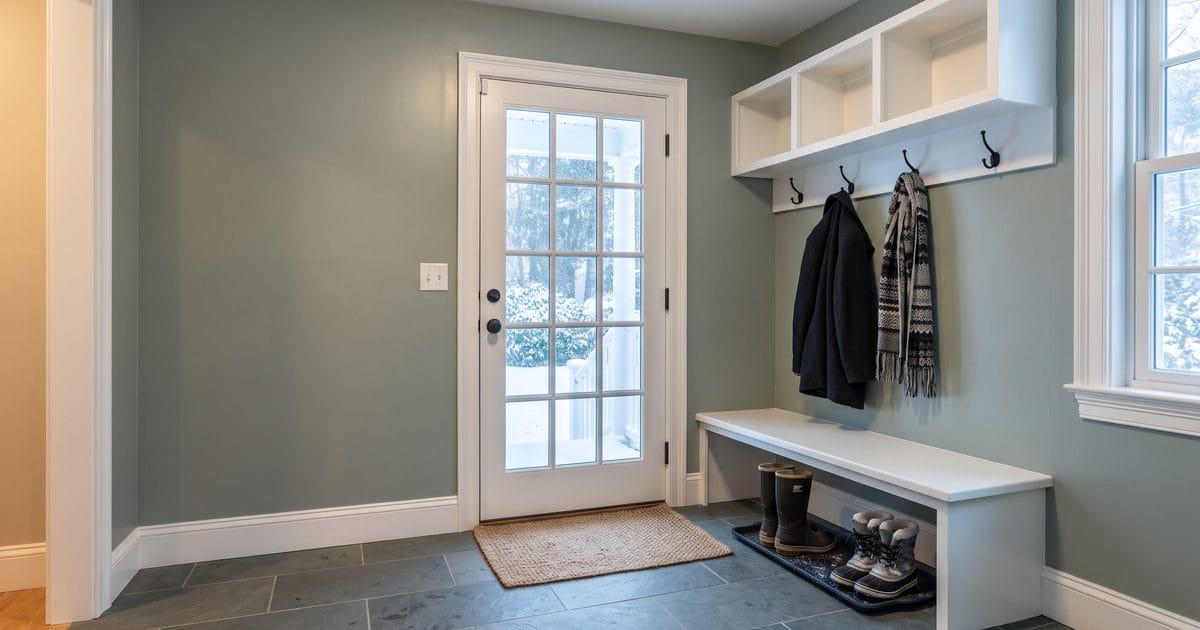
TL;DR: The right mudroom paint is a washable satin on the walls and a hard enamel, such as Benjamin Moore ADVANCE or Sherwin-Williams Emerald Urethane Trim Enamel, on the trim, bench, cubbies and doors. Pick a mid-tone color that hides mud and salt, and finish before the December snow so it can cure before the boots arrive.
Want the mudroom done before the first storm? Call or text Dave at (774) 217-9567. We'll look at the walls, the trim and the traffic, and tell you which finish each surface needs.
A mudroom in a Massachusetts house takes more abuse from December to March than most rooms see in a year. Boots get kicked off against the baseboard, salty slush drips onto the bench and hockey bags scrape the wall on the way in. The mudroom paint is the first thing that shows it. Good mudroom paint lets the marks wipe off without leaving a shiny patch, a dull smear or bare primer behind.
This mudroom paint guide covers every surface in the room, from the walls and trim to the bench, wainscot, doors and the strip of wall above the floor. It also explains what a scrub rating measures, how to get road salt off without wrecking the finish, which colors hide grime and why timing matters.
The short version
The best mudroom paint plan uses two products: a durable wall paint in satin (or eggshell on upper walls that rarely get touched) and a hard trim enamel in satin or semi-gloss on everything that gets kicked, sat on or grabbed. Give both the full cure time before winter traffic starts, and clean salt off with plain water before you reach for anything stronger. Here's our checklist for a mudroom paint job that lasts the winter.
- Split the room by height. The lower three or four feet takes almost all the abuse. Plan a tougher finish there, either wainscot, beadboard or a harder enamel on the wall itself.
- Skip flat finishes. Flat mudroom paint is the hardest to keep clean, and Benjamin Moore warns that stains are harder to remove from low-sheen paint and rubbing can burnish it.
- Use an enamel on trim, bench and doors. A waterborne alkyd or urethane-modified enamel dries harder than wall paint.
- Read the data sheet for each mudroom paint. Check the minimum temperature, the recoat time and how long before the surface can be washed.
- Don't shop for mudroom paint by scrub count alone. A scrub rating measures how long it takes to wear the film away, which is a different question from how well it hides scuffs.
- Prime bare wood and patches. New wood, sanded spots and fresh joint compound all need primer before the finish coats.
- Pick a mid-tone mudroom paint color. Mid-tones hide both dark mud and white salt residue better than bright white or near-black.
- Paint early enough to cure. Most mudroom paint finishes ask for about two weeks before washing, so aim to finish before December's snow in MetroWest.
- Clean salt off mudroom paint gently. Warm water first, then mild dish soap, with a soft sponge. No glass cleaner, no abrasive pads.
What is the best mudroom paint finish for walls?
Satin is the best all-round mudroom paint finish for walls, with eggshell as a fine choice for the upper half of the room where hands and bags rarely reach. If you're looking for the best paint for mudroom walls, start with the sheen. Satin has enough sheen to shed dirt and stand up to wiping without the glare and flaw-revealing shine of semi-gloss on a large flat wall.
Benjamin Moore's guide to choosing a paint finish lays out the trade-off clearly. Of flat paint it says: "Stains are harder to remove from low-sheen paint, and constant rubbing or cleaning can result in burnishing." Of satin, it says the finish offers "better stain resistance and durability than lower sheens, including eggshell." And of high gloss it warns, "Since a gloss finish reflects light and can accentuate blemishes, avoid using it on areas that are not completely smooth." Mudroom walls with moved hooks and filled dents rarely meet that bar.
Sherwin-Williams makes the same point in its wall cleaning guide: "Flat and matte finishes are less durable than Satin or Semi-Gloss, meaning you'll want to avoid scrubbing too hard." In a room where you'll be wiping slush splashes every week from December to March, that's a strong reason to choose a mudroom paint with more sheen than flat.
The sheen name on the can is a category with a range behind it. Benjamin Moore's ADVANCE satin lists a gloss of 25 to 35 at 60°, and Sherwin-Williams' Emerald Urethane satin lists 35 to 45 units at 60° on their data sheets (both linked below). Two satin mudroom paint products from two brands can look noticeably different side by side. We go deeper on that in our post on eggshell vs satin on MetroWest interior walls.
Is eggshell or satin mudroom paint better?
Satin for the lower walls and anywhere people lean, eggshell above about shoulder height if you want a softer look. Benjamin Moore describes eggshell as "an easy-to-clean, nearly shine-free finish, suited for most areas of a home, including family rooms and hallways," so it isn't a bad choice. As a mudroom paint it just has less margin for the hard wiping of a Massachusetts winter. If the room has wainscot or beadboard on the lower wall, eggshell on the upper wall works well because the panelling is doing the hard work below.
What about the newer scrubbable matte paints?
Some premium lines are sold as washable mattes, and Benjamin Moore says its matte finish "withstands frequent washing, even when applied in busier areas like hallways and family rooms." We still don't put matte mudroom paint on the lower wall of a working mudroom. A wall that survives washing can still polish where the same spot gets rubbed all winter, and that shiny patch is what you end up looking at.
What does a scrub rating on mudroom paint actually measure?
A scrub rating measures how many passes of an abrasive brush it takes to wear a paint film away in a lab. It doesn't measure how easily a boot scuff or a salt line comes off. That difference matters when you're comparing mudroom paint cans in the store.
The standard behind most scrub numbers is ASTM D2486, Standard Test Methods for Scrub Resistance of Wall Paints. Its scope says the methods determine "the resistance of wall paints to erosion caused by scrubbing." It has two versions. Test Method A reports "Cycles-to-failure obtained on test paint." Test Method B reports a "Ratio expressed as a percentage of cycles-to-failure obtained on the test paint to that obtained on a concurrent run with a known reference paint."
ASTM is honest about the limits. The standard's significance section says: "Poor correlation in scrub testing can be attributable to among other things variations in the stiffness of the brush bristles, condition of washability tester, application and drying conditions."
Benjamin Moore's own technical bulletin on scrub and scuff resistance goes further. It says "ASTM sets the error margin at about 58% between labs," that "Scrub testing is not about removing stains or cleaning the paint surface the way 'scrub' is understood outside of the lab," and that "Scrub testing is also NOT about removing scuffmarks from a painted surface." The same bulletin notes that its Green Promise products have "an ASTM scrub resistance higher than 400 cycles per Green Seal GS-11 requirements," and that alkyd paints "have inherently poor scrub resistance although they usually dry harder and are easier to clean than latex."
So when a blog or a sales sheet tells you one mudroom paint has a higher cycle count than another, treat that as a rough sign of a well-made film. It won't tell you which wall looks better in February. Ask where the number came from, which method was used, and whether the maker publishes it on a technical data sheet. Many premium lines don't print a cycle count at all.
Scrub, scuff and burnish: three different mudroom paint problems
These three words get used as if they mean the same thing, and they don't.
- Scrub resistance is how much abrasive cleaning the film survives before it wears through. ASTM D2486 measures this.
- Scuff resistance is whether a rubber heel, a stroller wheel or a bag strap leaves a dark mark in the first place, and whether that mark wipes off. Benjamin Moore's bulletin says "There is no official test for removing scuffmarks."
- Burnishing is the shiny patch left when a lower-sheen paint is rubbed smooth, by cleaning or by the same shoulder brushing the same corner every day.
Good mudroom paint has to handle all three. That's why the finish and the product line matter more than any single number, and why the trim and bench get a different product from the walls.
What mudroom paint should go on trim, benches and cubbies?
A hard-drying trim enamel, in satin or semi-gloss. Two we use often are Benjamin Moore ADVANCE and Sherwin-Williams Emerald Urethane Trim Enamel. Both are waterborne enamels that level out like an oil paint and dry harder than ordinary wall paint, which is what you want on a bench seat, a cubby shelf or a door casing that gets hit by boots.
Benjamin Moore's ADVANCE Waterborne Interior Alkyd Satin (792) data sheet describes it as "a tough, satin finish that stands up to repeated washing" and lists it as "Ideal for interior doors, trim, cabinets, walls, and ceilings." The numbers that matter for mudroom paint on trim:
- Dry time at 77 °F and 50% humidity: 4 to 6 hours to touch, 16 hours to recoat.
- Cure: "Do not expose to heavy abrasion or return shelves/tabletops to service for at least 5 – 7 days to prevent damage to the finish."
- Full hardness: "Depending on weather and drying conditions, it could take up to 30 days to reach optimum hardness and final sheen."
- Temperature: a minimum surface temperature of 50 °F during application.
- Sheen: 25 to 35 at 60°, and the sheet lists it as "Block-resistant."
Sherwin-Williams' Emerald Urethane Trim Enamel satin data sheet describes a "urethane modified alkyd resin system" that "delivers the look, feel and durability of an oil based enamel with the convenience of a waterbased formula." It lists 1 hour to touch and 4 hours to recoat at 77 °F and 50% humidity, a finish of 35 to 45 units at 60°, and "Apply at temperatures above 50°F (10°C)." It's labelled interior-exterior, which is useful on the inside face of an exterior door that sees cold air and snowmelt.
That 16-hour recoat on ADVANCE means two coats on a bench, cubbies and casings take at least two working days before the cure clock even starts. We go into trim products and prep in more detail in our guide to trim, crown moulding and millwork painting.
Why the bench seat and cubby shelves need the most patience
Horizontal surfaces get weight, wet and friction all at once: snow pants and boot buckles on the bench, wet mittens in the cubbies. Fresh mudroom paint on a bench can feel dry within hours and still be soft underneath, and a damp bag left on it overnight can stick or leave a print. That's what "block resistance" on a data sheet is about. ADVANCE's 5 to 7 day wait before shelves go back into service is the number we plan around, and on a bench we'd rather leave the seat empty for the full week.
If the bench top is bare wood that's been worn through by years of use, it needs sanding and a primer first. The ADVANCE sheet calls for wood to be primed with Benjamin Moore's Fresh Start primers before the finish coats.
Should a mudroom have wainscot or beadboard, and what mudroom paint goes on it?
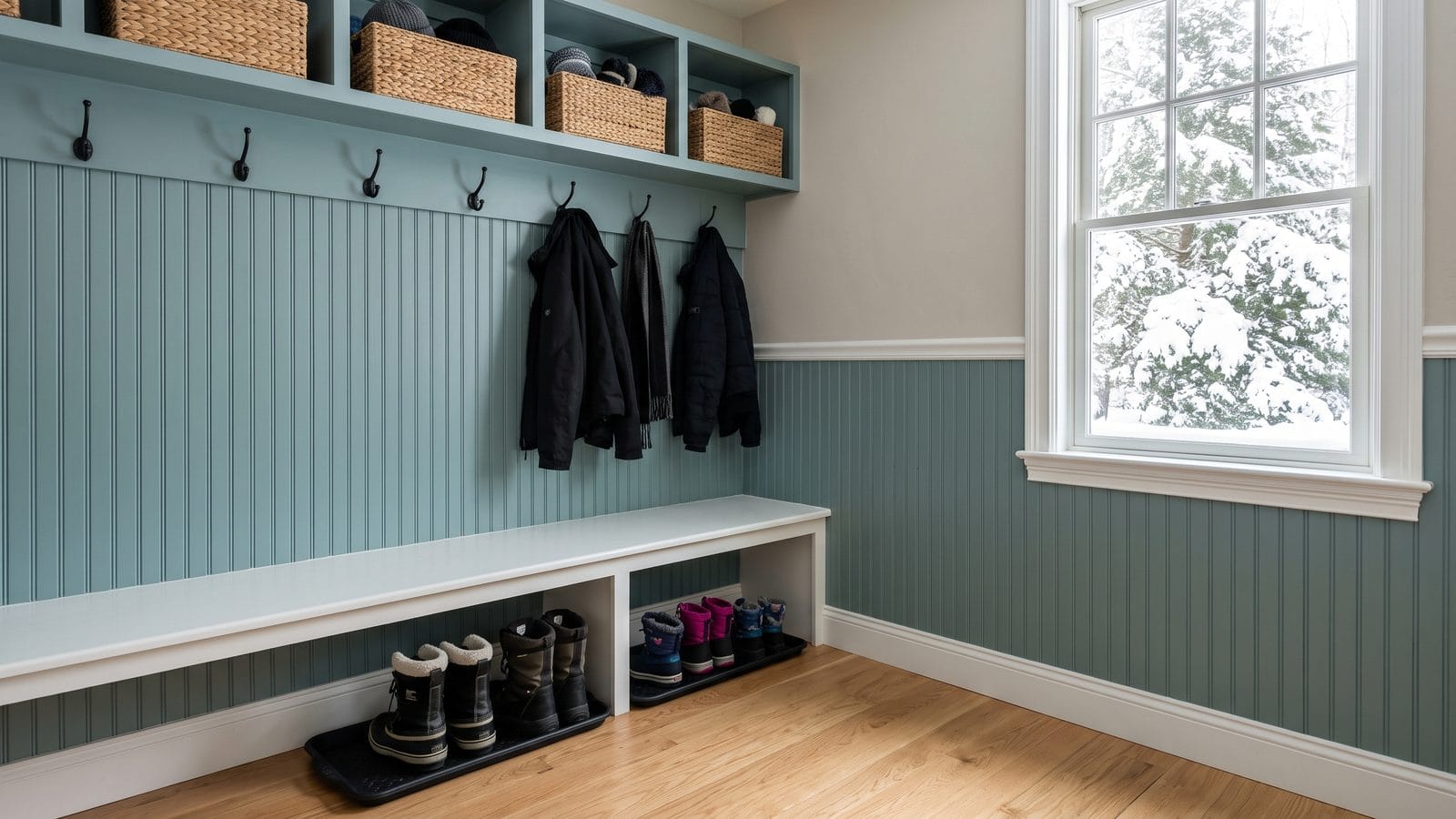
If you can add it, yes. Wainscot or beadboard on the lower wall gives you a hard, replaceable surface right where boots, bags and wet dogs make contact, and it takes trim enamel instead of wall paint. That's the single biggest upgrade we see in how well mudroom paint holds up.
A few practical points we follow:
- Height. We usually run it to the top of the bench back or a bit above, so the zone that gets bumped is covered. Lower wainscot leaves the strip above it exposed to coat zippers and backpack straps.
- Finish. Satin or semi-gloss enamel on the panelling, with satin or eggshell mudroom paint above. Benjamin Moore's finish guide suggests pearl for trim, wainscoting and doors.
- Grooves. Beadboard looks great but the grooves catch grit and dried salt. A soft brush before you wipe gets it out. Caulk the joints at the top cap and the baseboard so meltwater can't wick behind the boards.
- Two-tone walls. If panelling isn't in the budget, a darker satin or semi-gloss mudroom paint on the lower third with a chair rail line gives you the same color logic without the carpentry.
For beadboard technique, including how we deal with the grooves, see our post on painting beadboard porch ceilings.
What mudroom paint goes on doors, baseboards and surfaces next to the floor?
Trim enamel, with extra attention to the bottom edge, and a clear line between what's paint's job and what's the floor's job. The lowest six inches of a mudroom wall get more slush, salt and kicking than anything else in the house.
- Baseboards. Enamel in semi-gloss or satin, with the top edge caulked to the wall so water can't sit in the gap. We cut a clean line where the baseboard meets a tile or vinyl floor so the paint doesn't creep onto the floor, where it'll peel under wet boots.
- The exterior door, inside face. This side sees cold air and snowmelt. An interior-exterior enamel like Emerald Urethane suits it. Paint the top and bottom edges too if you can get the door off, because bare edges take on water and swell. Our post on painting or replacing doors covers when a tired door is worth painting.
- Door casings and the latch side. Hands grab here all winter. Enamel, two full coats, and a week before hard use.
- Floors. Wall and trim mudroom paint doesn't belong on a floor. Benjamin Moore's Scuff-X satin data sheet, a paint built for school hallways and locker rooms, still says "Not recommended for floors." A painted mudroom floor needs a floor-rated coating, and that's a separate project.
One more note on older houses. Many MetroWest mudrooms are converted back entries or porches with old trim and old paint. We use lead-safe methods on every pre-1978 home: containment, HEPA vacuums, wet scraping and proper disposal.
How do you clean road salt off mudroom paint?
Brush or vacuum the dry salt off first, then wipe with warm water and a soft sponge, and only add mild dish soap if water doesn't do it. Rinse with clean water and dry the wall. Scrubbing hard or using strong cleaners does more damage to mudroom paint than the salt does.
The salt comes in on every boot. MassDOT's Snow and Ice Control Program annual report says the state "used 455,447 tons of road salt in FY18, which is approximately 11% less than the long-term average annual usage of 500,096 tons for the last 18 years." When slush dries on a wall or baseboard, it leaves a white, chalky line, and in a mudroom that line builds up a little every day.
Here's how the paint makers say to clean salt off mudroom paint:
- Wait for the cure. Sherwin-Williams says: "For freshly painted walls, wait at least two weeks before cleaning with soap and water to ensure the finish has fully cured." Benjamin Moore's wall cleaning guide also says to "wait at least two weeks for newly painted walls to cure before dusting or cleaning them."
- Start with water. Benjamin Moore's guide says to begin with plain warm water and step up to warm water with mild dish detergent if that doesn't work.
- Use a soft sponge. Its instructions: "use a large, non-abrasive sponge and rub in a circular motion without scrubbing too hard."
- Skip harsh cleaners. "Never use glass cleaner or a heavy-duty household spray cleaner on a painted wall," Benjamin Moore says, because they "contain strong solvents that can damage the finish." It also says to "avoid using a combination of products."
- Rinse and dry. Soap left on the wall attracts dirt, and a damp baseboard is where salt crystals re-form.
Two habits help more than any cleaner. Wipe the splash zone weekly through the winter so salt doesn't build up in layers, and put a boot tray or a washable mat where boots come off so meltwater pools on the tray instead of against the baseboard. Salt-stain tips for floors and car mats often call for vinegar. The paint makers' wall-cleaning guidance doesn't, so we stick to water and mild soap on painted surfaces.
What mudroom paint colors hide dirt and salt best?
Mid-tone mudroom paint colors hide the most. Bright whites show every brown splash, and very dark colors show white salt lines and dust. A mid-tone gray, greige, muted green or soft blue sits between the two kinds of mess a mudroom collects.
The number to look at is light reflectance value. Sherwin-Williams explains LRV as the amount of light a color reflects, on a scale where, in its words, "The scale ranges from 0-100 with zero reflecting no light and 100 reflecting all light" (Sherwin-Williams, choosing color by room orientation).
Here's how we think about mudroom paint colors by LRV:
- High LRV whites and off-whites. They brighten a windowless mudroom but show every splash, so use them above the wainscot line and on the ceiling.
- Mid-range colors. Grays, greiges, sage and muted blue-greens in the middle of the scale hide the most day to day. These are our usual pick for the walls of a hard-working mudroom.
- Deep colors on the lower wall. A navy or charcoal on wainscot, the bench or a door looks sharp and hides mud. Benjamin Moore lists Hale Navy (HC-154) at an LRV of 8.36, near the dark end of the scale. In our experience, very dark finishes show dried salt and dust as a pale film, so they need that weekly wipe.
Sample on the actual wall under the room's own light, since a mudroom with one small window reads darker than the chip. If you're coordinating with a hallway, our post on hallway and stair interior paint covers finishes for the rooms the mudroom opens into.
When should you paint a mudroom before winter in Massachusetts?
Finish the mudroom paint by mid-November if you can, and as early in December as possible if you've missed that. Every day of cure before the snow helps: the walls need about two weeks before washing, and trim enamel keeps hardening for weeks after that.
NOAA's 1991-2020 climate normals for Natick show why the timing works the way it does. Normal snowfall is 1.1 inches in November, then 11.5 inches in December, 13.8 inches in January, 8.9 inches in February and 8.2 inches in March. The normal December high is 40.7 °F with a normal low of 22.9 °F. The mudroom goes from light use to full winter duty within a few weeks.
Now line that up with the data sheets:
- Walls: about two weeks before washing, per the Benjamin Moore and Sherwin-Williams cleaning guidance above, and Scuff-X's sheet says "Painted surfaces can be washed after two weeks."
- Trim enamel: 16 hours between coats for ADVANCE, then 5 to 7 days before heavy abrasion, and up to 30 days to reach full hardness.
- Temperature: a 50 °F minimum surface temperature on ADVANCE, Scuff-X and Emerald Urethane. A mudroom on a slab, or one that was once a porch, can have outside walls well below the thermostat setting.
Add those up and a mudroom paint job finished on November 14 is washable around Thanksgiving and well on its way to full hardness by the time December storms arrive. Finish on December 10 and you're asking soft paint to take wet boots the next morning.
If you're reading this in late November, the job can still be done well. Plan the cure into the room's routine: boots on a tray, wet coats hung away from the fresh wall, and spot cleaning only. Benjamin Moore's cleaning guide says that if spills or stains happen early, "you can safely clean a newly painted wall after four to six hours," so a gentle wipe of a splash is fine while the full wash waits two weeks.
If the mudroom is cold or only partly heated, read our guide to painting an unheated room in winter first. It covers surface temperature, dew point and safe heat. And plan on the room being out of use: our post on how long before furniture goes back after painting explains why "dry" and "ready for use" are different days.
How long does a mudroom paint job take?
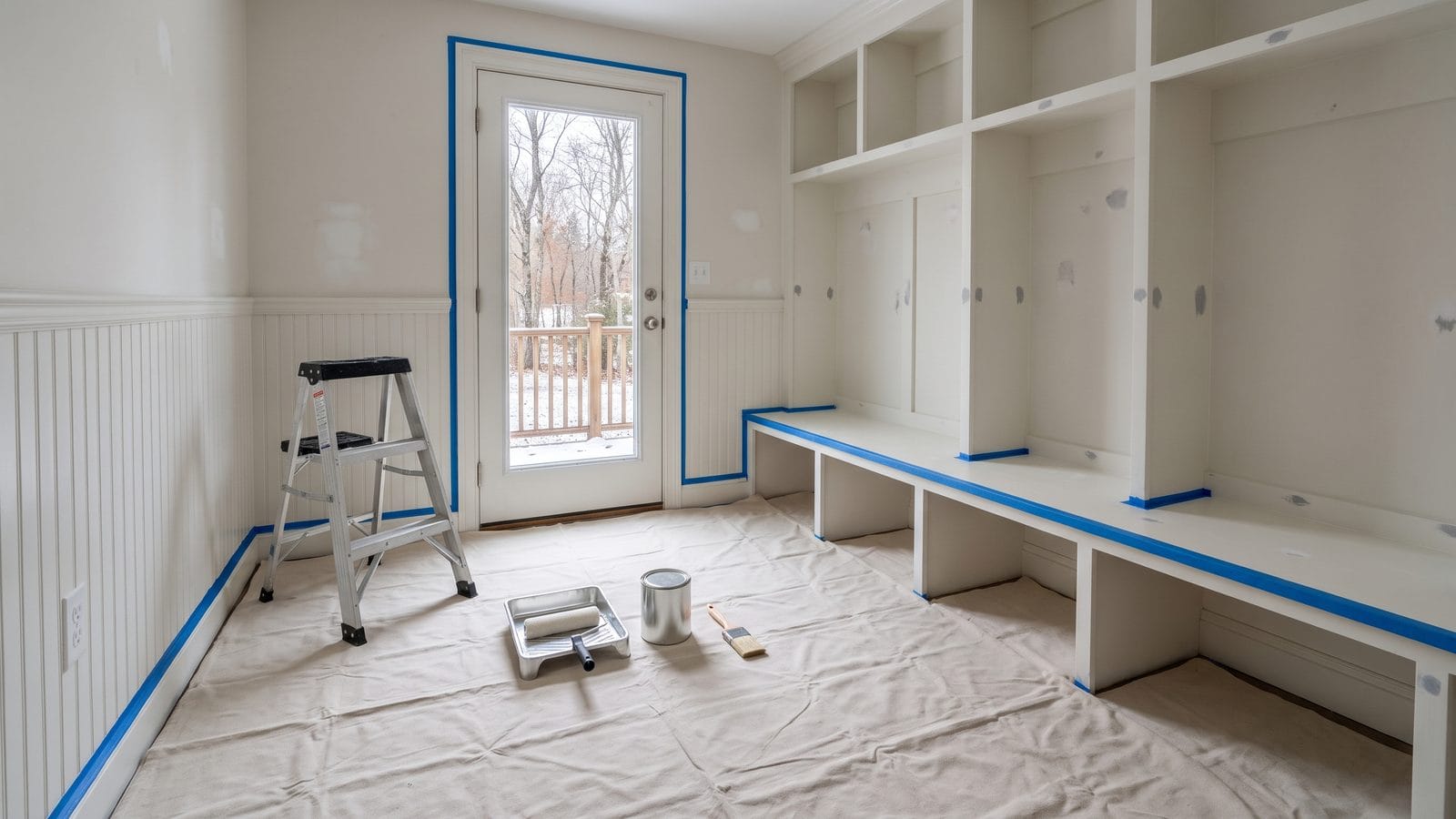
Plan two to three working days for a typical mudroom with walls, trim, a bench and cubbies, and longer if there's a lot of patching or bare wood. Day one is protection, cleaning, patching, sanding and priming. Day two is the wall coats and the first enamel coat. Enamel's overnight recoat usually pushes the second trim coat to day three. Then the week of light use for the bench and shelves starts.
What prep does mudroom paint need to stick?
Clean, dull and prime. Every data sheet we've quoted starts with the same rule. The ADVANCE sheet says surfaces "must be clean, dry, and free of dirt, dust, grease, oil, soap, wax, scaling paint, water soluble materials, and mildew," and that "Glossy areas should be dulled." In a mudroom, "water soluble materials" includes the salt film on the lower wall.
Our routine before any mudroom paint goes on:
- Protect the room. Drop cloths flat across the whole floor, bench and hooks cleared, hardware removed, straight tape lines on the floor edge.
- Wash the splash zone. Warm water and mild detergent on the lower wall and baseboards, then a clean-water rinse so no salt or soap is left under the new paint.
- Repair. Fill dents and anchor holes, re-secure loose casing and caulk open joints at the baseboard and wainscot cap.
- Sand and dull. Scuff glossy trim so the enamel bonds, and remove the dust.
- Prime. Spot prime patches and bare wood with the primer the data sheet names. For a big color change, a tinted primer helps the finish coats cover.
Skipping the wash step is the most common reason we see new mudroom paint failing early on a baseboard. Salt and grime under the paint keep it from bonding, and the first wet boot lifts it.
Mudroom paint in MetroWest homes
We're based in Holliston and paint mudrooms across MetroWest, including Hopkinton, Medway, Ashland, Sherborn, Millis and Natick. Older farmhouses and Colonials often have a back entry or enclosed porch turned mudroom, with old trim and drafty doors, which means more repair and lead-safe prep. Newer houses usually have a purpose-built mudroom off the garage with a lot of built-in millwork that needs a hard enamel. Both need the mudroom paint finished before the snow.
Frequently asked questions
What is the best mudroom paint finish?
Satin on the walls and a satin or semi-gloss trim enamel on trim, the bench, cubbies and doors. Benjamin Moore says stains are harder to remove from low-sheen paint and rubbing can burnish it, so we don't use flat paint on mudroom walls.
Is semi-gloss or satin mudroom paint better?
Satin for the walls, semi-gloss or satin enamel for trim and built-ins. Semi-gloss wipes easily, but on a large wall it shows patches and dents. Benjamin Moore advises against high gloss on any surface that isn't completely smooth.
What does a scrub rating mean on mudroom paint?
It's how many abrasive brush cycles the paint film survives before it wears through in an ASTM D2486 test. It doesn't measure scuff removal, and Benjamin Moore's technical bulletin says ASTM sets the error margin between labs at about 58%.
What color mudroom paint hides dirt best?
Mid-tone colors such as gray, greige, sage and muted blue-green. Bright white shows mud, and very dark colors show white salt residue and dust. A deep color on the lower wall or bench with a lighter color above works well.
How long should mudroom paint cure before winter boots?
About two weeks before washing the walls, which both Benjamin Moore and Sherwin-Williams recommend. Benjamin Moore ADVANCE trim enamel needs 5 to 7 days before heavy abrasion and can take up to 30 days to reach full hardness.
How do I get salt stains off mudroom paint?
Brush off the dry salt, then wipe with warm water and a soft sponge, adding mild dish soap only if needed. Rinse and dry. Benjamin Moore says never to use glass cleaner or heavy-duty spray cleaners on painted walls.
What mudroom paint should I use on a bench?
A hard trim enamel such as Benjamin Moore ADVANCE or Sherwin-Williams Emerald Urethane Trim Enamel, over primer on bare wood. Keep the seat clear for the 5 to 7 days the ADVANCE data sheet gives before shelves go back into service.
Is December too late for mudroom paint?
Not if the room and its walls stay above 50 °F, the minimum on the data sheets we use. The catch is the cure time: the walls need about two weeks before washing, so the room needs to stay out of hard use while snow and salt are coming in.
The bottom line
Mudroom paint lasts when each surface gets the right product: washable satin on the walls, hard enamel on the trim, bench, cubbies and doors, and panelling or a tougher finish on the lower wall. Don't buy on scrub count alone, pick a mid-tone color, clean salt with water and mild soap, and give the mudroom paint its full cure before December brings the boots.
Talk to Paint Pro
Paint Pro New England is based in Holliston and has painted homes across MetroWest for more than fifteen years. We are fully licensed and insured, including workers' compensation, use premium Benjamin Moore and Sherwin-Williams paints, back our work with a 2-year warranty on all work, and have more than 60 five-star reviews on Houzz. See our interior painting services for walls, ceilings, trim and doors. Call or text Dave at (774) 217-9567. You can also request a free, no-obligation estimate online.
Dave Griffiths
Dave Griffiths is the owner of Paint Pro New England, a professional painting company serving MetroWest Boston since 2011. With 15+ years of interior and exterior painting experience across the region, he leads every project with thorough prep, premium Benjamin Moore and Sherwin-Williams paints, and a 2-year warranty.

