



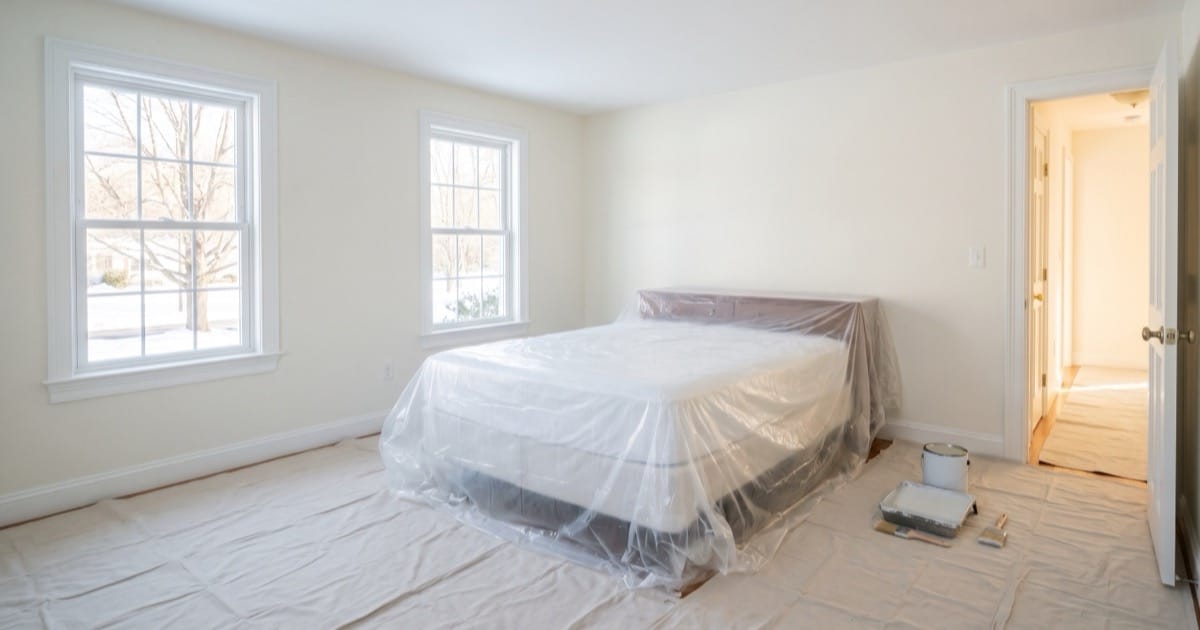
TL;DR: How long does paint take to dry in winter? Latex wall paint such as Regal Select is dry to the touch in about an hour and ready to recoat in 1 to 2 hours at 77 °F and 50% humidity. A cool, damp or closed-up room stretches every step, and full cure still takes about 30 days.
Thinking about painting a room this winter? Call or text Dave at (774) 217-9567. We'll look at the room, how it's heated and how it can be aired out, and give you a free estimate.
Winter is a good season for interior painting in New England. But the windows are shut, the heat cycles on and off, and some rooms run cooler or damper than the rest of the house, and those are exactly the things that slow paint down. This guide covers the three stages of drying, what the data sheets promise, why a January room doesn't match the label, and when you can sleep in the room, hang pictures and put the furniture back.
If you want to know how many hours a crew will be in the room, our guide to how long it takes to paint a room covers the labor. This one is about the paint after the brushes are washed.
The short version
How long does paint take to dry depends on which "dry" you mean. Dry to the touch takes about an hour for most latex wall paint, the recoat time is 1 to 4 hours depending on the product, and the cure time is two weeks to a month. Every one of those numbers is measured at 77 °F and 50% relative humidity, and a cool or humid winter room makes all of them longer.
Before you ask how long does paint take to dry in your own house this winter, run through this checklist:
- Read the data sheet. Note the dry and recoat times and the conditions they were measured at.
- Keep the room at 50 °F or warmer. Air and walls both, and hold it there overnight, not just while the crew is working.
- Check the coldest wall. An outside wall or a window frame can be several degrees colder than the thermostat says.
- Watch the moisture. Run the bathroom fan, turn off a humidifier in the room, and put a dehumidifier in a damp basement.
- Plan the ventilation. A box fan blowing out a cracked window keeps fresh air moving even when it's cold out.
- Don't aim heat at the wall. Warm the room, not the paint film.
- Add time between coats. Test a hidden spot before the second coat goes on.
- Treat the first month gently. No scrubbing, no tape and nothing pressed against the walls until the paint has cured.
What's the difference between dry to the touch, recoat and cured?
They're three separate stages, and each one comes with its own clock. Dry to the touch means the surface no longer feels wet or sticky. Ready to recoat means the film underneath has firmed up enough that a second coat won't drag or lift it. Cured means the paint has reached its full hardness and washability.
Sherwin-Williams separates them clearly in its guide on how to make paint dry faster. Dry time is "how long paint takes to be dry to the touch," and cure time "refers to how long paint needs to exhibit optimum performance results." The same page says acrylic and latex paints take "two or three weeks to cure."
Here's what two of the interior paints we use list on their current data sheets:
- Benjamin Moore Regal Select Eggshell (N549). The N549 technical data sheet lists a dry time at 77 °F and 50% RH of 1 hour to touch and 1 to 2 hours to recoat. It adds: "Painted surfaces can be washed after two weeks. High humidity and cool temperatures will result in longer dry, recoat and service times."
- Sherwin-Williams Emerald Interior Latex Satin (K37). The Emerald Interior product data sheet lists 1 hour to touch and 4 hours to recoat at 77 °F and 50% RH, and says "Drying and recoat times are temperature, humidity, and film thickness dependent."
Cure takes much longer than either. Benjamin Moore's guide to cleaning freshly painted walls says: "While the space can be used lightly after 24 hours, the paint will not be fully cured for about 30 days." A wall can feel dry on day two and still be soft enough to scuff or stick to a bookcase.
How long does paint take to dry in a cold house?
It takes longer than the label says, and there's no single number to plug in, because the label number is only true at 77 °F and 50% humidity. Plenty of houses are kept in the 60s in winter, and the spare room with the door shut, the finished basement and the bonus room over the garage can run cooler than that.
One Sherwin-Williams data sheet shows what cold does in two columns. The SuperPaint Exterior Latex Low Lustre (A78) data sheet lists drying times at 50% RH: at 45 °F and above, 2 hours to touch and 4 hours to recoat. At 35 to 45 °F, 2 hours to touch and 24 to 48 hours to recoat. With the same paint at the same humidity, the wait between coats goes from an afternoon to as long as two days. It's an exterior product, so the numbers don't carry over to bedroom walls, but the pattern does: the touch time didn't change while the recoat time did. That's why "it feels dry" isn't a safe test in a cold room.
Sherwin-Williams says the same thing about interior work: "painting in cooler temperatures can also slow down dry time for latex paints." Benjamin Moore's temperature guide lists what you may see when it's too cold: "Extended dry times," "Peeling," and "Inability for latex paint to form a film."
Here's how we plan a winter room:
- Assume at least double the label recoat time in a room in the low 60s, and more in a cooler one, then confirm it by checking a hidden spot behind a door or in a closet.
- Keep the coats thin. The Regal Select sheet lists a recommended wet film of 3.6 to 4.0 mils. A heavy coat traps water underneath a dry-feeling skin.
Why does humidity slow paint down in winter?
Latex paint dries by giving its water to the air, and damp air takes it more slowly. Sherwin-Williams puts it simply: "Moisture is the enemy when it comes to speedy dry times." Both data sheets above tie their dry times to 50% relative humidity for that reason.
A heated New England house is usually dry in midwinter, which helps. The exceptions are bathrooms, basements, laundry rooms and bedrooms with a humidifier running, and a cold outside wall is where moisture in a room condenses first. Benjamin Moore's temperature guide says "If the humidity is too high, paint can dry improperly."
What helps:
- Bathrooms: no showers in that bathroom on painting day, and run the exhaust fan for hours afterward.
- Basements: a dehumidifier running before, during and after. Sherwin-Williams suggests you "install a couple dehumidifiers around the room you've painted" to cut drying time. If the walls themselves are damp, that's a separate problem to solve before any paint goes on.
- Bedrooms: turn the room humidifier off until the paint has dried, and keep the door open to the rest of the heated house.
How warm does the room need to be for paint to dry?
For most interior latex paint, at least 50 °F in the air and on the surface, from the first coat until the paint has dried. The Regal Select sheet lists a minimum surface temperature during application of 50 °F and says "Do not paint when air or surface temperature is below 50 °F (10 °C)." The Emerald Interior sheet says "Apply at temperatures above 50°F."
Fifty is the floor, not the target. We'd rather see the room at normal living temperature and kept there overnight, because a deep nighttime setback can put the coldest wall under the line.
The paint needs to be warm, too. The Regal Select sheet lists a minimum storage temperature of 40 °F and is marked "PROTECT FROM FREEZING." Cans that spent December on a garage shelf should come inside overnight before you open them. If a can froze solid, our post on whether frozen paint from the garage is still usable explains how to tell.
A room that's never heated, like an enclosed porch, a three-season room or a detached garage, is a different job. Our guide to painting an unheated room in winter covers surface temperature, the dew point and safe heat for those spaces.
How do you ventilate a freshly painted room when it's freezing out?
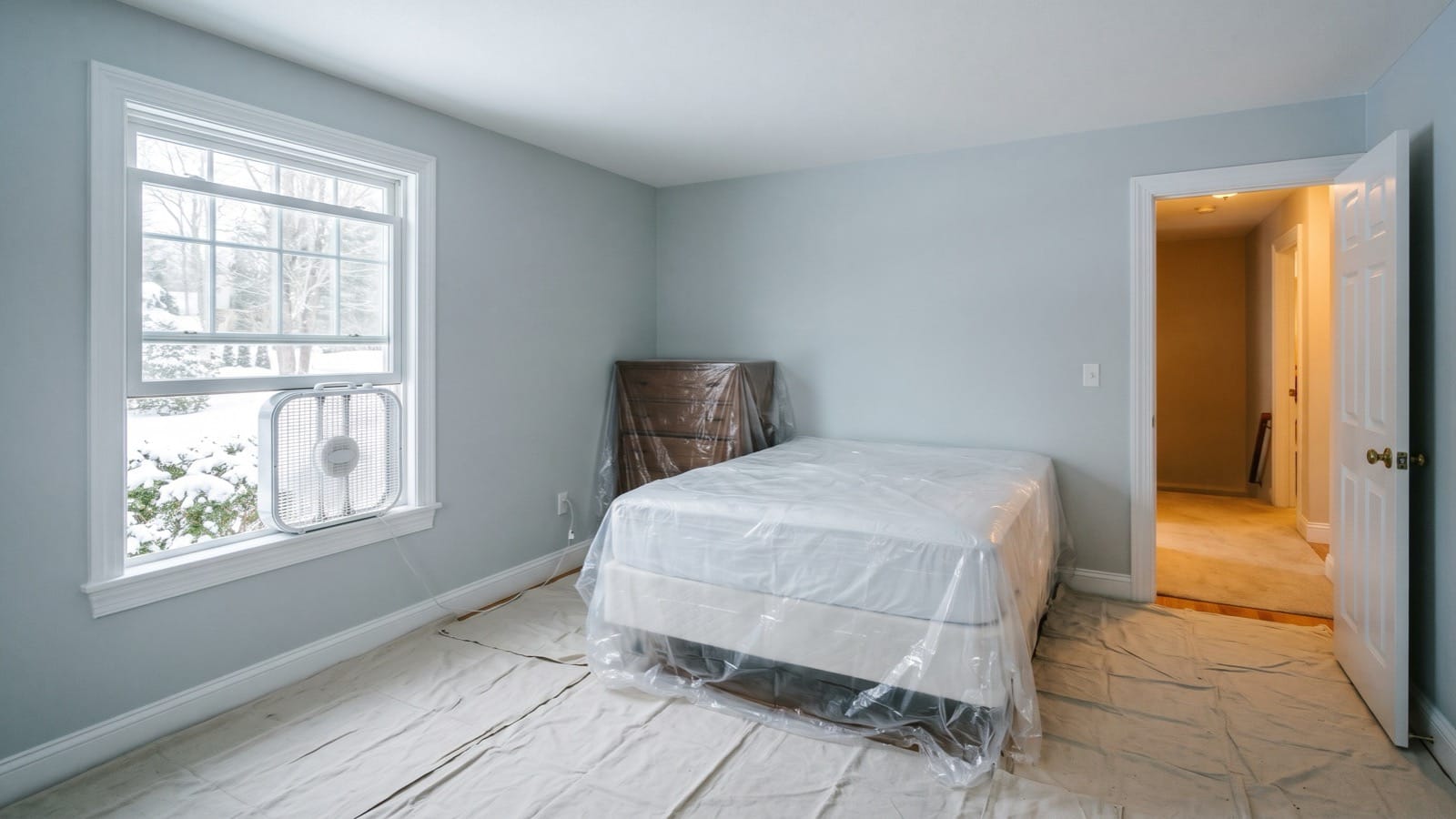
Crack a window in the painted room, put a fan in it blowing out, and keep the door to the rest of the heated house open.
Both paint makers ask for fresh air during drying, not just while the brush is moving. The Regal Select sheet says "Ensure fresh air entry during application and drying." The Emerald Interior sheet says to "open windows and doors or use other means to ensure fresh air entry during application and drying."
The EPA's page on indoor environmental concerns during remodeling is the most specific guidance we know of. It says "Most paints give off volatile organic compounds (VOCs)," and that "Under normal temperature and humidity, most emissions occur during drying, in the first few days after painting." It recommends exhaust fans, such as a box fan blowing from the painted room to the outdoors, and says to "Operate fans and provide as much ventilation as possible continuously (24 hours/day, 7 days/week) from the beginning of the painting work until 2 or 3 days after painting has been completed." It also suggests scheduling painting "for dry periods in the fall or spring, when windows are more easily left open for ventilation."
That's an honest limit on winter painting. For a room with no window that opens, we lean on the bathroom or kitchen exhaust fan, a fan moving air toward an open window elsewhere in the house, and a low-VOC product. Our post on low-VOC and zero-VOC paint explains what those labels mean and why the tint matters. The EPA's Care for Your Air guide adds a general rule: "Increasing the amount of fresh air brought indoors helps reduce pollutants inside."
Should you use a heater or a fan to dry paint faster?
Use a fan, but don't point a heater at the wall. Heat the whole room to a normal temperature with the house heat, and let moving air do the rest.
Benjamin Moore's guide to making paint dry faster says "We do not recommend using a heater or infrared heat lamp for drying paint," and warns that "any 11-degree change (Celsius) in temperature can potentially impact the paint's color." Sherwin-Williams agrees: "Circulating air is a great way to make paint dry faster, but you should avoid using heat. Heat changes can affect the overall color of the paint as it dries."
That doesn't contradict keeping the room at 50 °F or warmer. Room heat keeps the walls in the paint's working range; a heater or heat gun aimed at fresh paint is what to avoid. For fans, Benjamin Moore says to "keep the fan a few feet away from your painting project," and we aim it out the window, never straight at a wet wall.
When can you sleep in the room, hang pictures and put furniture back?
Each one waits for a different stage, and in winter each one comes a little later. Here's how the stages line up with daily life.
Sleeping in a freshly painted room
Dry to the touch isn't the same as aired out. The EPA says most emissions happen "in the first few days after painting," and recommends ventilation until "2 or 3 days after painting has been completed." The same EPA page says "pregnant women should avoid undertaking painting projects and should limit their time in freshly painted rooms," and that "susceptible people, such as young children and individuals with breathing problems, should avoid paint vapors." When people ask us whether they can sleep in a freshly painted room the same night in winter, we suggest sleeping somewhere else for the first night or two when there's a choice, and keeping fresh air moving through the room in the meantime. Our guide on how long after painting you can sleep in the room goes deeper, and getting the paint smell out of the house covers airing out a closed-up home.
Hanging pictures and decorations
Nails and screws can go in once the paint is dry and firm, but anything that sticks to the wall or presses against it needs the paint cured. Our post on how long to wait for Command strips after painting walks through the adhesive makers' numbers, and the short answer in a cool room is to wait longer than you think.
Furniture, cleaning and scrubbing
Benjamin Moore says the space "can be used lightly after 24 hours." Light use means furniture in the middle of the room, not pressed against soft paint. Our guide on how long before you can put furniture back after painting goes piece by piece. For cleaning, the Regal Select sheet says "Painted surfaces can be washed after two weeks," and Benjamin Moore's cleaning guide says to wait until the paint is fully cured and "At minimum, allow 30 days."
How does winter change a painting schedule?
It mostly adds waiting, not working, which is why the real answer to how long does paint take to dry in January is longer than the can says. The rolling and cutting in take the same time in January as in May. What changes is how long each coat needs before the next step. The second coat may start the next morning instead of after lunch.
On a winter job we:
- Start with the room warm. We ask that the heat stay at a normal daytime setting the day before, during and after, including overnight.
- Check before recoating. We press lightly in an out-of-the-way spot before the second coat, not just look at the clock.
- Leave the airflow running. The fan stays in the window and the door stays open when we leave for the night.
We use lead-safe methods on every pre-1978 home: containment, HEPA vacuums, wet scraping and proper disposal.
Paint drying times in MetroWest homes
We paint interiors across Holliston, Hopkinton, Ashland, Sherborn, Medway, Millis, Framingham, Natick and Milford and the rest of MetroWest. The older homes here tend to have plaster walls, drafty single-pane windows and rooms over unheated porches or garages, which run cooler and need more time between coats. In newer houses, finished basements and bonus rooms are the usual cold, damp exceptions. Either way, the plan starts with a look at how the room is heated and how it can be aired out.
Frequently asked questions
How long does paint take to dry before sleeping in the room?
Latex paint is dry to the touch in about an hour at 77 °F, but the EPA says most emissions happen in the first few days and recommends ventilation until 2 or 3 days after painting. In a closed-up winter house, we suggest sleeping elsewhere the first night or two when you can.
How long does paint take to dry between coats in winter?
It takes longer than the label says. Regal Select lists 1 to 2 hours and Emerald Interior 4 hours, both at 77 °F and 50% humidity. In a room in the low 60s we plan on at least double that and check a hidden spot before the second coat.
How long does paint take to dry in a cold room?
It takes longer than the label says. Benjamin Moore's Regal Select sheet says "High humidity and cool temperatures will result in longer dry, recoat and service times." Sherwin-Williams' SuperPaint Exterior sheet lists a 4-hour recoat at 45 °F and above, but 24 to 48 hours at 35 to 45 °F.
Can I use a space heater to make paint dry faster?
Don't aim one at the wall. Benjamin Moore and Sherwin-Williams both advise against using heat to dry paint because it can change the color. Warm the whole room with the house heat, and use a fan a few feet away to move air.
What temperature does paint need to dry indoors?
For most interior latex paint, at least 50 °F in the air and on the surface. The Regal Select sheet says not to paint below 50 °F, and Emerald Interior says to apply above 50°F. A normal living temperature dries far faster than the minimum.
How long does paint take to cure?
Curing takes weeks. Sherwin-Williams says latex and acrylic paints take two or three weeks to cure, the Regal Select sheet says painted surfaces can be washed after two weeks, and Benjamin Moore says wall paint is not fully cured for about 30 days.
How long does paint take to dry in a humid room?
It takes longer than the label says. Dry times on data sheets are measured at 50% relative humidity, and damp air slows latex paint from giving off its water. Run the bathroom fan, turn off room humidifiers and use a dehumidifier in a damp basement.
How long does paint take to dry with the windows closed?
It takes longer, and the room still needs fresh air. Both data sheets ask for fresh air during application and drying. Crack a window with a fan blowing out and keep the heat on. The EPA recommends ventilation until 2 or 3 days after painting.
The bottom line
How long does paint take to dry in winter? About an hour to the touch and a few hours to recoat on the data sheet, at 77 °F and 50% humidity. In a cool, closed-up New England house, plan on longer between coats, two or three days of steady ventilation, gentle use for the first two weeks and about 30 days before the walls are fully cured. Keep the room warm, keep the air moving and keep the heat off the paint itself.
Talk to Paint Pro
Paint Pro New England is based in Holliston and has painted homes across MetroWest for more than fifteen years. We are fully licensed and insured, including workers' compensation, use premium Benjamin Moore and Sherwin-Williams paints, back our work with a 2-year warranty on all work, and have more than 60 five-star reviews on Houzz. See our interior painting services for walls, ceilings, trim and doors. Call or text Dave at (774) 217-9567. You can also request a free, no-obligation estimate online.
Dave Griffiths
Dave Griffiths is the owner of Paint Pro New England, a professional painting company serving MetroWest Boston since 2011. With 15+ years of interior and exterior painting experience across the region, he leads every project with thorough prep, premium Benjamin Moore and Sherwin-Williams paints, and a 2-year warranty.

