



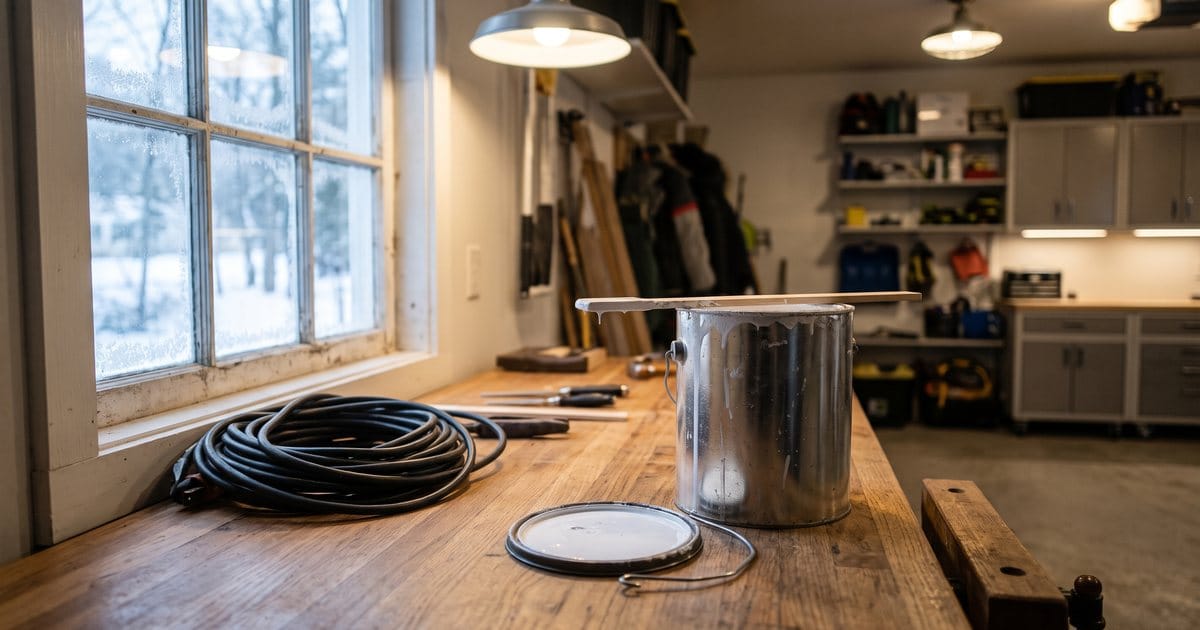
TL;DR: Frozen paint is not always ruined. Let the can thaw slowly at room temperature (Sherwin-Williams says about 70 °F), open it and stir it well. If it looks and brushes like a fresh can, it should be usable. If it has lumps, a cottage-cheese texture, rubbery pieces that won't stir out or a sour smell, it's done. Water-based latex is the most at risk, which is why Benjamin Moore prints "protect from freezing" on its data sheets and lists a minimum storage temperature of 40 °F.
Not sure your leftover paint is worth saving? Call or text Dave at (774) 217-9567. If you are planning a winter interior project, we can look at what you have and tell you whether to use it or start fresh. You can also request a free, no-obligation estimate online.
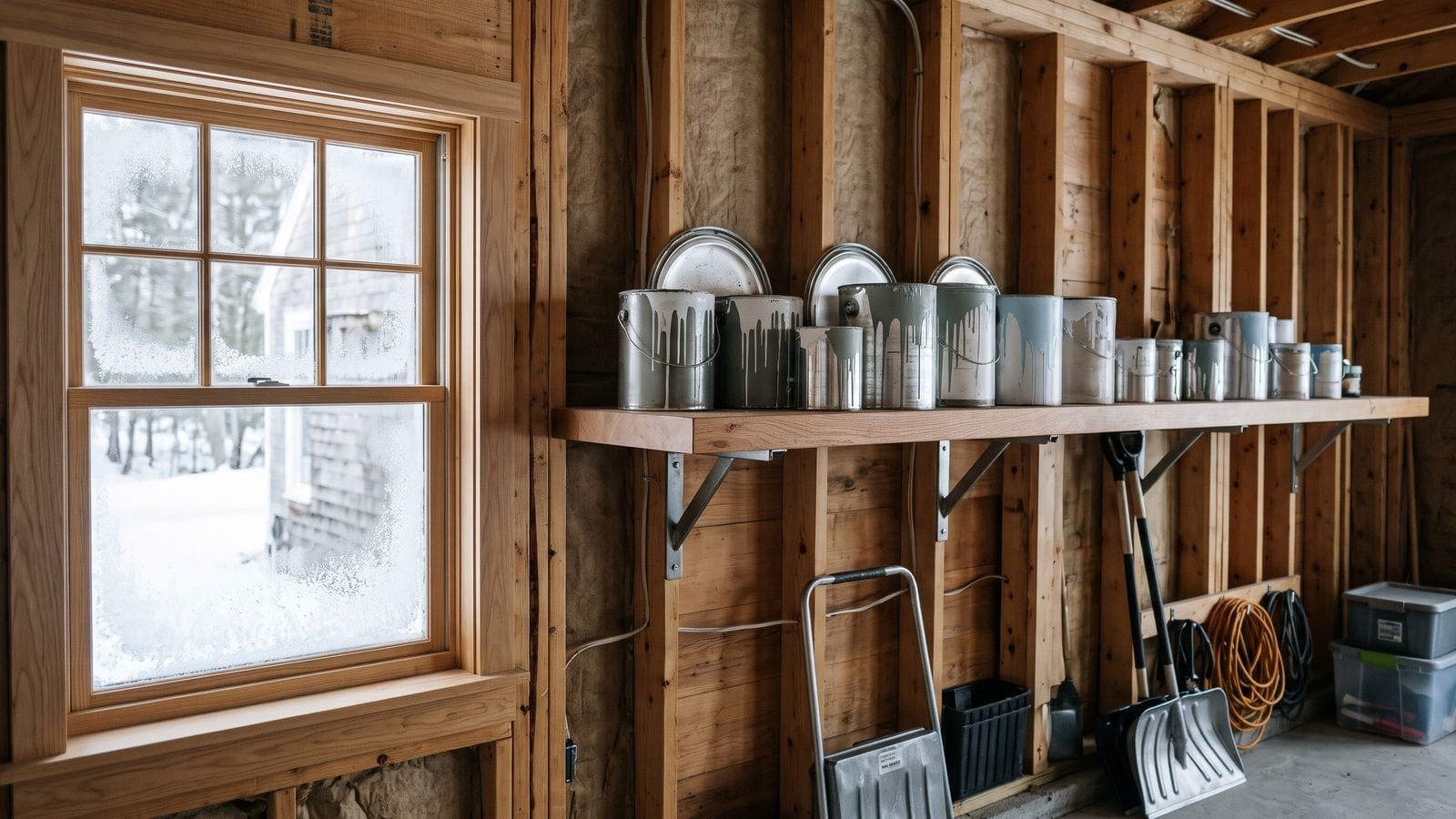
Almost every house we walk into has a shelf of leftover paint in the garage: the living room color, the trim white, half a gallon of something from the last owner. In MetroWest, that garage spends a good part of the year at or below freezing. By March, a lot of homeowners are staring at a can of frozen paint from January and wondering whether to use it for touch-ups. Here is how to tell, what the manufacturers say, and how to keep it from happening again.
Is frozen paint ruined?
Sometimes, not always. Whether frozen paint survives depends on the product, how cold it got and how many times it froze and thawed. Sherwin-Williams puts it plainly in its interior product FAQ: "It depends on the coating, you will need to open the container and observe the coating."
The same FAQ gives the test: "After gradually bringing frozen paint up to room temperature (70 degrees F), open the can and stir it. If the paint looks like a fresh, never-been-frozen can of the same product, it should be safe to use." It also warns, "When inspecting a thawed can of paint, be especially wary of lumps, thickening or solid pieces that can't be broken. If any are present, the paint should not be used."
So the answer is to thaw it, open it and look. You can't judge frozen paint from the outside of the can, and you can't judge it while it's still cold.
Why is frozen paint a problem for latex?
Latex, acrylic and other water-based paints are tiny particles of resin and pigment suspended in water. When that water turns to ice, it crowds the particles together. If they press together hard enough, they stick, and stirring won't pull them apart again. That is where the lumps and the cottage-cheese texture in frozen paint come from.
The data sheets we work from don't treat freezing as harmless, and Benjamin Moore goes further on its online store shipping policy: "Because our paint is eco-friendly, it is more susceptible to freezing than other paints." Low-VOC, water-based formulas are what most of us use indoors now, so it is worth assuming your leftover cans are the sensitive kind.
Repeated freezing makes it worse. Frozen paint from a can that froze once in a cold snap has better odds than one that froze and thawed a dozen times over a winter, which is exactly what happens in an unheated garage.
How cold does a MetroWest garage get in winter?
Cold enough, often enough, to freeze paint. NOAA's 1991-2020 climate normals for Worcester Regional Airport, an inland station just west of our towns, put the median first fall freeze on October 21 and the median last spring freeze on April 23. Worcester averages 129.7 nights a year at 32 °F or colder, and 45.4 days a year when the temperature never climbs above freezing at all.
The coast is milder. The same NOAA normals for Boston Logan Airport give a median first freeze of November 9 and 91.6 freezing nights a year. MetroWest sits between the two, so a garage in Holliston, Medway or Hopkinton should expect months of freezing nights.
In January, Worcester's normal low is 17.1 °F, according to NOAA's monthly normals, with an average of 28.4 freezing nights in the month. An attached garage can hold a few degrees above the outdoor low, but a detached or drafty one tracks the weather, and a can on a shelf against the outside wall will freeze.
How do you test frozen paint to see if it's still good?
Give it time, then use your eyes, a stir stick and a brush. Here is the routine we would follow with any can of frozen paint.
1. Thaw it slowly at room temperature
Bring the frozen paint inside and leave the can sealed somewhere at normal room temperature until it is warm all the way through. A gallon takes a while, so give it a full day. Don't speed it up with a space heater, a stove or hot water. Sherwin-Williams says to bring frozen paint up to room temperature "gradually," and fast, uneven heating does the paint no favors.
2. Open it and look before you stir
Some separation is normal in any can that has been sitting: a layer of clear or tinted liquid on top, heavier material settled at the bottom. That alone is not a sign of damage. What you're looking for in frozen paint is grainy, curdled or rubbery material.
3. Stir it thoroughly
Use a clean stir stick and work it from the bottom up for several minutes, scraping the sides and the bottom edge. If the paint comes back together into a smooth, even liquid, that's a good sign. If lumps keep surfacing no matter how long you stir, the resin has clumped and that frozen paint won't come back.
4. Brush it out on a test board
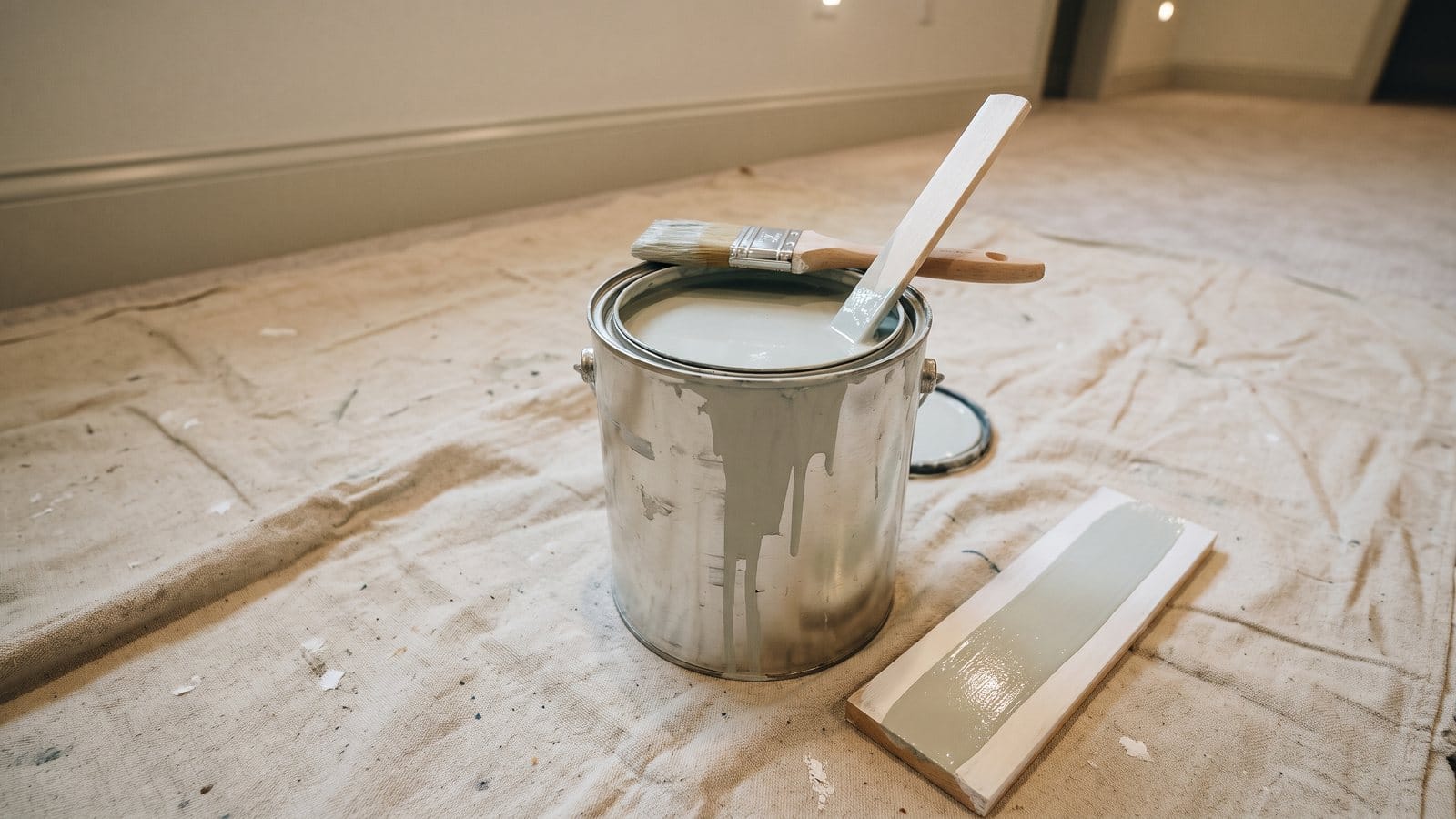
Brush a patch on a piece of primed scrap wood or cardboard. Good paint flows on smoothly and dries to an even film. Ruined frozen paint drags, leaves grit or specks in the film, or dries blotchy.
5. Smell it
Benjamin Moore's guide to storing leftover paint says paint that is past its shelf life "can smell sour and strong," and that "there should not be any chunks in or jelly-like texture to the paint." A sour or rotten smell means bacteria have gotten into it, frozen or not.
What are the signs frozen paint is ruined?
If you see any of these after the can is thawed and stirred, don't put it on a wall:
- Lumps or curds that keep coming back as you stir, often described as a cottage-cheese texture.
- Thick, gummy or stringy paint that won't loosen to the consistency of a fresh can.
- Rubbery solid pieces that you can't break apart with the stir stick.
- A sour or rotten smell.
- Grit in the brushed-out film on your test board.
Straining doesn't rescue frozen paint that has curdled. A paint strainer will catch bits of dried skin from the rim, but if the body of the frozen paint has clumped, Sherwin-Williams' guidance is that it "should not be used," and whatever passes through the strainer won't perform like the original product.
What about oil-based paint, stain and primer?
Water-based products are the ones to worry about. Sherwin-Williams' FAQ singles them out, saying it's best to protect paint, "especially water-based latex paints," from freezing temperatures. Oil-based paint and oil-based primer don't have water in them to freeze the same way, but cold makes them thick and slow, so let them warm up to room temperature before you use them.
Water-based stains, wood finishes, primers and caulks follow the same rule as latex paint: check the label, and if it says to protect from freezing, a frozen can needs the same thaw-stir-test routine. When in doubt, the product's technical data sheet lists its storage range.
What does the data sheet say about storage temperature and frozen paint?
The data sheet is the most precise answer you'll get, and it's usually tighter than people expect. Benjamin Moore's Regal Select Eggshell interior data sheet lists a storage temperature of 40 °F minimum and 90 °F maximum, and prints "PROTECT FROM FREEZING" in capitals. The Regal Select Exterior data sheet gives the same 40 °F to 90 °F storage range and the same warning.
In other words, a can of interior paint is out of its storage range long before it actually freezes. By NOAA's monthly normals, Worcester's average nightly low is below 40 °F in every month from November through April, so an unheated garage spends much of the winter outside that range.
Is frozen touch-up paint worth saving?
Even when frozen paint passes the test, think about what you need it for. Leftover paint is mostly for touch-ups, and touch-ups are where small changes show. Paint that has been through a hard winter, or that is a few years old, may not match the wall it came from in color or sheen. We explain why in why your touch-up paint never matches.
Age matters as much as freezing. Benjamin Moore says "once opened, most paint products, including Benjamin Moore, have a shelf life of two years." Sherwin-Williams' storage and disposal guide says "opened latex paint will keep for about two years" when stored properly. Frozen paint that is also past 2 years old is a poor bet for anything you care about.
For a closet, a basement wall or a shed, a can that passes the test is fine to use up. For the living room you will look at every day, fresh paint is cheap insurance. A gallon is a small part of what a paint job costs, as we lay out in the real cost of cheap paint.
How do you keep frozen paint from happening again?
Store it inside the heated part of the house over a Massachusetts winter.
Both manufacturers give the same everyday range: Benjamin Moore says "the temperature for storing paint should be between 60 and 80 degrees Fahrenheit," and Sherwin-Williams says paint "should be stored in a temperate environment between 60- and 80-degrees Fahrenheit." Sherwin-Williams also calls the garage "one of the worst places to store paint because of the temperature fluctuations."
- Pick the spot. A heated basement, utility room or interior closet. Keep cans off a bare concrete floor and away from the furnace and water heater.
- Seal it well. Wipe the rim clean, lay a piece of plastic wrap over the opening and tap the lid down evenly.
- Downsize half-empty cans. Benjamin Moore recommends a lined metal can, or a glass or plastic container, "not much bigger than the amount of paint that is left to limit air exposure."
- Label it. Write the room, the color name and number, the sheen and the date on the lid. That's what makes the leftover useful later.
- Move the garage shelf before the first freeze. With a median first freeze in mid- to late October inland, the start of fall is the time to bring the paint in.
Can you paint inside in winter with frozen paint from the garage?
If it passes the test and has warmed up fully, yes. Winter is a good time for interior work, and we cover the scheduling side in why the off-season is a good time for interior painting. The thing to watch is temperature at application. The Regal Select Eggshell data sheet says not to paint "when air or surface temperature is below 50 °F (10 °C)," so cold paint on a cold wall in an unheated room is a problem even if the paint itself is fine.
Paint for a winter job should come from a heated store or spend the night in the heated part of the house, so it goes on inside the range the manufacturer tested it in. That matters for the finish, and it matters for any warranty on the work. Our interior painting page explains how we prep and protect rooms for winter jobs.
What do you do with frozen paint that didn't survive?
Don't pour frozen paint down a sink or into a storm drain, and don't put liquid paint in the trash. Massachusetts handles latex and oil-based paint differently, and many towns collect certain paints on household hazardous waste days. Start with MassDEP's guidance on safely managing household hazardous products and your town's public works or recycling page for the current rules and collection dates.
Frequently asked questions
Can you still use frozen paint?
Often, yes: thaw the can gradually to room temperature, about 70 °F, open it and stir it, and if it looks and brushes like a fresh can of the same product it should be safe to use, but lumps, thickening or solid pieces that won't break up mean it should not be used.
Is latex paint ruined if it freezes?
Not always, but latex and other water-based paints are the most vulnerable, because freezing can force the resin particles together into clumps that won't stir back out, and repeated freeze-thaw cycles raise the risk.
How do you tell if frozen paint is still good?
Thaw it fully, stir it for several minutes and brush a test patch: good paint is smooth, even and free of grit, while paint the freeze has ruined has curds, gummy or rubbery pieces, or a sour smell.
How do you thaw frozen paint?
Bring the sealed can inside and let it warm up slowly at room temperature, giving a gallon a full day, and avoid space heaters, stoves or hot water, since Sherwin-Williams advises bringing frozen paint up to room temperature gradually.
At what temperature does paint freeze?
Water-based paint can freeze when it sits near or below 32 °F, and manufacturers set the safe limit well above that: Benjamin Moore's Regal Select data sheets list a minimum storage temperature of 40 °F.
How can you tell if paint has gone bad?
Benjamin Moore says paint past its shelf life can smell sour and strong and should not have chunks or a jelly-like texture, and both Benjamin Moore and Sherwin-Williams put the shelf life of opened latex paint at about two years.
Is it OK to keep frozen paint in the garage until spring?
No: once a can has frozen, more freeze-thaw cycles only add to the damage, so bring it inside to a space between 60 and 80 °F, the range Benjamin Moore and Sherwin-Williams both recommend, and test it once it has warmed up.
Can you strain frozen paint to save it?
Straining removes dried skin and debris, but it won't fix frozen paint that has curdled, because the clumped resin is the binder the paint needs to form a proper film.
The bottom line
Frozen paint deserves a fair test, not an automatic trip to the curb. Thaw it slowly, stir it well and brush out a patch. If it is smooth, even and smells normal, use it for small jobs. If it is lumpy, gummy or sour, let it go. Then bring the rest of your paint inside before the next freeze, because a MetroWest garage is below the manufacturers' storage range for months every winter.
Talk to Paint Pro
Paint Pro New England has painted homes across our 18 MetroWest towns for more than fifteen years. We are fully licensed and insured, including workers' compensation, use premium Benjamin Moore and Sherwin-Williams paints, back all work with a 2-year warranty, and have more than 60 five-star reviews on Houzz. If your winter project needs more than a touch-up, see our interior painting service, then call or text Dave at (774) 217-9567 for a free estimate.
Dave Griffiths
Dave Griffiths is the owner of Paint Pro New England, a professional painting company serving MetroWest Boston since 2011. With 15+ years of interior and exterior painting experience across the region, he leads every project with thorough prep, premium Benjamin Moore and Sherwin-Williams paints, and a 2-year warranty.

