




TL;DR: New England weather is brutal on exterior paint: freeze-thaw cracks rigid coatings, summer humidity breeds mildew, and UV fades color. After 1,000+ MetroWest projects, the lesson is consistent — flexible 100% acrylic paint plus thorough prep gets 7–10+ years instead of 4. Free estimate: (774) 217-9567.
What 15 Years of New England Weather Has Taught Me About Paint
Lessons from 1,000+ exterior projects in MetroWest Boston
I've painted houses in July when the humidity was so high we had to quit by noon. I've painted in October watching the forecast like a hawk, trying to squeeze in one more coat before the temperature dropped. I've seen what a single New England winter does to a paint job that wasn't applied right.
After fifteen years of exterior painting in Massachusetts, I can tell you: this climate is not kind to paint. It's not supposed to be. Our job is to know what we're dealing with and prepare for it.
The Enemy: The Freeze-Thaw Cycle
If you want to understand why exterior paint fails in New England, you need to understand what happens between November and April.
Water — in the form of rain, snow, ice, or condensation — finds its way into tiny cracks and gaps. Even microscopic ones. Even on surfaces that look solid.
Then the temperature drops below freezing. That water turns to ice. And ice takes up more space than water.
So now you have ice expanding inside tiny cracks, pushing outward, making those cracks bigger. Then it warms up. The ice melts. Water flows deeper into the enlarged cracks.
Then it freezes again. And expands again.
This happens dozens of times every winter. Sometimes multiple times in a single week. Water seeps into the paint, freezes, expands, and then thaws, causing stress that leads to cracking and peeling.
No paint, no matter how good, can survive this cycle if the surface underneath wasn't properly sealed. Every gap, every crack, every spot where paint isn't fully adhered — that's an entry point for water. And once water gets in, the freeze-thaw cycle takes over.
This is why preparation matters even more in New England than it does in milder climates. We're not just making surfaces look good. We're sealing them against an annual assault.
The Window We Work With
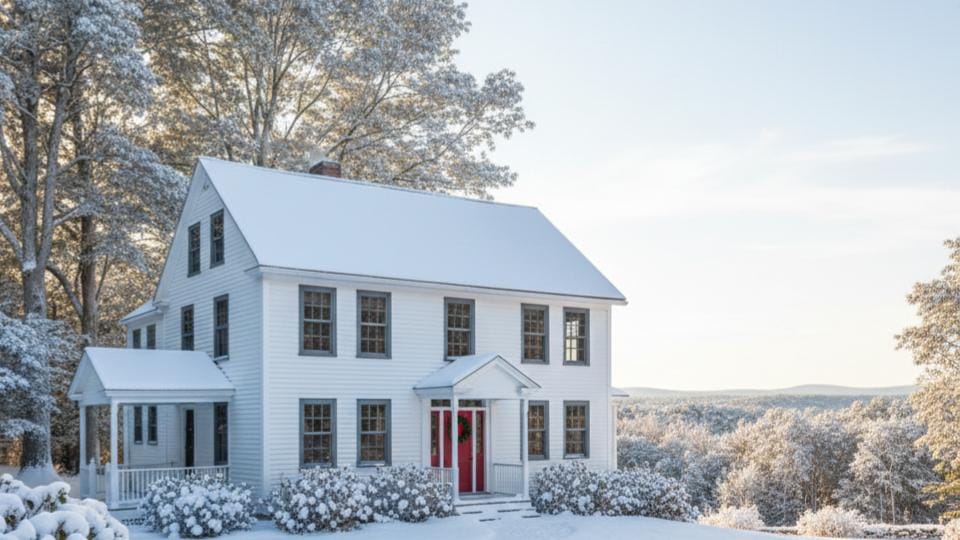
A lot of homeowners are surprised when I tell them we only do exterior painting from roughly late April to mid-October.
"Can't you paint in November? It's not that cold."
Here's the thing: it's not just about temperature. It's about the conditions paint needs to cure properly.
Paint doesn't just "dry." It goes through a chemical process called curing, where the polymers in the paint link together to form a hard, flexible film. This process requires:
- The right temperature. Most exterior paints need sustained temperatures above 50°F for proper curing. Some newer formulations can go lower — Sherwin-Williams has products rated for application at 35°F — but there's a limit.
- The right humidity. Too humid, and paint won't cure correctly. Too dry, and it can cure too fast, leading to cracking.
- Stable conditions. Abrupt temperature shifts are more troublesome than cold weather alone. A sunny 55-degree afternoon followed by a 30-degree night is actually worse than consistent cold.
Here in Massachusetts, we've had falls where we went weeks without a suitable painting window — mild days followed by cold nights, then rain every few days. It's frustrating, but pushing forward when conditions aren't right just creates problems down the road.
What Actually Determines How Long Paint Lasts
I get asked all the time: "How long will this paint job last?"
There's no single answer, because it depends on so many factors:
Your siding material matters. Aluminum and vinyl siding can hold paint for 20 years or more. Stucco typically goes 5-10 years. Wood siding? Usually only 4-7 years between paint jobs, sometimes less on south-facing walls.
Sun exposure matters. The sides of your house that get baked by afternoon sun will fade and break down faster than shaded areas. Darker colors absorb more sunlight and fade faster than lighter shades.
Moisture matters. If there's water getting behind your siding — from faulty flashing, clogged gutters, sprinkler systems hitting the house — no paint job will last. We always look for moisture issues during estimates, because painting over a moisture problem is just painting over a problem.
And preparation matters. You knew I was going to say this. A properly prepared surface with two coats of quality paint will outlast a poorly prepared surface by years. It's not even close.
Lessons From 15 Years in the Field

Lesson 1: Caulk is not optional.
Every gap around windows, doors, and trim needs to be sealed. I've seen painters skip caulking to save time, and I've seen the results — water infiltration, peeling paint, wood rot. A tube of caulk costs a few dollars. The damage from skipping it costs thousands.
Lesson 2: The north side of the house plays by different rules.
North-facing walls don't get the same sun exposure, so they stay damp longer. They're more likely to develop mildew. They need extra attention during prep — often a mildew treatment before painting.
Lesson 3: Historic homes need more time.
MetroWest has some beautiful old homes — 100, 150, even 200 years old. These houses have decades of paint layers, lead paint concerns, more complex trim details, and wood that's been weathering for generations. Properly preparing an older home takes significantly more work, but it's worth it to honor these buildings.
Lesson 4: You can't fight the weather.
Sometimes we have to reschedule. Sometimes a job takes longer than planned because we lost days to rain. I'd rather explain a delay to a homeowner than push forward in bad conditions and create a problem that shows up next spring.
What Good Exterior Work Looks Like
When we do an exterior job at Paint Pro, here's what it involves:
Power washing. Every surface gets cleaned. Dirt, mildew, chalking old paint — it all has to come off. You'd be amazed how much grime accumulates on a house over a few years.
Scraping and sanding. Any loose paint gets removed. We're not painting over failure; we're getting down to a stable surface.
Repairs. Rotted wood gets replaced. Cracks get filled. We're not just painters; we're restoring the surface underneath.
Caulking. Every gap gets sealed. Windows, doors, trim joints — anywhere water could find a way in.
Priming. Bare wood and problem areas get primed. This isn't optional. Primer creates the bond that holds everything together.
Two coats of quality paint. Manufacturers specify two coats for a reason — it's how the product is designed to perform. One coat might look okay, but it won't hold up the same way.
Final inspection. We walk the entire house looking for anything we missed. Touch-ups happen before we call it done, not after the homeowner notices something.
The Advice I'd Give My Own Family
If a friend or family member asked me about exterior painting, here's what I'd tell them:
Don't wait until it's an emergency. When paint starts failing, water starts getting in. What could have been a straightforward repaint becomes a repaint plus wood repairs. Staying ahead of deterioration saves money in the long run.
Get estimates in winter. Seriously. Painters have more time to do thorough estimates in January than in May. You'll get more attention, and you can lock in scheduling before the spring rush.
Ask about the full process. Don't just ask how much — ask how. A painter who takes time to explain their prep work, their materials, their timeline, is a painter who takes time to do the job right.
Plan for the right season. May through September is prime exterior painting season in Massachusetts. The weather is most cooperative, and there's time for proper curing before winter.
Accept that quality costs. A well-done exterior paint job is a significant investment. But it's an investment that protects a much larger investment — your home. Cutting corners doesn't save money; it just delays and increases the eventual cost.
Fifteen years in, I'm still learning things about painting in this climate. Every house is a little different. Every season brings its own challenges.
But the fundamentals stay the same: prepare thoroughly, use quality materials, respect the weather, and take pride in the work. Do those things, and the New England climate can be managed.
Skip them, and you'll find out just how unforgiving our winters can be.
Related Reading
- How Long Does Exterior Paint Last in New England?
- What Temperature Is Too Cold to Paint Outside?
- How Much Does House Painting Cost in Massachusetts? (2025-2026...
- Painters in Holliston, MA — Interior, Exterior & Cabinet Refin...
Planning an exterior project in Massachusetts?
Call (774) 217-9567 or request your free estimate. We'll take a look at your home and tell you exactly what it needs.
For a full breakdown of spring timing and what to inspect on your exterior before the season starts, see our spring home painting checklist for MetroWest.
Landlords and property managers planning exterior work for the season will find specific cost and scheduling guidance in our rental property painting planning guide for MetroWest.
Frequently Asked Questions
What does New England weather do to exterior paint?
Freeze-thaw cycles crack brittle coatings, summer humidity encourages mildew, and UV fades color. Flexible acrylic paint and good prep resist all three.
How long does exterior paint last in New England?
Seven to ten years or more with premium acrylic paint and proper prep; four to seven with lesser paint or exposure-heavy walls.
What paint holds up best in New England weather?
100% acrylic latex exterior lines like Benjamin Moore Aura and Sherwin-Williams Duration, which flex with temperature swings and resist moisture and UV.
Dave Griffiths
Dave Griffiths is the owner of Paint Pro New England, a professional painting company serving MetroWest Boston since 2011. With 15+ years of interior and exterior painting experience across the region, he leads every project with thorough prep, premium Benjamin Moore and Sherwin-Williams paints, and a 2-year warranty.

