



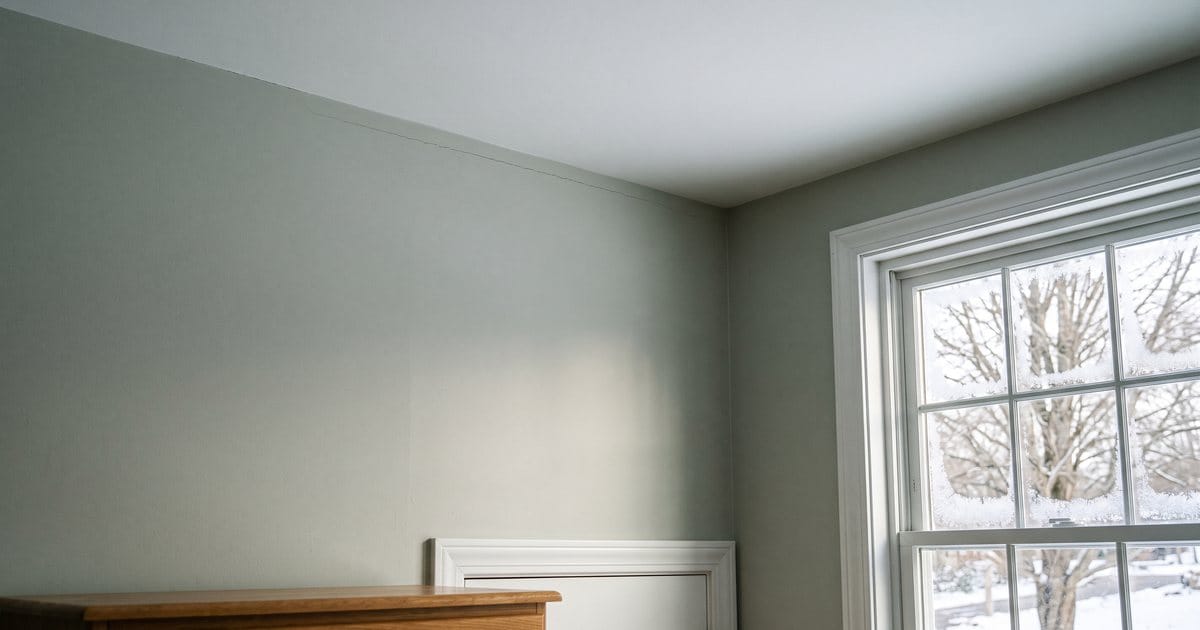
TL;DR: Ceiling cracks in winter that open where an interior wall meets the ceiling, then close again by summer, are usually truss uplift: roof trusses arching up as their top and bottom chords dry and swell by different amounts. It is a well-documented cosmetic issue, not a sign the house is failing. Paint alone will not stop it, but the corner can be reworked so the crack stops showing, and nail pops and hairline joint cracks are straightforward to repair at the end of the heating season.
Seeing the same crack every January? Call or text Dave at (774) 217-9567. We will look at where it is, how it moves and tell you plainly what paint can and cannot do about it.
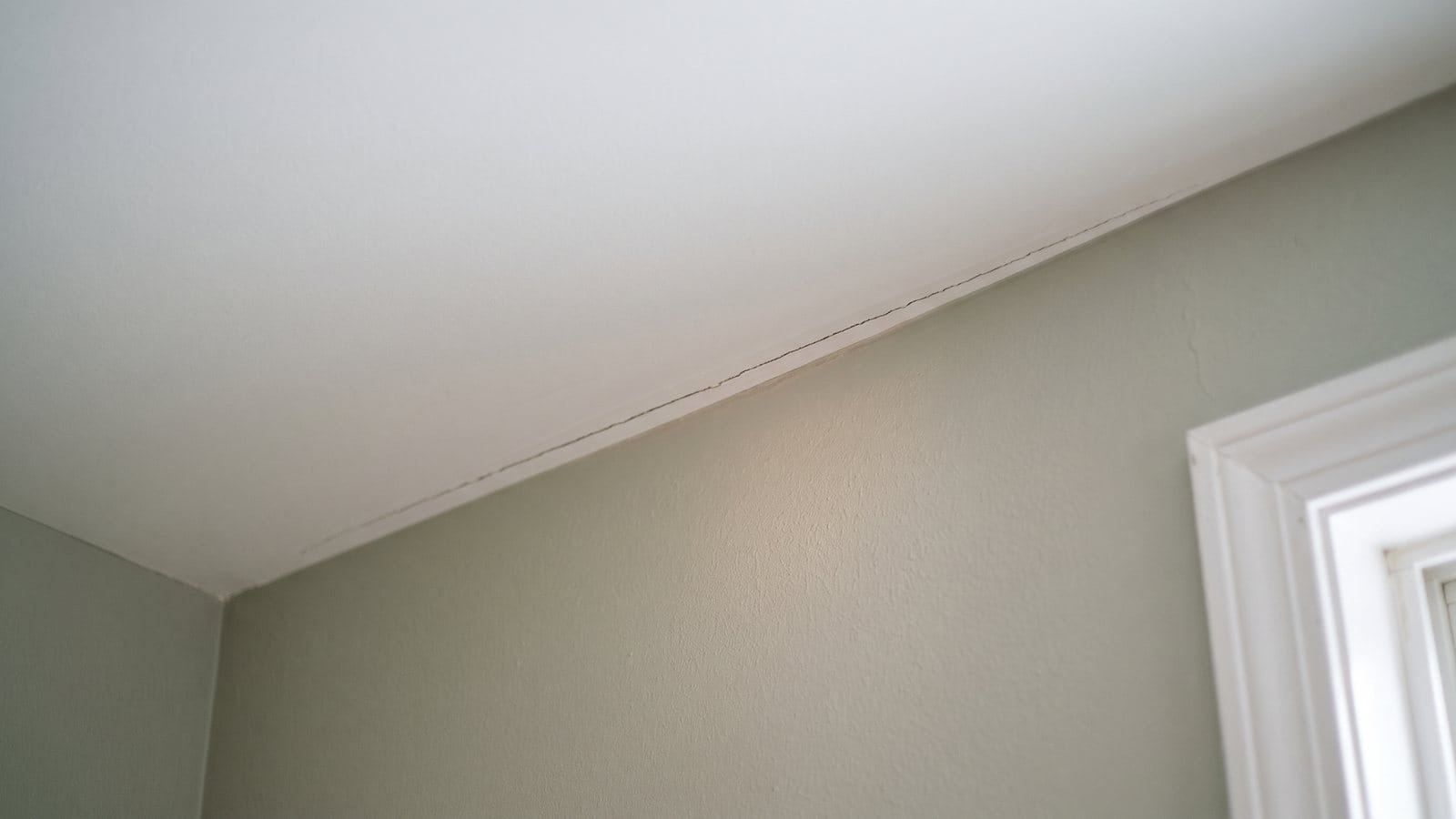
Ceiling cracks in winter are one of the most common things we get asked about once the heat comes on in MetroWest. A crack appears along the top of a hallway or bedroom wall, sometimes a neat line right in the corner, sometimes a gap where the tape has pulled away. In spring it seems to fade. The next winter it is back. Homeowners worry that something is moving that should not be. Usually something is moving, but it is moving the way wood always has.
Why do ceiling cracks in winter show up in the same place every year?
Because the framing above them changes size with the seasons, and it changes the same way every year. Wood takes on and gives up moisture with the air around it. In a New England winter, the air inside a heated house is dry, the air in a ventilated attic is cold and damp, and the framing sitting between those two conditions does not move evenly.
Two kinds of seasonal movement explain most ceiling cracks in winter:
- Truss uplift. In houses with a truss roof, the trusses can arch upward in winter and lift the ceiling off the tops of interior walls. That is the classic crack or gap at the wall-ceiling corner.
- Shrinkage of the framing. Joists, studs and plates dry out during the heating season. As they shrink, nails and screws can back out of the wood a hair, which shows up as nail pops, and taped joints can crack.
Older plaster ceilings crack for related reasons, plus age. We cover those in whether to repair plaster before painting an older Massachusetts home.
What is truss uplift, and why does it cause ceiling cracks in winter?
A roof truss is a triangle of lumber: two sloped top chords that hold the roof, a flat bottom chord that the ceiling hangs from, and web pieces tying them together. In an insulated attic, those parts live in different climates.
Joseph Lstiburek of Building Science Corporation puts it in one sentence in his research report Drywall, Wood and Truss Uplift: "Truss uplift occurs because of moisture content differences between the upper and lower chords of wood trusses." The bottom chord is buried in insulation, so it stays close to room temperature and dries out. The top chords sit above the insulation in cold attic air, where the relative humidity is high, so they take on moisture.
The Journal of Light Construction explains the result: the warmer, drier bottom chord shrinks more than the top chords, and the triangle changes shape. The bottom chord bows upward in the middle of its span, and it takes the ceiling drywall with it. Where the ceiling is nailed or screwed close to an interior wall, the ceiling lifts and the wall does not, and the taped corner between them cracks or separates.
Two details from that article matter to homeowners. First, it says: "This is not a structural problem." Second, in summer, when the chords reach similar moisture and temperature, "the truss will come back to its original position, closing any cracks that have formed." It adds that in some houses the cycle happens only once and in others it happens every year.
How does wood move with the seasons?
Wood swells as it takes on moisture and shrinks as it dries, and it does not move the same amount in every direction. The USDA Forest Products Laboratory, which publishes the Wood Handbook, summarizes the numbers in its frequently asked questions: from green to oven-dry, wood shrinks only 0.1% to 0.2% along its length, 2% to 6% radially and 7% to 12% tangentially, in the direction of the growth rings.
Framing in a house never goes from green to oven-dry, but it does follow the air. The Wood Handbook's table of equilibrium moisture content (Table 4-2 in chapter 4) shows how far: at 70°F, wood in air at 30% relative humidity settles at about 6.2% moisture content, and wood in air at 80% relative humidity settles at about 16.0%. A heated house in January and a cold, ventilated attic can sit near those two ends at the same time. That difference, spread along the length of a truss chord, is enough to move a ceiling, and it is why ceiling cracks in winter follow the calendar.
The same seasonal swing happens everywhere in the house, which is why the Gypsum Construction Handbook, published by USG, says that "all building materials grow or shrink in response to changes in temperature and humidity." Its chapter on problems, remedies and preventive measures lists "structural movement and/or hygrometric and thermal expansion and contraction" among the common causes of joint cracking. Hygrometric just means moisture-driven.
Which ceiling cracks in winter are cosmetic?
Most of them. The pattern tells you a lot, and we look at where the crack is, which way it runs and whether it changes with the season.
- A straight crack or gap in the wall-ceiling corner, at an interior wall, that opens in winter and closes in summer. That is the truss uplift pattern described above.
- Small round bumps or popped spots in a line across the ceiling. Those are nail pops along a joist or chord. The USG handbook says pops that "occur after one month's heating or more are usually caused wholly or partly by wood shrinkage," so pops that show up 30 days or more into the heating season are mostly the framing drying out.
- A thin crack along a taped joint between two sheets of drywall. The handbook lists fast drying, joint compound problems and seasonal expansion and contraction among the causes.
- A crack in the very apex of a corner, often with thick compound or paint in it. The handbook notes angle cracking can be caused by "improper application of joint compound in corner angle or excessive build-up of paint," not only by movement.
- Fine, branching cracks in an old plaster ceiling. Common in pre-war homes and usually a plaster repair question, not a framing one.
Can paint fix ceiling cracks in winter?
Paint by itself does not fix a crack that is moving. Paint is a thin film; it can bridge a hairline that has stopped moving, but it will split again over a joint that opens and closes with the seasons. What a painter can do is repair the surface correctly and, for some cracks, change the detail so the movement stops showing.
Here is what a painter can and cannot do about ceiling cracks in winter:
- Nail pops. Yes. Reset or replace the fastener, then spot and repaint. Timing matters: the USG handbook says pops caused by wood shrinkage "should not be repaired until near end of heating season," once the framing has stopped drying. For a pop caused by twisted or wet framing, it says to refasten "when moisture content in framing has stabilized after one heating season."
- Hairline joint cracks. Yes. The handbook's remedy for narrow cracks along tape is to cut away weak tape edges, seal hairlines with shellac and refill, or retape and feather the compound out so the repair blends.
- Angle cracks from compound or paint buildup. Yes. Smooth out the excess at the apex, fill only hairlines and avoid building it back up, as the handbook describes.
- Truss uplift at the wall-ceiling corner. Partly. Retaping and repainting the corner makes it look new, but if the ceiling is still fastened near the wall, the crack will come back next winter. Lasting fixes change how the ceiling attaches near that wall, which is the next section.
- Framing, trusses and anything structural. No. That is for a builder or a structural engineer.
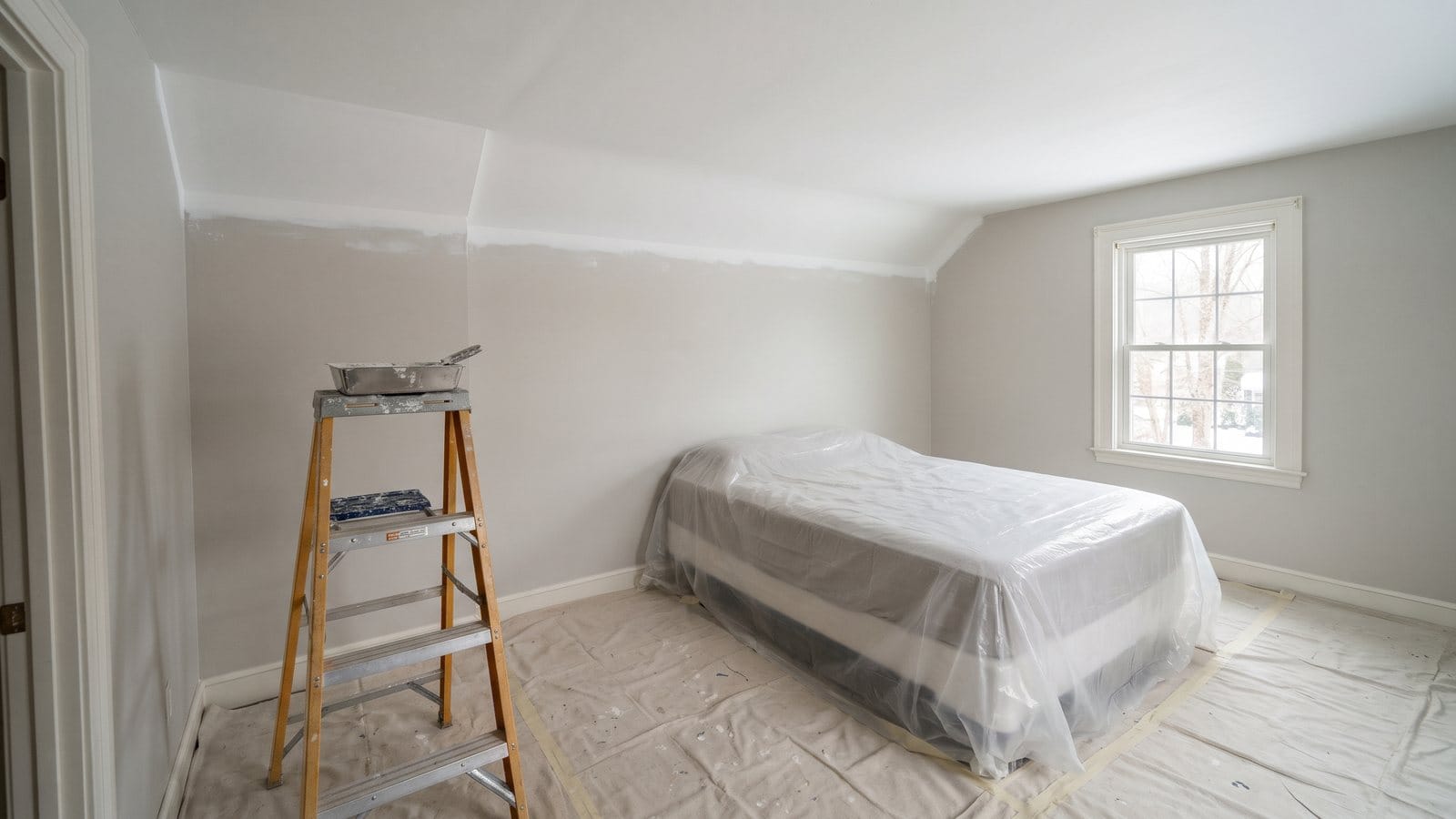
Before any of this, the ceiling has to be clean and sound. Our walk-through of what happens when you hire an interior painter covers how we prep and protect a room for ceiling work.
How do you stop ceiling cracks in winter from coming back?
You cannot stop the trusses from moving, so the fixes let the ceiling move without tearing the corner. Lstiburek is blunt about it in the Building Science report: "You can't prevent it," so let the trusses move.
- Float the corner. Building Science Corporation's report says not to install "ceiling drywall adhesive or ceiling drywall screws/nails closer than 18" to interior partition top plates," and that "floating corners for drywall attachment is the way to go." USG's wood-framed systems guide describes its "Floating Interior Angle System" as a way "to effectively reduce nail pops and angle cracking," with the first ceiling fastener 8 inches from the intersection.
- Clips at the top of the wall. The Building Science report notes that "use of clip support for gypsum board results in floating corners and significantly less drywall cracking." The JLC article lists sliding truss connectors and drywall corner clips as options too.
- Rework an existing corner. For angle cracks caused by framing that moves independently, the USG handbook's remedy is to remove fasteners closer than 6 inches from the angle, retape and finish. That is drywall work, done from below, and it is often the step that makes a repaint stick.
- Cover it with trim. Some homeowners choose crown molding attached to the ceiling only, not the wall, so it rides up and down with the ceiling and hides the joint.
- Keep the attic dry and the house humidity moderate. Truss uplift is driven by moisture, so warm, damp house air leaking into the attic makes it worse. The EPA's guide to mold and moisture recommends keeping indoor humidity "below 60 percent (ideally between 30 and 50 percent)." Sealing attic bypasses and keeping the attic vented is work for an insulation or roofing contractor.
When should you call a structural pro instead of a painter?
When ceiling cracks in winter do not fit the seasonal pattern, or when something besides the crack has changed. These are questions for a builder or a structural engineer, and we would rather send you to the right person than paint over something that needs a look first.
- The ceiling sags or bulges, rather than just showing a line.
- The crack keeps getting wider from one year to the next and does not close up in summer.
- One side of the crack sits lower than the other, so the surfaces are no longer in the same plane.
- Cracks run across the middle of the ceiling and down the walls, or several appear at once, especially with doors that suddenly stick or floors that have started to slope.
- There is staining, dampness or soft drywall near the crack. That points to a roof, plumbing or ice dam leak, and the leak gets fixed before anything is painted.
- The framing has been changed. A wall removed during a renovation, trusses cut for attic access, or heavy storage added in the attic are all reasons to have the structure checked. Trusses are engineered as a unit.
If the crack is the textbook winter corner gap and nothing else in the house has changed, it is very likely truss uplift, and the conversation is about how you want it to look.
When should ceiling cracks in winter be repaired?
Late winter or spring is usually the right time for cracks driven by seasonal movement. The USG handbook's guidance on pops caused by wood shrinkage is to wait until near the end of the heating season, and for ridged joints it says to let the condition develop fully, noting "usually six months is sufficient," before repairing. A wait of about 6 months from the first cold snap lands most MetroWest homes in spring. Truss uplift gaps are smallest in summer, so a corner that has been reworked to float can be finished then and stay closed.
Cracks that are not moving, such as compound buildup in a corner or an old plaster crack, can be repaired whenever the room is being painted. Interior ceiling work is good winter work for us, and a whole ceiling repainted after repairs is also a chance to try a color. Our post on painted ceilings, the fifth wall, has ideas if you want more than white.
One practical note: ceilings are painted wall to wall. A patch spot-painted in the middle of an older ceiling almost always shows, so plan on repainting the whole ceiling after repairs. Follow the recoat time on the paint's data sheet; dry times run longer in a cool room.
Frequently asked questions
What does it mean when you get cracks in your ceiling?
Usually that the framing or drywall has moved a little with seasonal changes in moisture and temperature. The USG Gypsum Construction Handbook lists structural movement, moisture-driven and thermal expansion and contraction, and joint compound problems as common causes of drywall cracking.
Are ceiling cracks in winter a structural problem?
Not usually. When the crack runs along the wall-ceiling corner at an interior wall and closes again in summer, it is typically truss uplift, which the Journal of Light Construction describes plainly: "This is not a structural problem." A ceiling that sags, or a crack that keeps widening year after year, is worth a structural look.
How do you fix ceiling cracks in winter?
Repair the surface at the right time and let the ceiling move. Reset nail pops and retape joints near the end of the heating season, and for truss uplift, float the corner by keeping ceiling fasteners away from the wall, as Building Science Corporation and USG describe, before retaping and repainting.
Why do ceiling cracks in winter close up in summer?
Because the truss chords reach similar moisture and temperature in summer, and the Journal of Light Construction says the truss then comes back to its original position, closing the cracks that opened over the winter.
Does cold weather cause plaster to crack?
Cold weather itself is not the main cause. Heated, dry indoor air in winter makes framing and lath shrink, and the USDA Wood Handbook shows wood moisture content dropping as relative humidity falls. Old plaster is rigid, so it cracks where the wood behind it moves.
Do ceiling cracks in winter mean the house is settling?
Not necessarily. Settling is movement of the foundation and structure, while seasonal cracks come from wood drying and swelling. A crack that opens and closes with the seasons is a moisture pattern, and a crack that keeps growing, or comes with sloping floors and sticking doors, is the one to have checked.
What types of cracks can you not ignore?
Cracks with a sagging or bulging ceiling, cracks where one side sits lower than the other, cracks that widen every year, and any crack with staining or damp drywall. Those are worth a builder, engineer or roofer looking at before any paint goes on.
Can you caulk ceiling cracks in winter?
For a truss uplift gap, a flexible, paintable caulk can hide a small seasonal gap for a while, but if the ceiling moves more than the caulk can stretch, it tears and the line comes back. Floating the corner or covering it with trim fastened to the ceiling only lasts longer.
The bottom line
Ceiling cracks in winter that show up at the same wall-ceiling corner and fade by summer are almost always truss uplift or seasonal shrinkage of the framing, both well documented and both cosmetic. Paint does not stop the movement, but a corner that is reworked to float, nail pops reset at the end of the heating season and joints retaped properly will let the ceiling look right year round. If the ceiling sags, the crack keeps growing or there is water involved, start with a builder, engineer or roofer, then paint.
Talk to Paint Pro
Paint Pro New England is based in Holliston and has painted homes across MetroWest for more than fifteen years. We are fully licensed and insured, including workers' compensation, use premium Benjamin Moore and Sherwin-Williams paints, back our work with a 2-year warranty on all work, and have more than 60 five-star reviews on Houzz. Dave personally oversees each project from the estimate through the final walkthrough. See our interior painting services for ceilings, walls, trim and doors. Call or text Dave at (774) 217-9567. You can also request a free, no-obligation estimate online.
Dave Griffiths
Dave Griffiths is the owner of Paint Pro New England, a professional painting company serving MetroWest Boston since 2011. With 15+ years of interior and exterior painting experience across the region, he leads every project with thorough prep, premium Benjamin Moore and Sherwin-Williams paints, and a 2-year warranty.

