



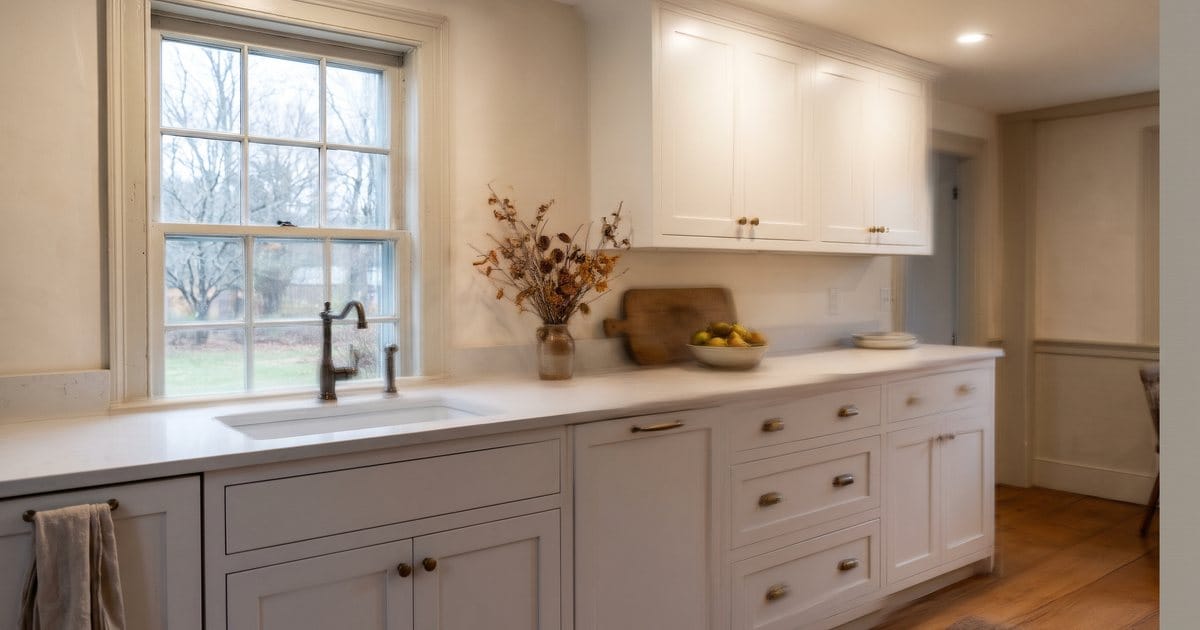
TL;DR: A cabinet painting timeline is set by the paint, not the painter. Benjamin Moore's Advance cabinet enamel needs 16 hours between coats and 5 to 7 days before heavy use, and can take up to 30 days to reach full hardness. Thanksgiving is Thursday, November 26, 2026, so for a holiday kitchen the last coat should be on about a week before, which means prep starting by the middle of November.
Want your kitchen done before the holidays? Call or text Dave at (774) 217-9567. We will look at your cabinets and give you a schedule you can plan dinner around. You can also request a free, no-obligation estimate online.
Every fall, the same question comes in: can the cabinets be painted before family arrives? The answer is often yes, but not because a crew works faster. Cabinet enamels are built to level out smooth and dry hard, and that chemistry takes time between coats and time after the last one. The calendar is the part you control. If you know how a cabinet painting timeline stacks up, you can tell in five minutes whether your dates work.
Here is what each stage of a kitchen cabinet job involves, the drying and cure times printed on the data sheets for two common cabinet enamels, and how the math works backward from Thanksgiving and Christmas.
What does a cabinet painting timeline look like?
A cabinet painting timeline runs in the same order on almost every kitchen. Some stages take hours, and the drying stages take days no matter how many people are on the job.
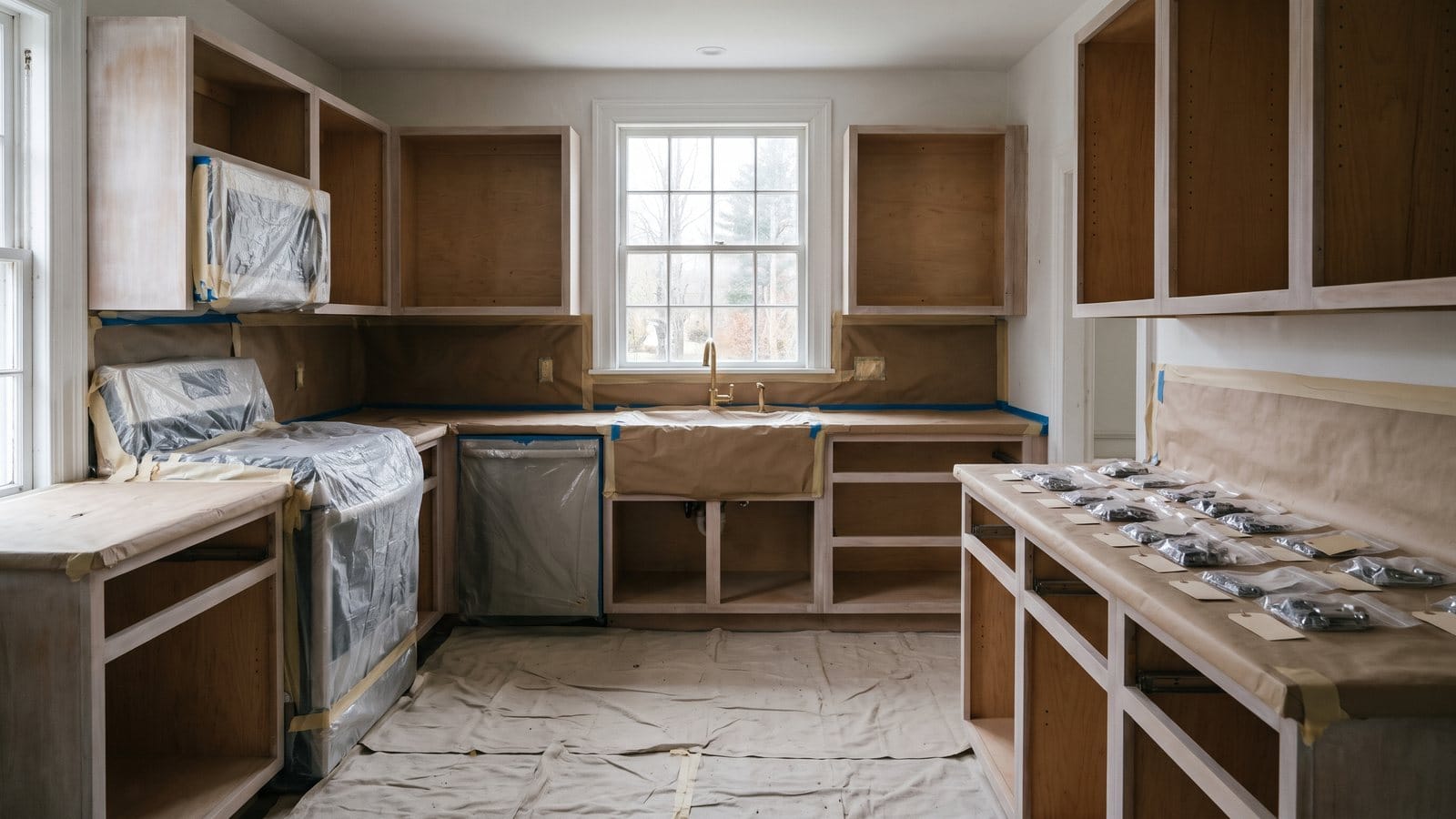
- Empty and protect. Cabinets emptied, counters, floors and appliances covered, and the work area set up so dust and spray stay where they belong.
- Remove and label. Doors, drawer fronts and hardware come off and every piece is labeled, so each door goes back on the same box it came from.
- Clean and degrease. Kitchen cabinets carry cooking grease, especially near the range. Sherwin-Williams' data sheet says surfaces must be cleaned of "all surface contamination," and paint will not hold on grease.
- Repair and fill. Dents, chips and old hardware holes if you are changing pulls.
- Sand. Benjamin Moore's Advance sheet says cabinetry surfaces should be "roughened by sanding (220 grit or coarser) before priming," with all dust cleaned off.
- Prime. A bonding or stain-blocking primer suited to the surface: bare wood, an old glossy finish, laminate or a big color change.
- Two finish coats, with light sanding between coats.
- Reinstall. Doors, drawers and hardware go back on once they are dry enough to handle.
- Gentle use, then full cure. The kitchen is usable, but the finish is still hardening.
Steps 1 through 6 are prep, and prep is where most of the hours go. Steps 6 through 9 are where the paint sets the pace.
How long does cabinet paint need between coats?
Much longer than wall paint. HomeGuide's room painting guide notes that "most paints require 2 hours of dry time between coats." Cabinet enamels are a different class of product, and the two below show how far apart they can be.
- Benjamin Moore Advance (waterborne alkyd). The Advance Satin 792 technical data sheet lists dry to the touch in 4 to 6 hours and ready to recoat in 16 hours at 77°F and 50 percent humidity. In practice that puts one coat per day on the cabinet painting timeline.
- Sherwin-Williams Emerald Urethane Trim Enamel. The satin product data sheet (3/2026) lists touch in 1 hour and recoat in 4 hours at 77°F and 50 percent humidity, and specifies a primer plus two coats over wood.
Both sheets carry the same warning in different words. Benjamin Moore: "High humidity or cooler temperatures will prolong dry, recoat and cure times." Sherwin-Williams: "Drying and recoat times are temperature, humidity, and film thickness dependent." Both also set a floor: Benjamin Moore lists a minimum surface temperature of 50°F during application, and Sherwin-Williams says to "apply at temperatures above 50°F." In a Massachusetts November, that means the kitchen stays heated, and doors are never finished in a cold garage.
How long before you can use painted cabinets?
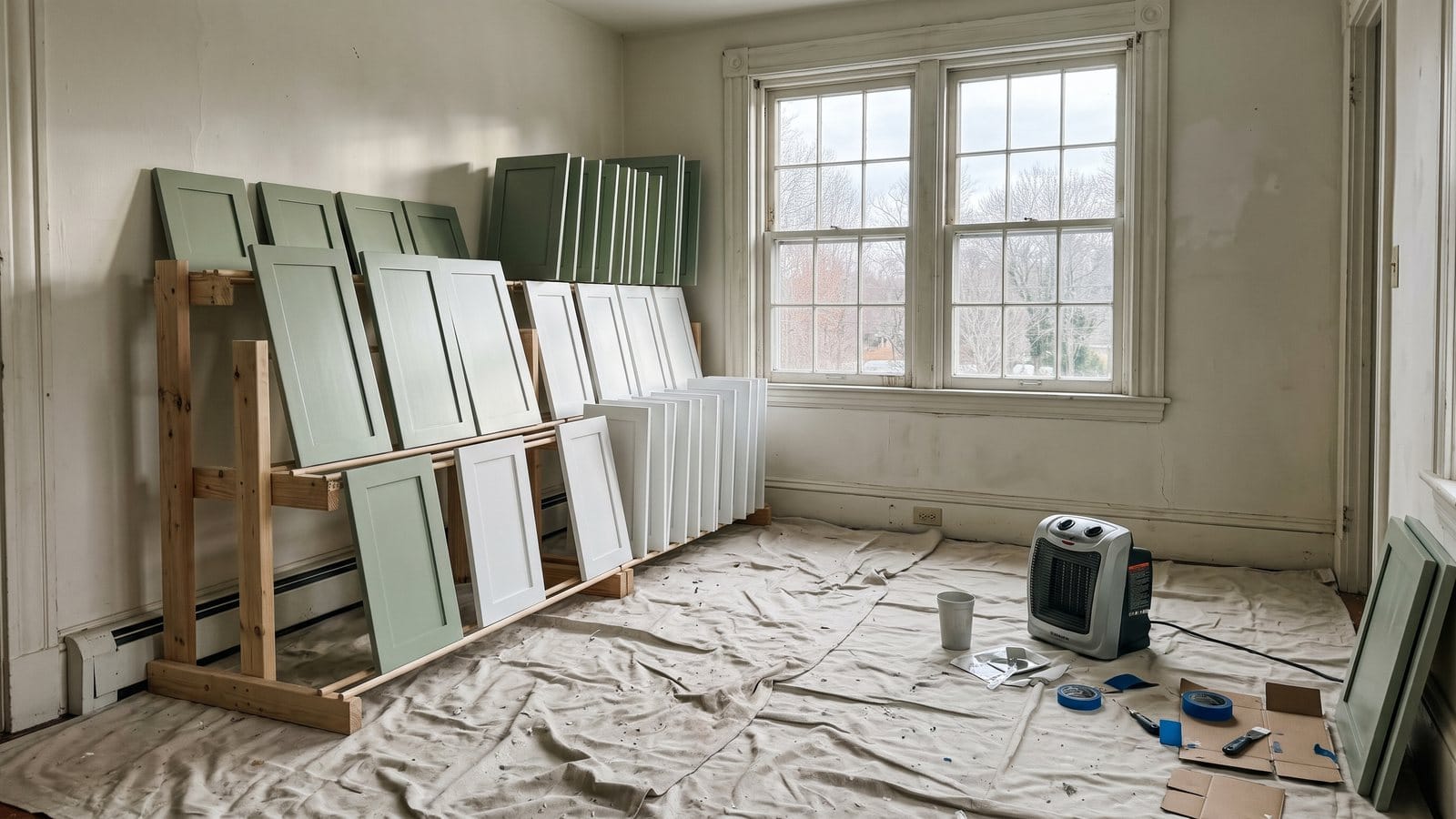
You can open and close them within days, but the finish is not at full strength for weeks. Benjamin Moore's Advance sheet says "full hardness and adhesion develop over time," and tells you not to "expose to heavy abrasion or return shelves/tabletops to service" for at least 5 to 7 days "to prevent damage to the finish." Under limitations, it adds that "depending on weather and drying conditions, it could take up to 30 days to reach optimum hardness and final sheen."
The Sherwin-Williams Emerald Urethane sheet does not publish a cure or return-to-service time, so plan the same kind of buffer before a holiday kitchen sees heavy use.
What "gentle" means for the first week or two:
- Open doors by the edge or the hardware, not by pressing on the face.
- Do not stack heavy pots or slide dishes across freshly painted shelves.
- Wipe spills with a soft damp cloth; skip scrubbing pads and strong cleaners.
- Leave a little space where doors close onto each other or onto bumpers, so fresh paint does not stick.
For a holiday, that 5 to 7 day window is the part of the cabinet painting timeline to plan around. A turkey, a dozen guests and every drawer opened twenty times an hour is heavy use.
Can a cabinet painting timeline fit before Thanksgiving?
Thanksgiving falls on Thursday, November 26, 2026, according to the federal holiday calendar from the U.S. Office of Personnel Management. Working backward with Advance as the example, our arithmetic looks like this:
- November 26: Thanksgiving dinner.
- By about November 19: last finish coat on, so the cabinets get the full 7 days that Benjamin Moore gives before heavy use.
- About November 17 to 19: primer, then two finish coats, one per day at a 16-hour recoat, longer if the house is cool or damp.
- Before that: emptying, removing, cleaning, repairs and sanding, which depend on the number of doors and drawers and the shape they are in.
So for a typical kitchen, the cabinet painting timeline needs to start around the middle of November. As of November 8, that leaves a little over a week to get on a schedule. With a faster-recoat enamel the coating days compress, but the buffer before heavy use should not shrink, and prep takes as long as it takes.
If the dates are too tight, there are two honest options. Paint the cabinets after the holiday and enjoy the before photos at dinner, or narrow the job: an island or a single run of cabinets fits a shorter window than the whole kitchen.
What about a cabinet painting timeline before Christmas?
Christmas Day is Friday, December 25, 2026, on the same OPM calendar. Run the same cabinet painting timeline backward, and the last coat should be on by about December 18, with prep starting in the second week of December. That leaves more room than Thanksgiving, but December is when a lot of homeowners turn to indoor projects, and the weeks around the holidays go fast. The earlier you book, the more choice you have.
If you plan to host both holidays, one option is a schedule between them: the kitchen is fully usable for Thanksgiving, painted after, and has two weeks or more of cure before Christmas.
What slows a cabinet painting timeline down?
Most delays come from the cabinets themselves, not the paint. These are the things that add days in MetroWest kitchens:
- A slick old finish. Factory lacquers, old oil-based enamel and glossy paint have to be dulled before primer will bond. Sherwin-Williams says "glossy surfaces should be sanded dull," and Benjamin Moore says to "sand glossy alkyds before applying Advance."
- Grease and stains. Sherwin-Williams says stains from "water, smoke, ink, pencil, grease, etc. should be sealed with the appropriate primer-sealer." Heavy grease near a range can mean extra cleaning passes.
- Wood tannins. Knots and tannin-rich woods can bleed color through light paint. The Sherwin-Williams sheet says that on these bare woods the finish "may show some staining," and recommends spot priming severe areas with an oil-based primer.
- A big color change. Dark wood to white, or white to a deep green, may need a tinted primer. If you are still choosing, our post on cabinet colors MetroWest kitchens are choosing in 2026 covers the options.
- New hardware. Changing from knobs to pulls means filling old holes, sanding them flush and drilling new ones before paint.
- Cold and damp. Below 50°F the paint should not go on at all, and cool, humid air stretches every drying window. Steam from cooking during the project slows things too.
- An older home. Cabinets in a house built before 1978 may carry lead paint. We use lead-safe methods on every pre-1978 home: containment, HEPA vacuums, wet scraping and proper disposal. That setup is part of the schedule.
Sherwin-Williams puts the reason for all this prep plainly: "Recognize that any surface preparation short of total removal of the old coating may compromise the service length of the system." A finish that is rushed onto greasy, glossy doors is the one that chips by spring.
Does spraying or brushing change the schedule?
Application method changes how the finish looks and how the work is set up more than it changes the cabinet painting timeline. Recoat and cure times on the data sheets apply whether the enamel goes on by brush, roller or sprayer. Both data sheets list airless and HVLP spray settings alongside brush and roller. We compare the two finishes, and how each holds up in a busy kitchen, in sprayed vs brushed cabinets.
How do you live in the kitchen while cabinets are painted?
Plan for a few days of a working but limited kitchen. You can usually keep the refrigerator and a coffee maker running and lean on simple meals. Things that help:
- Empty the cabinets into labeled bins before the crew arrives, and keep a small box of daily dishes out.
- Plan meals that do not need the range, since cooking steam and grease work against fresh paint.
- Keep the heat on and the kitchen near room temperature the whole time, nights included.
- Keep pets out of the work area while doors are drying.
Our cabinet refinishing service page explains how we approach the job, and how much kitchen cabinet painting costs in Massachusetts covers what moves the price.
Frequently asked questions
What is a typical cabinet painting timeline?
A typical cabinet painting timeline runs prep first (emptying, removing doors, cleaning, repairs and sanding), then primer and two finish coats, then reinstall and a gentle-use period. With Benjamin Moore Advance at a 16-hour recoat, the coating alone is about one coat per day, and the sheet asks for 5 to 7 days before heavy use.
How long does it take for painted cabinets to cure?
Benjamin Moore says Advance should not see heavy abrasion for at least 5 to 7 days and can take up to 30 days to reach optimum hardness and final sheen. Cool or humid conditions make that longer.
Can a cabinet painting timeline be finished before Thanksgiving 2026?
Often, if it starts by about the middle of November. Thanksgiving is November 26, 2026, and working back from a 7-day buffer before heavy use puts the last coat around November 19, with prep and primer before that.
How long should you wait between coats of cabinet paint?
Follow the data sheet for the product. Benjamin Moore Advance lists 16 hours to recoat and Sherwin-Williams Emerald Urethane Trim Enamel lists 4 hours, both at 77°F and 50 percent humidity, and both take longer in cool or damp air.
How many coats does a cabinet painting timeline include?
Usually a primer and two finish coats, which means at least three drying windows. Sherwin-Williams specifies one coat of primer and two coats of Emerald Urethane Trim Enamel over wood, and Benjamin Moore's Advance sheet calls for one to two coats over a primed surface, with light sanding between coats.
Can you use your kitchen during a cabinet painting timeline?
Yes, with limits. You can usually keep the refrigerator and simple meals going, and avoid heavy cooking near drying doors. Once the cabinets are back on, open them gently and avoid heavy loads on shelves for the first week.
Does cold weather change a cabinet painting timeline?
Yes. Cabinets can only be painted in a heated space, and cool air stretches every drying window. Benjamin Moore lists a 50°F minimum surface temperature for Advance, and Sherwin-Williams says to apply Emerald Urethane Trim Enamel above 50°F, so in a Massachusetts winter the kitchen and drying area stay heated.
What delays a cabinet painting timeline the most?
Prep problems: a glossy or oil-based old finish that must be sanded dull, heavy grease, wood tannins that bleed through, a large color change, new hardware holes, cold or humid air, and lead-safe setup in pre-1978 homes.
The bottom line
A cabinet painting timeline is mostly fixed by the paint: recoat windows, a 5 to 7 day buffer before heavy use, and weeks to full hardness. What you control is the start date. For Thanksgiving on November 26, the work needs to be underway by the middle of November. For Christmas, mid-December is the latest comfortable start. If those dates are too tight, painting after the holidays, or doing part of the kitchen now, is better than rushing a finish you will live with for years.
Talk to Paint Pro
Paint Pro New England is based in Holliston and has painted homes across MetroWest for more than fifteen years. We are fully licensed and insured, including workers' compensation, use premium Benjamin Moore and Sherwin-Williams paints, back our work with a 2-year warranty, and have more than 60 five-star reviews on Houzz. Dave personally oversees each project, from the estimate through the final walkthrough. Paint Pro is an expert painter, not a bargain shop: thorough prep and premium Benjamin Moore and Sherwin-Williams paints, priced for the work your home actually needs. See our cabinet refinishing service to start your schedule. Call or text Dave at (774) 217-9567.
Dave Griffiths
Dave Griffiths is the owner of Paint Pro New England, a professional painting company serving MetroWest Boston since 2011. With 15+ years of interior and exterior painting experience across the region, he leads every project with thorough prep, premium Benjamin Moore and Sherwin-Williams paints, and a 2-year warranty.

